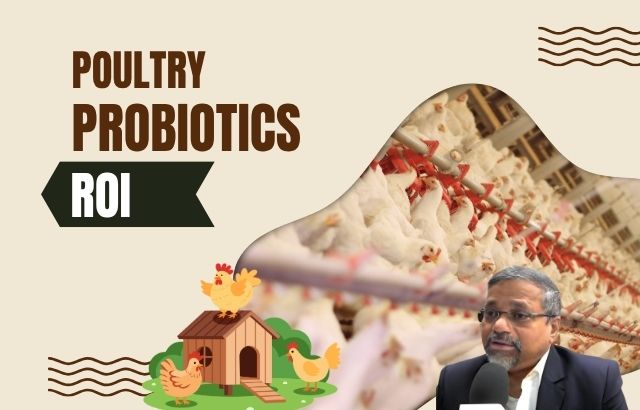
In recent years, there has been a paradigm shift in agriculture, with sustainable farming practices gaining momentum. Among these practices, probiotics have emerged as a leading innovation in poultry farming, offering not just health benefits for the birds but also significant financial advantages. While the initial cost of probiotics may seem like an investment, the long-term benefits—including reduced feed costs, lower veterinary expenses, and lower mortality rates—make probiotics a cost-effective solution for poultry farmers.
In this blog, we’ll explore the cost-effectiveness of probiotics in poultry farming, break down the financial advantages, and provide insights from Jaiguru Kadam, a key figure in green innovation in agriculture. Through statistical analysis and practical examples, we’ll also discuss how farmers can maximize their return on investment (ROI) by incorporating probiotics into their operations.
Understanding the Cost of Probiotics vs. Long-Term Savings
When it comes to adding any new technology or solution to a poultry operation, the initial investment is always a critical consideration. Probiotics are no different. The cost of incorporating probiotics into poultry diets varies depending on the strain, the quantity needed, and the scale of the operation. However, the financial benefits far outweigh the initial costs.
Key Financial Advantages of Probiotics:
- Reduction in Feed Costs:
Probiotics improve feed conversion efficiency (FCE), meaning poultry can convert feed into body weight more effectively. This leads to lower feed consumption per bird, which is a significant savings for farmers. Studies show that probiotics can improve feed efficiency by 5-10%, which can lead to considerable feed cost reductions. - Lower Veterinary Care Costs:
By boosting immunity and reducing the need for antibiotics, probiotics can help lower veterinary expenses. Healthy birds require fewer treatments for diseases and infections, leading to lower medical bills and fewer veterinary interventions. - Reduced Mortality:
Probiotics help lower mortality rates by enhancing gut health, reducing stress, and improving overall bird resilience. A reduction in mortality means fewer birds to replace and better overall productivity. Studies show probiotics can reduce mortality by up to 20-25%, resulting in greater yields and improved farm profitability. - Faster Growth and Market Readiness:
Probiotics also help accelerate growth, reducing the time to market. A faster time to market allows farmers to cycle flocks more frequently, increasing production capacity and revenue potential. By shortening the growth cycle by just 2-3 days, farmers can gain an additional cycle per year, contributing to increased profits.
Jaiguru Kadam’s Insights: Cost-Effective Decisions for Sustainable Farming
Jaiguru Kadam, a leading proponent of green innovations in agriculture, stresses the importance of making cost-effective decisions that align with sustainability goals. Kadam believes that incorporating probiotics into poultry farming is a step toward a more profitable and sustainable future for farmers. According to Kadam, “Investing in probiotics is not just a financial decision—it’s an investment in long-term farm health, sustainability, and overall profitability.”
Key insights from Jaiguru Kadam:
- Long-term thinking: While probiotics may have an upfront cost, their long-term impact on reducing disease, improving efficiency, and cutting down on antibiotic use provides substantial financial returns.
- Improved farm sustainability: By reducing the need for antibiotics and promoting healthier birds, probiotics align with the industry’s move toward antibiotic-free poultry and sustainable farming practices.
- Increased farm resilience: Probiotics help create a resilient farming system that can withstand the stresses of disease outbreaks, fluctuating feed prices, and unpredictable market conditions.
Kadam further explains that farmers should think of probiotics as a long-term strategy for improving the overall health of their flocks and the profitability of their operations. The cost savings from feed, veterinary care, and reduced mortality ultimately lead to a higher ROI.
Example Calculation: Return on Investment (ROI) from Probiotic Use
Let’s break down the financial impact of probiotics in a typical poultry operation, using an example calculation to illustrate the return on investment (ROI).
Assumptions:
- Farm size: 50,000 broilers per cycle
- Initial cost of probiotics: $0.02 per bird
- Average feed cost: $0.30 per kg
- Average feed conversion ratio (FCR) without probiotics: 2.5 kg of feed per kg of body weight
- Feed conversion ratio (FCR) with probiotics: 2.3 kg of feed per kg of body weight (a 10% improvement in FCR)
- Mortality rate without probiotics: 8%
- Mortality rate with probiotics: 6% (a 25% reduction in mortality)
- Selling price per bird: $3.00
Without Probiotics:
- Total feed consumption per bird (over 45 days):
2.5 kg/day×45 days=112.5 kg of feed2.5 \, \text{kg/day} \times 45 \, \text{days} = 112.5 \, \text{kg of feed} - Total feed cost per bird:
112.5 kg×0.30 USD/kg=33.75 USD112.5 \, \text{kg} \times 0.30 \, \text{USD/kg} = 33.75 \, \text{USD} - Total feed cost for 50,000 birds:
50,000×33.75 USD=1,687,500 USD50,000 \times 33.75 \, \text{USD} = 1,687,500 \, \text{USD} - Total mortality cost (8% mortality, assuming $3 per bird):
50,000×8%=4,000 birds lost50,000 \times 8\% = 4,000 \, \text{birds lost}
4,000×3 USD=12,000 USD lost4,000 \times 3 \, \text{USD} = 12,000 \, \text{USD lost}
With Probiotics:
- Total feed consumption per bird (with improved FCR of 2.3):
2.3 kg/day×45 days=103.5 kg of feed2.3 \, \text{kg/day} \times 45 \, \text{days} = 103.5 \, \text{kg of feed} - Total feed cost per bird:
103.5 kg×0.30 USD/kg=31.05 USD103.5 \, \text{kg} \times 0.30 \, \text{USD/kg} = 31.05 \, \text{USD} - Total feed cost for 50,000 birds:
50,000×31.05 USD=1,552,500 USD50,000 \times 31.05 \, \text{USD} = 1,552,500 \, \text{USD} - Total mortality cost (6% mortality, assuming $3 per bird):
50,000×6%=3,000 birds lost50,000 \times 6\% = 3,000 \, \text{birds lost}
3,000×3 USD=9,000 USD lost3,000 \times 3 \, \text{USD} = 9,000 \, \text{USD lost}
Savings and ROI Calculation:
- Feed savings:
1,687,500−1,552,500=135,000 USD savings in feed1,687,500 – 1,552,500 = 135,000 \, \text{USD savings in feed} - Mortality savings:
12,000−9,000=3,000 USD savings in mortality costs12,000 – 9,000 = 3,000 \, \text{USD savings in mortality costs} - Total savings:
135,000+3,000=138,000 USD total savings135,000 + 3,000 = 138,000 \, \text{USD total savings} - Cost of probiotics:
50,000×0.02=1,000 USD cost of probiotics50,000 \times 0.02 = 1,000 \, \text{USD cost of probiotics} - Net savings:
138,000−1,000=137,000 USD net savings138,000 – 1,000 = 137,000 \, \text{USD net savings} - ROI:
137,0001,000=137 times ROI\frac{137,000}{1,000} = 137 \, \text{times ROI}
Conclusion: Probiotics as a Smart Investment for Sustainable Poultry Farming
While the initial cost of probiotics may seem like an added expense, the long-term cost savings and increased profitability make them a smart investment for poultry farmers. The benefits of improved feed efficiency, lower veterinary care, and reduced mortality all contribute to a healthier and more profitable farming operation.
As Jaiguru Kadam points out, probiotics are not just a temporary solution—they are a long-term strategy that supports sustainable, green farming practices. By incorporating probiotics into their operations, poultry farmers can ensure a more profitable, efficient, and sustainable future for their businesses.
Ultimately, probiotics are not just good for poultry health—they are good for business.
FAQs:

1. How much can probiotics reduce feed costs in poultry farming?**
- Probiotics can improve feed conversion efficiency (FCE) by 5-10%, leading to significant feed cost savings.
2. Do probiotics really lower poultry mortality?
- Yes, studies have shown that probiotics can reduce mortality rates by up to 25%, making them an effective tool for improving flock health and profitability.
3. Are probiotics cost-effective in the long term?
- Absolutely. While the initial cost of probiotics is low, the long-term savings in feed, veterinary care, and mortality reduction make them a highly cost-effective solution.
4. How can probiotics improve farm sustainability?
- Probiotics reduce the need for antibiotics, promote healthier poultry, and support environmentally friendly farming practices.
5. What is the ROI from probiotics in poultry farming?
- In the example above, the ROI is 137 times the initial investment, showing that the long-term savings and increased profits far outweigh the initial costs.