By Jaiguru Kadam, Subject Matter Specialist (Aquaculture & Sustainable Systems)
Introduction: Why Perspective Matters in Green Innovation
In the fast-evolving world of sustainability, decisions are often influenced by urgency—cost pressures, supply constraints, or quick performance gains. But true green innovation demands that we see beyond immediate emotions and adopt a systems-thinking approach.
For a green innovator, especially in aquaculture, this means evaluating not just what works now, but what sustains ecosystems, livelihoods, and profitability over time. Aquaculture is one of the fastest-growing food sectors globally, yet it faces critical challenges: feed efficiency, environmental impact, and animal health.
This is where innovative feed supplements become pivotal.
Why It Matters for Green Innovators
A green innovator must balance three pillars:
- Environmental sustainability – reducing waste, emissions, and resource depletion
- Economic viability – ensuring affordability and scalability
- Biological performance – improving animal growth, immunity, and survival
Traditional fish feed often relies heavily on fishmeal and fish oil, leading to:
- Overfishing pressure
- High carbon footprint
- Nutrient inefficiencies
By contrast, sustainable feed supplements:
- Improve Feed Conversion Ratio (FCR)
- Reduce nitrogen and phosphorus waste
- Enhance disease resistance naturally
Product Focus: Sustainable Aquaculture Feed Supplement
Let’s design a next-generation green aquaculture feed supplement with functional and eco-conscious ingredients.
Product Name (Example): EcoGrow AquaBoost
Formulation Strategy
A well-balanced supplement should address:
- Digestibility
- Immunity
- Growth performance
- Environmental impact
Core Functional Components
| Ingredient Category | Purpose | Inclusion (%) |
|---|---|---|
| Plant Protein Hydrolysates | Improve amino acid absorption | 20% |
| Algal Biomass | Omega-3 source, sustainable lipid | 15% |
| Probiotics (Bacillus spp.) | Gut health, disease resistance | 5% |
| Prebiotics (MOS, FOS) | Enhance microbiome | 5% |
| Phytogenic Extracts | Natural growth promoters | 3% |
| Mineral Chelates | बेहतर nutrient absorption | 7% |
| Binder & Carrier Base | Stability and delivery | 45% |
Key Ingredients Explained
1. Plant Protein Hydrolysates
- Derived from soy, pea, or rice
- Pre-digested → faster absorption
- Reduces dependency on fishmeal
2. Algal Biomass
- Rich in DHA/EPA
- Cultivated sustainably (low land use)
- Enhances fish flesh quality
3. Probiotics
- Improve gut flora balance
- Reduce disease outbreaks
- Lower antibiotic dependence
4. Phytogenic Additives
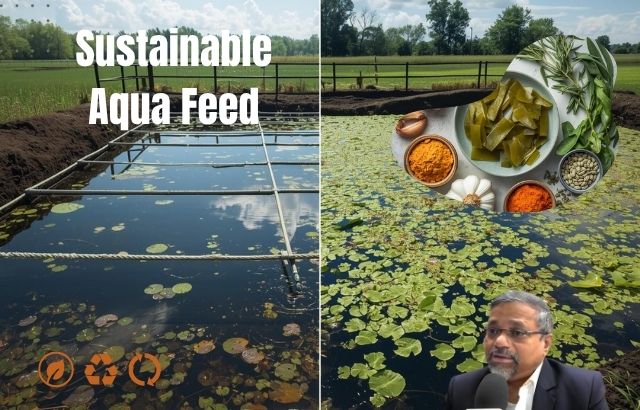
- Includes garlic extract, turmeric, oregano oil
- Natural antimicrobial and antioxidant effects
Example Calculation: Impact on Feed Efficiency
Let’s compare a standard feed vs. supplemented feed.
Scenario:
- Farm produces 10,000 kg fish
- Standard FCR = 1.8
- Improved FCR with supplement = 1.5
Feed Required:
- Without supplement:
10,000 × 1.8 = 18,000 kg feed - With supplement:
10,000 × 1.5 = 15,000 kg feed
Feed Savings:
- 18,000 – 15,000 = 3,000 kg feed saved
If feed cost = ₹50/kg:
Cost Savings:
- 3,000 × 50 = ₹150,000 saved per cycle
Environmental Impact Calculation
Lower feed use = lower waste output.
Assuming:
- 30% of feed becomes waste
Waste Reduction:
- 3,000 × 30% = 900 kg less waste
This directly reduces:
- Water pollution
- Ammonia buildup
- Eutrophication risk
Real-World Application: Jaiguru Kadam’s Role
As a Subject Matter Specialist, Jaiguru Kadam works across:
- Feed formulation optimization for diverse species (shrimp, tilapia, carp)
- Global benchmarking of sustainable ingredients
- Farm-level trials to validate performance improvements
- Training farmers on cost-benefit adoption
Example Case
In a Southeast Asian shrimp farm:
- Introduced probiotic + phytogenic blend
- Survival rate improved from 70% → 85%
- Antibiotic usage dropped significantly
This demonstrates how science-backed innovation + field adaptation creates measurable impact.
Seeing Beyond Immediate Emotions
A farmer may initially resist:
- “This supplement is more expensive per kg.”
But a green innovator asks:
- What is the total cost of production, not just input cost?
- What is the long-term soil and water health impact?
- How does this affect market acceptance and export quality?
This shift—from reactive to strategic thinking—is the essence of sustainable innovation.
Frequently Asked Questions (FAQs)
1. Are sustainable feed supplements more expensive?
Yes, per unit cost may be higher, but overall production cost often decreases due to better FCR and survival rates.
2. Can these supplements replace fishmeal entirely?
Not always fully, but they significantly reduce dependency while maintaining performance.
3. Are probiotics safe in aquaculture?
Yes, when properly selected strains are used, they enhance gut health and reduce disease risk.
4. How long before results are visible?
Typically within one production cycle (30–90 days depending on species).
5. Do these supplements work for all species?
Formulation must be species-specific, but the core principles apply broadly.
Final Thoughts
Green innovation is not about reacting to immediate pressures—it’s about designing systems that endure. In aquaculture, feed supplements represent a powerful lever to align profitability with sustainability.
By combining science, field expertise, and long-term thinking, innovators like Jaiguru Kadam demonstrate that responsible aquaculture is not just possible—it is the future.
“Sustainability begins where short-term thinking ends.”