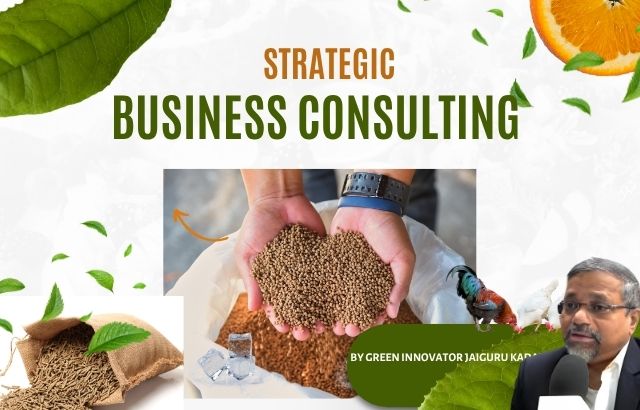
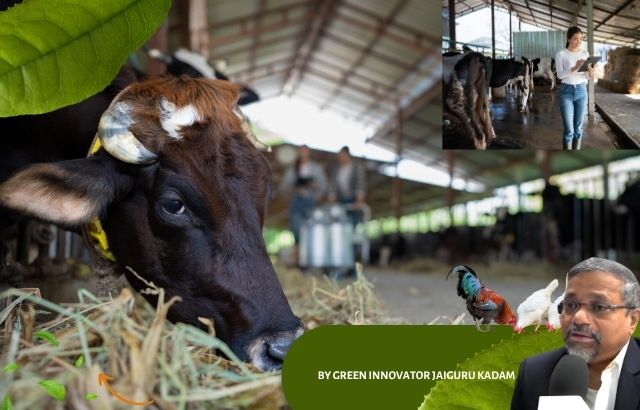
By Green Innovator Jaiguru Kadam
Subject Matter Specialist with Vast International Experience
The Feed Mill That Discovered Sustainability Was More Profitable Than It Expected
A few years ago, I visited a large animal feed supplement manufacturer supplying poultry and dairy producers across Asia.
The management team faced a familiar challenge.
Raw material prices were rising.
Customers demanded better feed conversion ratios.
Export markets were tightening sustainability requirements.
At the same time, livestock producers were under pressure to reduce emissions while maintaining profitability.
The company had invested heavily in product innovation, yet margins continued to shrink.
During our strategic discussions, one question emerged:
What if sustainability was not a compliance requirement but a growth strategy?
The answer transformed the business.
Instead of focusing solely on increasing sales volume, the company began helping customers improve feed efficiency, reduce nutrient losses, optimize formulations, and document environmental performance.
Within two years, customer retention improved significantly, premium product sales increased, and the company positioned itself as a sustainability partner rather than simply a feed supplier.
The lesson was powerful:
The future of animal feed supplementation is not just about nutrition. It is about strategic value creation.
A New Era for Animal Feed Supplement Manufacturers

The global livestock industry is undergoing one of the most significant transformations in its history.
Growing populations, changing dietary patterns, climate commitments, and stricter regulations are forcing the industry to rethink how animal protein is produced.
Animal feed supplement manufacturers now sit at the center of this transformation.
They are no longer merely ingredient suppliers.
They are becoming:
- Productivity partners
- Sustainability enablers
- Innovation leaders
- Carbon reduction contributors
- Strategic advisors to livestock producers
As global demand for meat, dairy, eggs, and aquaculture products continues to grow, feed efficiency and sustainability are emerging as critical competitive advantages.
The Strategic Opportunity Most Companies Overlook
Most businesses focus on increasing production.
Few focus on improving resource efficiency.
Yet one of the most overlooked business opportunities lies in a simple metric:
Feed Conversion Ratio (FCR)
A small improvement in feed efficiency can generate substantial financial and environmental benefits.
Consider a poultry producer consuming:
- 100,000 tonnes of feed annually
- Feed cost: ₹35,000 per tonne
If strategic feed supplementation improves feed efficiency by just 2%:
Feed savings:
100,000 × 2%
= 2,000 tonnes
Financial savings:
2,000 × ₹35,000
= ₹70,000,000
= ₹7 Crore annual savings
The environmental impact is equally significant.
Less feed required means:
- Lower agricultural resource use
- Reduced transportation emissions
- Lower energy consumption
- Reduced waste generation
- Lower carbon footprint per kilogram of meat produced
This is where strategic business consulting creates measurable value.
Why Sustainability Is Becoming a Business Imperative
Many feed manufacturers still view sustainability as an environmental initiative.
Global markets increasingly view it as a business requirement.
Major food companies, retailers, and international buyers are demanding:
- Traceability
- Sustainable sourcing
- Carbon footprint transparency
- Responsible production practices
The companies that proactively address these expectations are gaining market access advantages.
The companies that delay may eventually face barriers to growth.
As I often tell industry leaders:
“The next generation of feed manufacturers will compete not only on product quality but on sustainability outcomes delivered to their customers.”
— Jaiguru Kadam
Three Strategic Shifts Reshaping the Industry
1. From Feed Products to Feed Solutions
Customers increasingly seek measurable performance outcomes.
Instead of asking:
“What supplement should we buy?”
They are asking:
“How much productivity improvement can you deliver?”
Successful companies are shifting from product selling to solution selling.
2. From Cost Reduction to Resource Optimization
Traditional consulting focused on reducing operational expenses.
Modern consulting focuses on maximizing resource productivity.
This includes:
- Nutrient utilization
- Water efficiency
- Energy efficiency
- Waste reduction
- Emissions reduction
These improvements create both financial and environmental value.
3. From Compliance to Competitive Advantage
The most successful organizations are using sustainability to:
- Differentiate products
- Strengthen customer relationships
- Improve brand reputation
- Access premium markets
- Attract investors
What was once considered compliance is now becoming a growth strategy.
Real-World Example 1: Enzyme Technology Creates Dual Benefits
A poultry feed manufacturer introduced advanced enzyme supplementation programs.
Results included:
- Improved nutrient digestibility
- Better feed conversion
- Reduced feed wastage
- Lower phosphorus excretion
The business benefits extended beyond animal performance.
The company reduced formulation costs while helping customers improve sustainability metrics.
This strengthened customer loyalty and increased market competitiveness.
Real-World Example 2: Transitioning Beyond Antibiotic Growth Promoters
As regulatory restrictions increased across global markets, one livestock nutrition company expanded its probiotic and phytogenic product portfolio.
The strategy helped customers:
- Improve gut health
- Support animal performance
- Reduce dependence on antibiotic growth promoters
The company successfully entered premium markets demanding antibiotic-responsible production systems.
The result was both commercial growth and stronger sustainability positioning.
Real-World Example 3: Turning Waste into Opportunity
A feed ingredient manufacturer partnered with food processing industries to utilize nutrient-rich by-products that would otherwise become waste.
The initiative generated:
- Lower raw material costs
- Reduced disposal requirements
- Circular economy benefits
- Improved sustainability credentials
This approach demonstrates how innovation can simultaneously create economic and environmental value.
Lesser-Known Insight: Carbon Reduction Begins in the Feed Mill
When discussing livestock emissions, attention often focuses on animals.
However, one of the most effective carbon reduction opportunities begins much earlier—in feed formulation.
Better digestibility.
Better nutrient absorption.
Better feed efficiency.
These factors directly influence emissions intensity.
A modest improvement in feed utilization across thousands of farms can produce carbon reductions equivalent to large-scale sustainability projects.
This is an area where feed supplement manufacturers possess extraordinary influence.
Did You Know?
🐄 Feed typically represents up to 70% of livestock production costs.
🌱 A 1–3% improvement in feed efficiency can save millions annually for large livestock operations.
♻️ Many agricultural by-products can be transformed into valuable feed ingredients through circular economy approaches.
🌍 Sustainability reporting is becoming increasingly important for companies seeking international partnerships and investment.
🧬 Precision nutrition technologies are helping producers improve productivity while reducing environmental impact.
Expert Perspective: The Future of Animal Nutrition
Throughout my international engagements, one trend has become increasingly clear.
The future leaders of the feed industry will not necessarily be those producing the highest volume.
They will be those delivering the highest value.
Future success will depend on:
- Precision nutrition
- Data-driven decision making
- Sustainable sourcing
- Carbon-conscious innovation
- Circular economy integration
As I often emphasize:
“Every kilogram of feed saved is a gain in profitability, a gain in resource efficiency, and a step toward a more sustainable food system.”
— Jaiguru Kadam
Frequently Asked Questions
1. Why is strategic consulting important for feed supplement manufacturers?
Strategic consulting helps align product innovation, sustainability, operational efficiency, and market opportunities with long-term business growth.
2. Can sustainability improve profitability?
Yes. Improved feed efficiency, reduced waste, optimized formulations, and better resource utilization often generate significant cost savings.
3. What is the biggest sustainability opportunity in animal nutrition?
Feed efficiency improvement remains one of the most impactful opportunities for reducing both costs and environmental impact.
4. How can feed manufacturers support carbon reduction goals?
Through advanced formulations, improved digestibility, precision nutrition, and innovative feed technologies.
5. What role does the circular economy play in feed manufacturing?
Circular economy approaches help convert underutilized resources and by-products into valuable feed ingredients while reducing waste.
6. Are sustainability requirements affecting export markets?
Increasingly yes. Many international buyers now consider sustainability performance when selecting suppliers.
7. Where should companies begin their sustainability journey?
Start by measuring resource use, feed efficiency, waste generation, and environmental impact before developing a strategic improvement roadmap.
Action Steps for Feed Supplement Manufacturers
To remain competitive in the coming decade:
✓ Assess your sustainability readiness
✓ Measure environmental and operational performance
✓ Invest in feed efficiency innovation
✓ Explore circular economy opportunities
✓ Strengthen sustainability reporting capabilities
✓ Develop a long-term green growth strategy
✓ Position your organization as a value-creation partner rather than a product supplier
A Vision for the Green Future
The future of animal nutrition is being shaped by a powerful convergence of science, sustainability, technology, and business strategy.
Feed supplement manufacturers have a unique opportunity to influence the entire food production ecosystem.
They can help farmers produce more with fewer resources.
They can help supply chains reduce environmental impact.
They can help consumers access more sustainable food products.
Most importantly, they can transform sustainability from a challenge into a competitive advantage.
The green future of animal nutrition will not be defined by those who react to change.
It will be led by those who anticipate it.
The question is no longer whether sustainability will shape the animal feed industry.
The question is whether your organization will help define what that future looks like.
— Green Innovator Jaiguru Kadam
Strategic business consulting is helping feed supplement manufacturers drive profitability and sustainability simultaneously.
Disclaimer
This article is intended for educational, informational, and professional discussion purposes only.
Any business scenarios, case studies, examples, calculations, organizations, management teams, customers, or industry situations described in this article are illustrative in nature unless explicitly stated otherwise. They have been created to demonstrate strategic concepts and should not be interpreted as references to any specific company, individual, or actual business event.
The views and insights presented are based on industry observations, publicly available information, and the professional experience of Green Innovator Jaiguru Kadam. While reasonable efforts have been made to ensure accuracy, readers should independently verify information and seek professional advice before making business, financial, operational, regulatory, or investment decisions.
Industry statistics and market information are based on sources believed to be reliable at the time of writing. Market conditions, regulations, technologies, and sustainability standards may change over time.
The author and publisher assume no liability for any actions taken based on the information contained in this article.
© All rights reserved. Reproduction or distribution of this content, in whole or in part, should be undertaken only with appropriate permission and attribution.