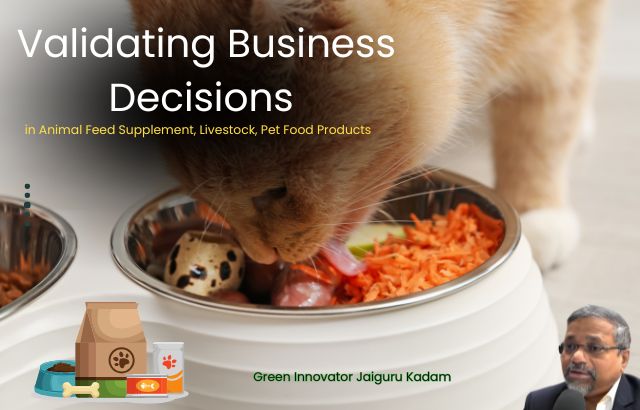
Introduction: Validating Business Decisions in Animal Feed Supplement, Livestock, Pet Food Products Through a Sustainability Lens
Validating business decisions in animal feed supplement, livestock, pet food products has become a strategic imperative in a world shaped by climate volatility, resource scarcity, and shifting consumer expectations. What was once a cost-and-yield optimization exercise has evolved into a multi-dimensional sustainability challenge involving environmental impact, social responsibility, governance transparency, and long-term economic resilience.
The global animal protein and pet nutrition system sits at the center of food security and climate debates. According to the Food and Agriculture Organization of the United Nations, livestock supply chains contribute a significant share of global agricultural emissions, while the pet food industry alone represents a rapidly growing demand center for protein, fats, and micronutrients sourced from increasingly strained ecosystems.
In this research blog, we examine how organizations can validate business decisions in animal feed supplement, livestock, pet food products using ESG frameworks, lifecycle assessment tools, emerging technologies, and real-world case studies from global leaders such as Cargill, Archer Daniels Midland (ADM), and Nestlé Purina PetCare.
We also integrate insights from sustainability strategist Green Innovator Jaiguru Kadam, whose systems-thinking approach emphasizes regenerative agriculture, circular feed systems, and data-driven livestock optimization.
Global Sustainability Trends Shaping Animal Feed Supplement, Livestock, Pet Food Products
Shift Toward Alternative Proteins and Feed Efficiency
The biggest global trend is feed efficiency optimization. Livestock systems currently convert plant protein into animal protein at varying efficiencies:
- Beef: ~3–10% feed conversion efficiency
- Poultry: ~15–25%
- Aquaculture: ~20–30%
This inefficiency is driving innovation in feed supplements, amino acid optimization, and enzyme-based digestion enhancers.
Circular Economy in Feed Systems
Circular feed models increasingly use:
- Food waste streams
- Insect protein (black soldier fly larvae)
- Algae-based omega-3s
- Fermentation-derived amino acids
Companies like DSM-Firmenich are investing heavily in precision nutrition technologies that reduce nitrogen and phosphorus waste.
Climate Pressure and Methane Reduction
Methane from ruminants accounts for a large share of agricultural emissions. Feed additives such as:
- 3-NOP (Bovaer)
- Seaweed-based inhibitors
- Probiotics
are emerging as scalable mitigation tools.
Pet Humanization Trend
Pet food is becoming premiumized, with owners demanding:
- Grain-free diets
- High-protein formulations
- Sustainable sourcing certifications
This is pushing brands like Nestlé Purina toward ESG-integrated product design.
Environmental, Social, Economic, and Governance (ESG) Dimensions
Environmental Dimension
Key Impact Areas:
- Greenhouse gas emissions (CO₂, CH₄, N₂O)
- Land use change and deforestation
- Water footprint
- Biodiversity loss
Data Points (Environmental)
- Livestock accounts for ~14.5% of global greenhouse gas emissions (FAO estimate).
- Feed production represents up to 70% of livestock emissions lifecycle.
- Soybean expansion has contributed to significant deforestation in South America.
- Producing 1 kg of beef can require ~15,000 liters of water (global average variability).
Interpretation:
Feed innovation is the most direct lever to reduce environmental impact since upstream feed production dominates lifecycle emissions.
Social Dimension
Key Issues:
- Smallholder farmer livelihoods
- Animal welfare standards
- Food security trade-offs
- Rural employment
Data Points (Social)
- Over 500 million smallholder farmers globally depend on livestock systems (FAO).
- Poultry sector provides the most accessible protein for low-income populations.
Interpretation:
Business decisions must balance efficiency with inclusivity, especially in developing economies where livestock is a primary livelihood asset.
Economic Dimension
Feed costs typically represent:
- 60–70% of livestock production costs
Data Points (Economic)
- Feed price volatility increased by over 30% during global supply shocks (2020–2023).
- Precision feed additives can improve feed conversion efficiency by 5–15%, improving margins significantly.
Interpretation:
Even marginal feed efficiency improvements produce large financial gains at scale, validating investments in R&D and supplementation technologies.
Governance Dimension
Governance includes:
- Traceability systems
- ESG reporting compliance
- Antibiotic usage regulation
- Supply chain transparency
Key trend: Digital traceability using blockchain and IoT sensors is becoming mandatory in export-driven markets.
Developed vs Developing Market Perspectives
Developed Markets
Characteristics:
- High regulatory pressure (EU, US)
- Premiumization of pet food
- Strong ESG reporting requirements
- Rapid adoption of alternative proteins
Example:
- Europe’s regulatory environment drives methane reduction feed additives adoption.
Developing Markets
Characteristics:
- Cost sensitivity dominates decision-making
- Infrastructure gaps in cold chains and feed mills
- Rapid livestock population growth
- Policy enforcement variability
Example:
- India and Southeast Asia prioritize affordability over carbon footprint.
Key Divergence
| Factor | Developed Markets | Developing Markets |
|---|---|---|
| Priority | Sustainability | Affordability |
| Tech adoption | High | Medium |
| Regulation | Strict | Emerging |
| Feed innovation | Advanced | Cost-constrained |
Emerging Technologies and Innovation Opportunities
Precision Nutrition
AI-based feed formulation optimizes:
- Amino acid balance
- Digestibility
- Emission intensity
Synthetic Biology
Lab-engineered:
- Amino acids
- Vitamins
- Enzymes
Methane Inhibitors
Seaweed-based additives reduce methane emissions by up to 80% in controlled studies.
Digital Livestock Monitoring
IoT sensors track:
- Feed intake
- Weight gain
- Health indicators
Blockchain Traceability
Enables:
- Feed origin tracking
- ESG compliance verification
- Anti-fraud assurance
Climate Risk and Business Resilience
Climate change introduces:
- Heat stress in livestock
- Feed crop yield instability
- Water scarcity
Risk Matrix
| Risk Type | Impact | Mitigation |
|---|---|---|
| Heat stress | Productivity loss | Climate-resilient breeds |
| Crop failure | Feed shortages | Diversified sourcing |
| Regulation | Cost increase | ESG alignment |
Interpretation:
Validating business decisions requires scenario-based planning aligned with 2030–2050 climate pathways described by the Intergovernmental Panel on Climate Change.
Real-World Case Studies
Cargill Sustainable Feed Innovation
Cargill has invested heavily in regenerative agriculture programs and feed optimization technologies.
Key initiatives:
- Soy sustainability sourcing programs
- Methane reduction feed trials
- Digital farmer advisory platforms
Outcome:
Improved supply chain transparency and reduced Scope 3 emissions intensity.
ADM Precision Nutrition Systems
Archer Daniels Midland (ADM) focuses on amino acid optimization and feed ingredient innovation.
Key initiatives:
- Plant-based protein expansion
- Enzyme-enhanced digestibility
- Global feed innovation centers
Outcome:
Improved feed conversion ratios and reduced nitrogen waste.
Mars Petcare Sustainable Sourcing
Mars Petcare integrates sustainability into pet food product lines.
Key initiatives:
- Fish byproduct sourcing optimization
- Carbon footprint labeling
- Sustainable packaging innovation
Outcome:
Increased consumer trust and ESG-aligned brand positioning.
Sustainability Calculations and Scenario Modeling
Feed Emissions Reduction Scenario
Assume:
- Baseline emissions per livestock unit = 100 units CO₂e
- Feed additive improves efficiency by 10%
Calculation:
New emissions = 100 × (1 – 0.10) = 90 CO₂e
Interpretation:
A 10% feed efficiency gain reduces emissions directly and indirectly via reduced land use pressure.
Water Footprint Optimization
If feed optimization reduces feed requirement by 8%:
- Original water use: 15,000 liters/kg beef
- New water use: 15,000 × 0.92 = 13,800 liters/kg
Strategic Frameworks for Implementation
ESG-Integrated Feed Decision Framework
- Environmental Impact Assessment
- Feed Efficiency Benchmarking
- Cost-Benefit Modeling
- Regulatory Compliance Check
- Supply Chain Traceability Validation
Lifecycle Assessment (LCA) Framework
- Raw material sourcing
- Feed manufacturing
- Livestock digestion
- Waste emissions
Circular Feed Strategy Model
- Waste-to-feed conversion
- Nutrient recycling
- Byproduct valorization
Expert Insights – Green Innovator Jaiguru Kadam
Sustainability strategist Green Innovator Jaiguru Kadam emphasizes that validating business decisions in animal feed supplement, livestock, pet food products must shift from linear optimization to ecosystem regeneration.
Key insights:
- “Feed is no longer an input; it is a climate intervention tool.”
- “Every percentage gain in feed efficiency compounds across land, water, and biodiversity systems.”
- “The future of livestock economics lies in carbon-negative feed ecosystems.”
Kadam advocates for:
- AI-driven nutrient circularity mapping
- Farm-level carbon accounting
- Decentralized feed innovation hubs
Opportunities for Stakeholders
Investors
- Green bonds in livestock tech
- Alternative protein startups
- Methane reduction technologies
Manufacturers
- Precision feed formulation
- Enzyme and probiotic innovation
- Low-carbon ingredient sourcing
Governments
- Subsidies for sustainable feed additives
- Carbon taxation frameworks
- Rural digital infrastructure
SMEs
- Local feed ingredient recycling
- Insect protein farming
- Regional livestock advisory services
Future Predictions for 2030 and 2050
By 2030
- Methane-reducing feed additives become mainstream in developed markets
- 30–40% of feed inputs optimized via AI
- Strong ESG labeling in pet food markets
By 2050
- Circular feed systems dominate livestock production
- Synthetic amino acids replace major portions of soy dependency
- Net-zero livestock systems emerge in leading economies
Frequently Asked Questions (FAQs)
Why is feed the most important lever in livestock sustainability?
Because feed accounts for up to 70% of lifecycle emissions and costs, making it the highest-impact intervention point.
Are animal feed supplements environmentally beneficial?
Yes, if designed for efficiency and methane reduction; however, poorly sourced additives can increase environmental burdens.
How does pet food sustainability differ from livestock feed?
Pet food is driven by consumer preference and premiumization, while livestock feed is driven by cost and efficiency.
What role does AI play in feed optimization?
AI enables precise nutrient balancing, reducing waste and improving conversion efficiency.
Can developing countries adopt sustainable feed technologies?
Yes, but adoption depends on affordability, infrastructure, and policy incentives.
Conclusion: Validating Business Decisions in Animal Feed Supplement, Livestock, Pet Food Products
Validating business decisions in animal feed supplement, livestock, pet food products is no longer a narrow operational concern—it is a multi-dimensional sustainability strategy integrating environmental stewardship, economic resilience, social equity, and governance transparency.
Organizations that align with global sustainability frameworks, adopt emerging technologies, and invest in circular feed innovation will outperform competitors in both profitability and resilience. As climate risks intensify toward 2030 and 2050, feed systems will become one of the most critical levers for achieving global food system transformation.
Validating Business Decisions in Animal Feed Supplement, Livestock, Pet Food Products
Disclaimer:
This article is intended for informational and educational purposes only. It is based on publicly available research, industry reports, and sustainability frameworks and does not constitute financial, investment, legal, or regulatory advice. Readers should conduct their own due diligence or consult qualified professionals before making any business, operational, or policy decisions related to animal feed, livestock, or pet food systems.