By Green Innovator Jaiguru Kadam
Subject Matter Specialist | Global Sustainability Expert | Green Innovation Strategist | Industry Thought Leader
Introduction: The Hidden Factor Behind Agricultural Success
Across agriculture, animal nutrition, dairy farming, poultry production, crop management, and agribusiness, companies continuously develop innovative solutions designed to improve productivity, profitability, and sustainability.
Advanced feed technologies, biological inputs, precision farming tools, sustainable production systems, and climate-smart agricultural practices are creating new opportunities for farmers and businesses worldwide.
Yet a critical question remains:
Why do some innovative solutions create exceptional results while others fail to deliver their expected potential?
The answer often lies beyond the product itself.
The real success equation depends on the connection between:
Fear of Failure → Product Adoption → Application Quality → Measurable Results
As Green Innovator Jaiguru Kadam, a sustainability expert and innovation strategist working at the intersection of agriculture, technology, and environmental responsibility, I believe that sustainable transformation happens when innovation is supported by confidence, knowledge, and disciplined execution.
A great product can create opportunity.
But only effective application can create impact.
The Fear of Failure: The Invisible Barrier to Innovation
Agriculture has always involved uncertainty.
Farmers and agribusiness leaders manage challenges such as:
- Changing weather patterns
- Market volatility
- Disease risks
- Increasing input costs
- Regulatory changes
- Pressure to improve sustainability
Because of these challenges, many decision-makers naturally become cautious when introducing new technologies or products.
Common questions include:
- Will this solution actually work?
- What if I lose my investment?
- How quickly will I see results?
- Will this affect my existing production system?
- Can my team implement it correctly?
These concerns are understandable. However, excessive fear can prevent organizations from adopting solutions that could improve efficiency and profitability.
The biggest risk is often not trying something new.
The bigger risk is continuing inefficient practices while competitors adopt better solutions.
Understanding the Green Innovator Perspective
A Green Innovator does not simply introduce a product.
A Green Innovator creates a pathway from innovation to measurable value.
The role requires connecting:
Science + Sustainability + Business Performance + Human Adoption
According to Green Innovator Jaiguru Kadam, successful innovation requires answering four important questions:
1. Is the solution scientifically effective?
The product must have proven technical value.
Examples:
- Improved nutrient utilization
- Better animal performance
- Reduced environmental impact
- Higher resource efficiency
2. Can users apply it correctly?
Even the best technology fails when implementation is poor.
3. Can success be measured?
Without data, innovation becomes an opinion.
4. Does it create long-term value?
Sustainable success must benefit:
- Businesses
- Farmers
- Animals
- Consumers
- The environment
Product Quality Alone Does Not Guarantee Results
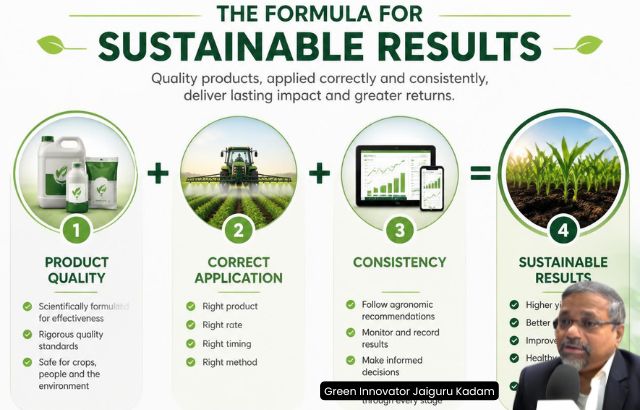
One of the most common mistakes in agriculture is assuming:
Better Product = Better Results
The reality is:
Results = Product Quality × Application Effectiveness × Consistency
This means:
If:
- Product quality = 90%
- Application effectiveness = 50%
- Consistency = 60%
Then:
90 × 0.50 × 0.60 = 27%
The potential value of the product is reduced dramatically because implementation is weak.
The product may be excellent.
The execution determines the outcome.
Case Study 1: Dairy Nutrition — The Difference Between Ownership and Application
Situation
A dairy farm with 100 cows introduces a scientifically developed nutritional supplement designed to improve milk production.
The recommended program suggests:
- Correct daily dosage
- Consistent feeding schedule
- Regular monitoring of production data
Scenario A: Fear-Based Implementation
The farmer worries about additional costs and reduces usage.
Application:
- 50% recommended dosage
- Irregular feeding
- No performance tracking
Results:
Average milk production:
Before supplementation:
20 litres/cow/day
After supplementation:
21 litres/cow/day
Improvement:
1 litre increase
Percentage improvement:
(1 ÷ 20) × 100 = 5% improvement
The farmer concludes:
“The product does not create enough value.”
However, the issue was not the product.
The issue was incomplete application.
Scenario B: Green Innovation Approach
The farmer follows the complete program:
- Correct dosage
- Proper feeding management
- Employee training
- Weekly performance review
Results:
Before:
20 litres/cow/day
After:
23 litres/cow/day
Improvement:
3 litres increase
Percentage improvement:
(3 ÷ 20) × 100 = 15% improvement
Additional milk:
100 cows × 3 litres = 300 extra litres/day
Annual additional production:
300 × 365 = 109,500 litres/year
A small improvement per animal creates a significant business impact.
Case Study 2: Poultry Production — Technology Requires Integration
Situation
A poultry company introduces an enzyme-based feed additive to improve feed efficiency.
The expected benefits:
- Better nutrient absorption
- Improved feed conversion ratio
- Reduced feed cost
Implementation Challenge
The additive is introduced without adjusting:
- Feed formulation
- Nutritional balance
- Management practices
Outcome
The company sees limited improvement and questions the technology.
A Green Innovator would analyze the complete system:
Product + Process + People + Performance Data
The solution may require:
- Nutritionist involvement
- Feed reformulation
- Correct dosage
- Farm-level monitoring
Innovation succeeds when the entire system supports it.
Case Study 3: Sustainable Crop Production — Timing Creates Value
A farmer invests in biological soil enhancement technology.
The product has potential benefits:
- Improved soil health
- Better nutrient availability
- Reduced dependency on chemical inputs
However, application occurs:
- At the wrong crop stage
- Without proper moisture conditions
- Without recommended field practices
Result:
Inconsistent performance.
The farmer loses confidence.
A Green Innovator approach focuses on:
Right Product + Right Timing + Right Method
Sustainability depends on precision.
The Change Management Journey: Moving from Fear to Growth
Successful agricultural transformation follows a clear pathway:
Stage 1: Awareness
The user understands the challenge and available solutions.
Example:
“A dairy farmer learns about technologies that improve feed efficiency.”
↓
Stage 2: Responsibility
The user recognizes the need for change.
Example:
“We need better resource utilization to remain profitable.”
↓
Stage 3: Clarity
The user understands:
- How the solution works
- Expected outcomes
- Required investment
- Implementation steps
↓
Stage 4: Action
The solution is adopted properly.
↓
Stage 5: Measurement
Performance indicators are tracked.
↓
Stage 6: Sustainable Success
The innovation becomes part of long-term business strategy.
Building Confidence Through Evidence
Fear decreases when uncertainty decreases.
The strongest tool against fear is measurable evidence.
Important performance indicators include:
Animal Nutrition
- Milk yield improvement
- Feed conversion efficiency
- Animal health indicators
- Cost per litre of milk
Poultry
- Feed conversion ratio
- Growth rate
- Mortality reduction
- Production consistency
Crop Production
- Yield improvement
- Soil health indicators
- Input efficiency
- Resource conservation
Business Performance
- Return on investment
- Cost reduction
- Market competitiveness
Data transforms innovation from a promise into a business decision.
The Green Innovator Framework for Sustainable Impact
Green Innovator Jaiguru Kadam emphasizes a practical framework:
1. Innovation
Develop solutions that solve real problems.
2. Education
Help users understand the science behind the solution.
3. Demonstration
Show measurable field-level success.
4. Implementation Support
Guide correct application.
5. Measurement
Track results using meaningful indicators.
6. Continuous Improvement
Optimize performance over time.
This approach converts innovation into sustainable business growth.
Frequently Asked Questions (FAQ)
1. Why do some agricultural products fail even when they are scientifically developed?
Most failures occur because of incorrect application, insufficient training, poor timing, or lack of monitoring.
A product creates potential, but implementation creates performance.
2. Is adopting new technology always risky for farmers?
Every business decision involves risk. However, avoiding innovation also creates risk through declining efficiency, rising costs, and reduced competitiveness.
The goal is not to eliminate risk but to manage it intelligently.
3. How can farmers increase success after adopting a new product?
They should focus on:
- Correct dosage
- Proper timing
- Employee training
- Record keeping
- Performance measurement
- Technical guidance
4. What is the role of a Green Innovator in agriculture?
A Green Innovator connects scientific solutions with practical business outcomes.
The role includes:
- Identifying challenges
- Evaluating sustainable solutions
- Supporting adoption
- Measuring impact
- Creating long-term value
5. How can companies improve adoption of innovative agricultural products?
Companies should invest not only in product development but also in:
- Farmer education
- Demonstration projects
- Technical support
- Customer success programs
Innovation must be supported beyond the point of sale.
6. How do businesses measure whether sustainability initiatives are successful?
Success can be measured through:
- Productivity improvement
- Resource efficiency
- Profitability
- Environmental impact reduction
- Customer adoption
- Long-term resilience
The Future of Agriculture: Application Will Define Success
The next generation of agricultural success will not be determined only by who develops the best products.
It will be determined by who can successfully connect:
Innovation + Knowledge + Application + Sustainability
Organizations that help farmers and businesses overcome fear, understand solutions, and apply technologies correctly will create stronger economic, environmental, and social outcomes.
The future belongs to leaders who do more than create innovation.
They create confidence.
They create adoption.
They create measurable impact.
As Green Innovator Jaiguru Kadam believes:
“Sustainable success is not achieved by simply investing in better solutions. It is achieved when people have the knowledge, confidence, and commitment to apply those solutions effectively.”
Because in agriculture, the true value of innovation is not what we purchase.
The true value is what we successfully implement and improve.