A Green Innovation Perspective by Jaiguru Kadam
Introduction: From Soil to Water to Feed Systems
Modern food systems go beyond crops—they include aquaculture, livestock, and feed ecosystems. In all these domains, the distinction between discovery and invention becomes crucial for achieving sustainability, productivity, and profitability.
As a global Subject Matter Specialist, Jaiguru Kadam emphasizes:
“Whether in soil, water, or animal nutrition—discovery reveals biological intelligence, and invention transforms it into scalable solutions.”
Discovery Across Agriculture & Aquaculture
Discovery involves understanding natural biological and ecological systems.
🌱 Agriculture Discoveries
- Soil microbiome and nutrient cycles
- Nitrogen fixation in legumes
- Plant growth hormones
🌊 Aquaculture Discoveries
- Fish metabolism and feeding behavior
- Role of plankton in aquatic food chains
- Dissolved oxygen dynamics
🐄 Animal Nutrition Discoveries
- Gut microbiota in livestock
- Protein-energy balance for growth
- Enzyme roles in digestion
✔ These discoveries provide the scientific foundation for innovation.
Invention: Turning Knowledge into Solutions
Inventions apply discoveries into technologies, products, and systems.
🌾 Agriculture
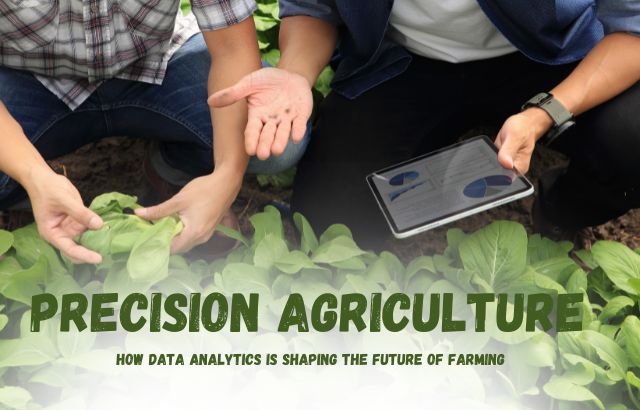
- Biofertilizers
- Precision irrigation
- Climate-smart farming tools
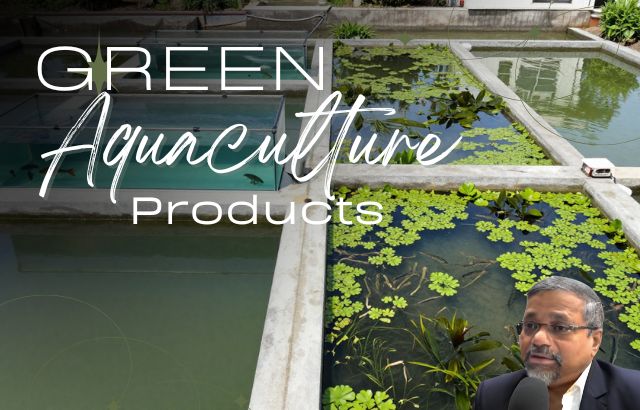
🐟 Aquaculture
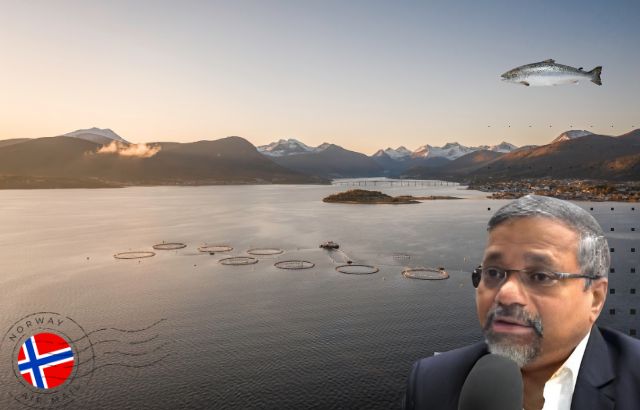
- Aeration systems
- Recirculating Aquaculture Systems (RAS)
- Automated feeders
🐄 Animal Feed

- Probiotic supplements
- Mineral mixtures
- Enzyme-enhanced feeds
✔ Inventions deliver measurable productivity and efficiency gains.
Jaiguru Kadam’s Integrated Role
Jaiguru Kadam works at the intersection of:
1. Agri–Aqua System Integration
- Designing systems where farm waste supports aquaculture
- Example: Integrated fish farming with crop irrigation
2. Feed Innovation Specialist
- Develops sustainable, low-cost feed formulations
- Focus on reducing dependency on expensive imports
3. Circular Economy Architect
- Converts agri-waste into feed inputs
- Example: Using rice bran, oil cakes
4. Field Implementation Leader
- Bridges lab discoveries to farmer-level adoption
Discovery → Invention Examples
1. Plankton Ecology
- Discovery: Plankton are natural fish feed
- Invention: Pond fertilization techniques to boost plankton
2. Animal Digestion
- Discovery: Enzymes improve nutrient absorption
- Invention: Enzyme-based feed additives
3. Crop Residues
- Discovery: Residues contain usable nutrients
- Invention: Processed cattle feed pellets
Animal Feed Supplement Formulations (Practical Examples)
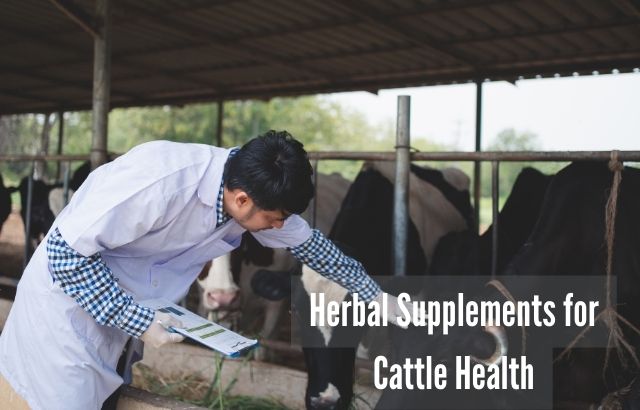
🐄 1. Cattle Feed Supplement (Low-Cost Model)
Objective: Improve milk yield and digestion
Ingredients:
- Mustard oil cake: 25%
- Maize powder: 20%
- Wheat bran: 30%
- Mineral mixture: 2%
- Salt: 1%
- Molasses: 22%
✔ Benefits:
- Enhances energy + protein balance
- Improves milk production by ~10–15%
2. Poultry Feed Supplement
Objective: Improve growth rate and feed conversion
Ingredients:
- Soybean meal: 35%
- Corn: 40%
- Fish meal: 10%
- Mineral mix: 2%
- Enzymes + probiotics: 1%
- Rice bran: 12%
✔ Benefits:
- Faster weight gain
- Better gut health
3. Aquaculture Feed (Fish Feed)
Objective: Optimize fish growth in ponds
Ingredients:
- Fish meal / alternative protein: 25%
- Rice bran: 30%
- Groundnut oil cake: 20%
- Wheat flour: 15%
- Vitamins & minerals: 2%
- Algae powder: 8%
✔ Benefits:
- Improves feed conversion ratio (FCR)
- Enhances immunity
Calculation: Feed Conversion Ratio (FCR) in Aquaculture
FCR Formula:
[
FCR = \frac{\text{Feed given (kg)}}{\text{Weight gain (kg)}}
]
Example:
- Feed used = 1,500 kg
- Fish weight gain = 1,000 kg
[
FCR = 1.5
]
👉 If improved feed reduces FCR to 1.2:
Feed Savings:
[
(1.5 – 1.2) \times 1000 = 300 \text{ kg feed saved}
]
✔ Lower FCR = higher efficiency + lower cost
Aquaculture System Calculation: Oxygen Requirement
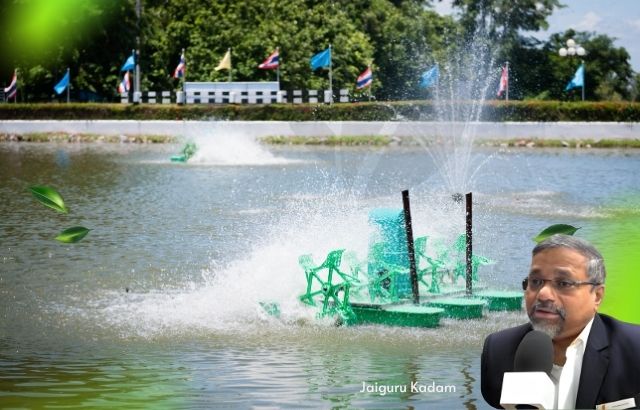
- Fish oxygen demand ≈ 200 mg O₂/kg/hour
- For 1,000 kg fish:
[
200 \times 1000 = 200,000 \text{ mg/hour} = 200 g/hour
]
👉 Aeration systems must supply at least 200 g oxygen/hour
✔ This is where invention (aerators) applies discovery (fish respiration needs)
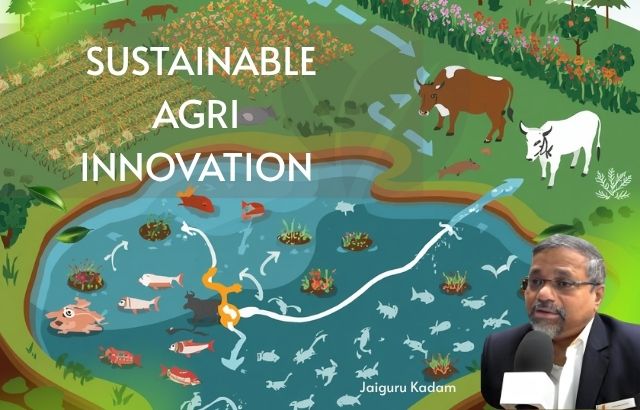
Integrated Farming Model (Jaiguru Kadam Approach)
Example System:
- Crop farm + fish pond + livestock
Flow:
- Crop waste → animal feed
- Animal waste → pond fertilizer
- Pond water → irrigation
✔ Outcome:
- Zero waste system
- Multiple income streams
- Reduced input costs
Frequently Asked Questions (FAQs)
1. Why include aquaculture in agriculture innovation?
Because fish farming is one of the fastest-growing food sectors and complements land farming.
2. Are feed formulations customizable?
Yes. They depend on:
- Species
- Growth stage
- Local ingredient availability
3. What is the biggest cost in livestock and aquaculture?
Feed accounts for 60–70% of total cost.
4. How can farmers reduce feed cost?
- Use local ingredients
- Adopt scientific formulations
- Improve FCR
5. Is integrated farming profitable?
Yes. It reduces waste and increases total farm productivity by 20–40%.
Conclusion: The Future of Food Systems
Agriculture, aquaculture, and animal nutrition are no longer separate—they are interconnected ecosystems.
Jaiguru Kadam summarizes:
“The future lies in integrated systems where discoveries in biology lead to inventions in feed, farming, and fisheries.”
To build sustainable food systems:
- Discover biological efficiency
- Invent cost-effective solutions
- Integrate systems holistically
🌾🌊🐄 Because the next revolution in farming is not just growing food—
it’s engineering ecosystems that sustain life.