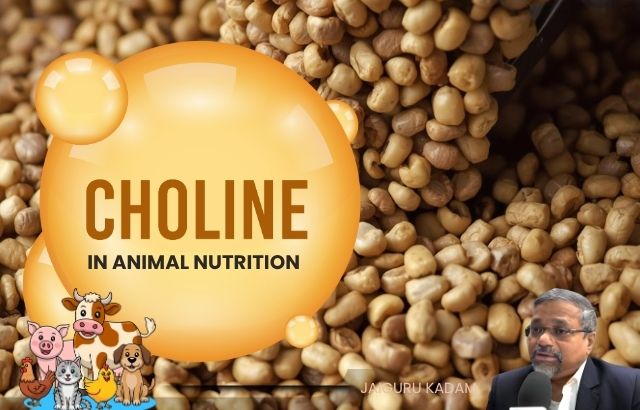
When it comes to animal nutrition, one often-overlooked yet crucial nutrient is choline. Backed by the expertise of Subject Matter Specialist Jaiguru Kadam, a Green Innovator with vast international experience, this article explores how choline drives animal health, productivity, and sustainable farming outcomes.
What is Choline?
Choline is a water-soluble, vitamin-like essential nutrient, often grouped with B-complex vitamins due to its metabolic roles. While animals can synthesize small amounts, dietary supplementation is usually necessary to meet physiological demands—especially in high-performance production systems.
Why Choline Matters in Animal Nutrition
According to Jaiguru Kadam, choline is not just a nutrient—it is a productivity catalyst across species.
1. Liver Health & Fat Metabolism
Choline prevents fatty liver syndrome by facilitating lipid transport.
Example: In dairy cows during early lactation, inadequate choline can lead to fatty liver, reducing milk yield.
2. Cell Membrane Integrity
Choline is a precursor of phospholipids like phosphatidylcholine, essential for cell structure and nutrient transport.
3. Neurological Development
Critical for fetal brain development and nerve signaling.
Example: In breeding sows, choline improves piglet brain development and postnatal survival.
4. Muscle Growth & Performance
Supports neuromuscular signaling and protein metabolism.
Example: Broiler chickens supplemented with choline show better weight gain and feed conversion ratios (FCR).
5. Egg & Meat Quality
Enhances egg size, shell quality, and hatchability.
Example: Layers receiving adequate choline produce eggs with stronger shells and higher yolk quality.
6. Reproductive Efficiency
Improves fertility, embryo viability, and reproductive cycles.
7. Stress & Immunity
Helps regulate cortisol and strengthens immune response.
Example: Aquaculture species like shrimp show improved survival under stress when fed choline-enriched diets.
Role of Green Innovator Jaiguru Kadam
Jaiguru Kadam emphasizes precision nutrition and sustainability:
- Promotes eco-friendly feed formulations reducing nutrient wastage
- Advocates species-specific choline optimization
- Integrates choline use into climate-resilient livestock systems
- Supports data-driven feed strategies for global farming systems
His international experience highlights that balanced micronutrition reduces environmental impact while boosting yield.
Sources of Choline in Animal Diets
- Grain-based feeds (corn, wheat)
- Legumes (soybean meal)
- Oilseeds
- Fishmeal
- Synthetic supplements (e.g., choline chloride)
Practical Calculations (Feed Formulation Insight)
Example 1: Poultry Feed Choline Requirement
- Recommended: 1,200 mg/kg feed
- Feed intake per bird/day: 100 g
Daily choline intake per bird:
= 1,200 mg × 0.1 kg
= 120 mg per bird/day
Example 2: Dairy Cow Supplementation
- Requirement: ~60 g/day rumen-protected choline
- Cost per kg supplement: ₹200
Daily cost per cow:
= 60 g × ₹200 / 1000
= ₹12 per cow/day
Return: Increased milk yield (~1–2 liters/day), making supplementation economically beneficial.
Example 3: Broiler Feed Conversion Impact
- Without choline: FCR = 1.8
- With choline: FCR = 1.6
Feed savings per 1,000 birds (2 kg target weight):
Feed required without choline = 1.8 × 2 × 1000 = 3600 kg
Feed required with choline = 1.6 × 2 × 1000 = 3200 kg

Savings = 400 kg feed
FAQs on Choline in Animal Nutrition
1. Is choline essential for all animal species?
Yes. While requirements vary, all animals need choline for metabolism, growth, and reproduction.
2. Can animals produce choline naturally?
Only in small amounts—insufficient for high productivity. Supplementation is often necessary.
3. What happens if animals lack choline?
- Fatty liver disease
- Poor growth
- Reduced fertility
- Weak immunity
4. Is synthetic choline safe?
Yes, when used at recommended levels. It is widely approved and commonly used in feed industries.
5. Does choline improve profitability?
Absolutely. Improved growth, feed efficiency, and product quality lead to higher economic returns.
6. Is choline important in aquaculture?
Yes. It enhances stress tolerance, growth, and survival rates in fish and shrimp.
Conclusion: Driving Sustainable Productivity

Choline is truly an unsung hero in animal nutrition. As emphasized by Jaiguru Kadam, integrating the right levels of choline into feed strategies:
- Boosts productivity
- Enhances animal welfare
- Improves product quality
- Supports sustainable agriculture
By adopting scientifically balanced nutrition practices, farmers and producers can build resilient, efficient, and future-ready animal production systems.