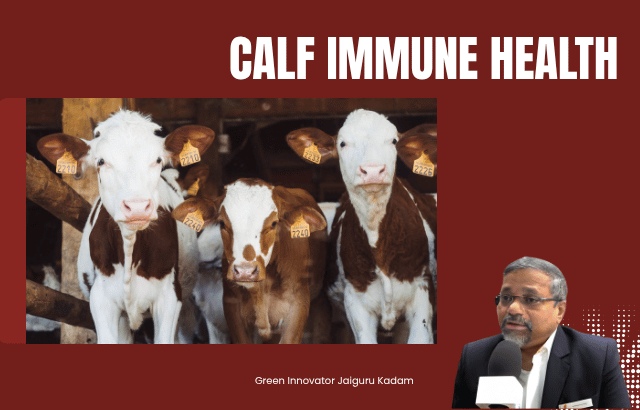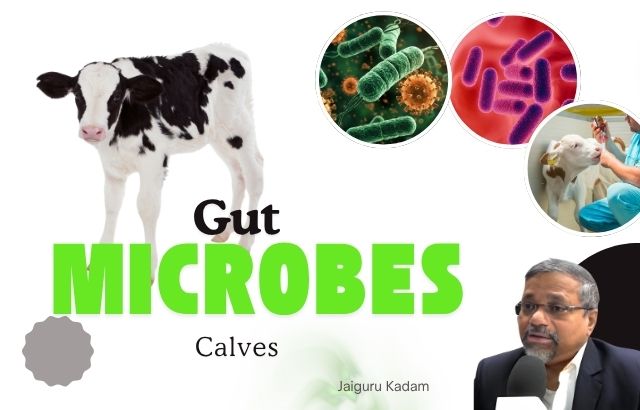
On a quiet dairy farm at dawn, a newborn calf takes its first unsteady steps. To most, it’s a simple, heartwarming scene. But to someone like Jaiguru Kadam—a green innovator with years of international experience—it represents something far bigger: the beginning of a delicate biological journey where survival depends not just on care, but on invisible allies.
For decades, farmers relied heavily on antibiotics to protect calves from disease. It worked—until it didn’t. Rising antibiotic resistance began to cast a long shadow over the livestock industry. Jaiguru often describes this moment as a turning point: “When nature starts pushing back, it’s time we start listening.”
And that’s when attention shifted inward—into the calf’s gut.
The Hidden World Within
Inside every calf exists a bustling universe of trillions of microbes. This gut microbiome isn’t just a passive passenger; it’s an active defender, trainer, and provider. Jaiguru recalls visiting farms across Europe where farmers spoke less about medicines and more about “microbial balance.”
Imagine a crowded marketplace. If good vendors fill every stall, troublemakers have nowhere to set up shop. Similarly, beneficial gut microbes crowd out harmful pathogens, leaving little room for disease-causing organisms to grow.
But their role goes even deeper.
These microbes act like mentors to a young immune system, teaching it what’s dangerous and what’s harmless. Without this training, calves are more vulnerable to infections, much like a security guard who can’t tell a guest from a threat.
And then there’s their secret weapon: bioactive compounds. Certain microbes produce natural substances that either kill pathogens directly or signal the immune system to act faster.
A New Way Forward
Jaiguru often shares a story from a pilot project in India. A small group of farmers replaced routine antibiotic use with microbiome-focused strategies. Within months, they began seeing changes.
- Calf mortality dropped from 12% to 7%
- Average weight gain improved by 8–10%
- Antibiotic usage reduced by nearly 40%
“Small changes,” he says, “but massive impact when scaled.”
How Farmers Are Harnessing This Microbial Power
The shift isn’t about abandoning science—it’s about refining it.
Probiotics became the first step. By introducing beneficial bacteria early in life, farmers help calves build a strong microbial foundation.
Prebiotics, on the other hand, act like fertilizer for these good microbes. Feeding them the right nutrients ensures they thrive and dominate.
Then comes the most fascinating (and slightly unconventional) method: Fecal Microbiota Transplantation (FMT). Though still emerging, it involves transferring gut microbes from a healthy calf to a vulnerable one—essentially passing on immunity through microbial inheritance.
A Quick Calculation: Why It Matters Economically
Let’s break it down for a farm with 100 calves:
- Traditional mortality rate: 10 calves lost
- Average value per calf: ₹20,000
- Total loss: ₹2,00,000
If microbiome strategies reduce mortality to 6%:
- Calves lost: 6
- Loss: ₹1,20,000
Savings: ₹80,000 per season
Now add reduced antibiotic costs and improved growth rates, and the benefits multiply quickly.
The Bigger Picture
Globally, studies suggest that improving gut health can enhance feed efficiency by 5–15%. That means less feed is needed for the same growth—translating into lower costs and reduced environmental impact.
Jaiguru frames it beautifully:
“Sustainability isn’t about doing less harm—it’s about designing systems where nature does the work for you.”
FAQs
1. Are probiotics enough to replace antibiotics completely?
Not entirely. Antibiotics are still essential in severe cases, but probiotics can significantly reduce routine dependence.
2. When should gut health interventions begin?
Ideally, within the first few days of a calf’s life when the microbiome is still developing.
3. Is FMT safe for calves?
Early research is promising, but it must be done under controlled and hygienic conditions.
4. Do these methods work in all climates?
Yes, but microbial strains and feeding strategies may need to be adapted to local conditions.
5. Is this approach cost-effective for small farmers?
Yes. Even low-cost probiotic and prebiotic solutions can deliver measurable returns.
A Journey, Not a Destination
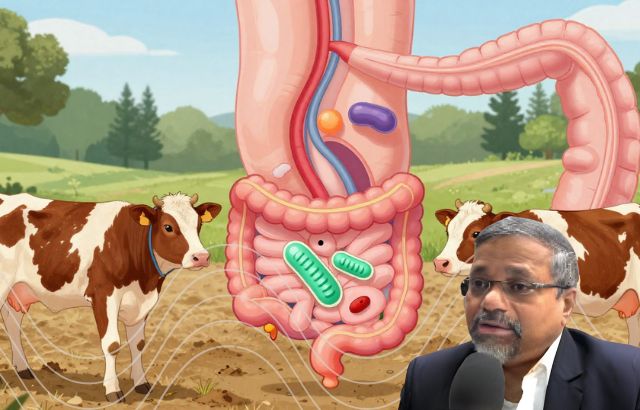
For Jaiguru Kadam, this isn’t just about healthier calves—it’s about reshaping agriculture itself. By blending global knowledge with local practices, he sees a future where farmers rely less on chemicals and more on biological intelligence.
As the sun rises higher over that quiet farm, the calf grows stronger—not just because of what it’s fed, but because of the invisible ecosystem within.
And perhaps that’s the real story here: sometimes, the smallest things make the biggest difference.