By Green Innovator Jaiguru Kadam
The global shift toward sustainability is no longer a trend—it is a transformation. Industries ranging from home care and personal care to agriculture and pharmaceuticals are actively replacing conventional surfactants with green surfactants that are biodegradable, safe, and environmentally responsible.
However, creating a result-oriented green surfactant product requires more than just selecting plant-based ingredients. It demands strategic decision-making backed by science, sustainability metrics, and performance benchmarks.
Below are five essential decision-making habits every innovator should adopt when developing high-performance green surfactant products.
1. Prioritize Renewable Raw Materials

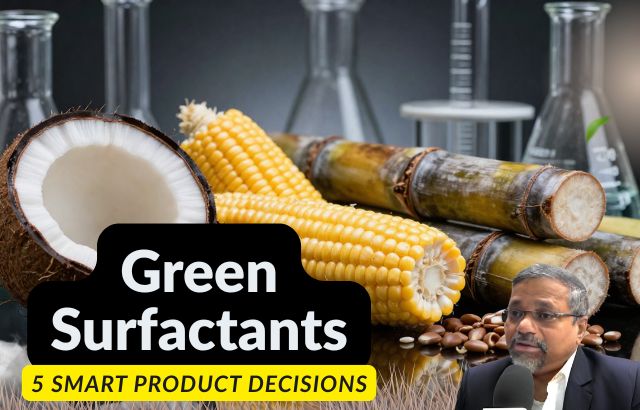
One of the first decisions in developing green surfactants is choosing renewable feedstocks such as coconut oil, palm kernel oil, corn glucose, or sugar derivatives.
Why it matters
• Reduces dependency on petrochemicals
• Lowers carbon footprint
• Improves biodegradability
Example
Many modern biosurfactants such as alkyl polyglucosides (APG) are derived from glucose and fatty alcohols obtained from plant oils. They are widely used in eco-friendly detergents and shampoos.
Quick Calculation
If a traditional surfactant contains 80% petroleum-based ingredients and a green surfactant reduces that to 10%, the renewable content increases significantly.
Example:
Total formulation = 100 kg
Traditional formulation
Petroleum ingredients = 80 kg
Green formulation
Petroleum ingredients = 10 kg
Reduction in petroleum usage
80 − 10 = 70 kg reduction
That equals 87.5% reduction in fossil-based material.
2. Balance Sustainability with Performance
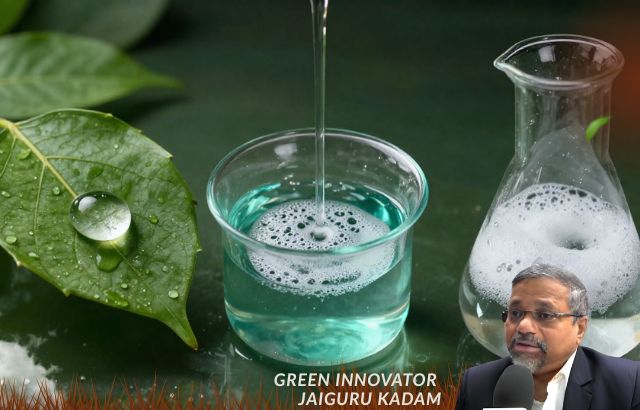
A common misconception is that eco-friendly surfactants compromise on cleaning efficiency. Successful innovators avoid this mistake by balancing sustainability with performance metrics.
Key performance indicators include:
• Surface tension reduction
• Foam stability
• Wetting ability
• Emulsification power
Example
A well-formulated green dishwashing liquid using plant-based surfactants can achieve surface tension reduction from 72 mN/m to 28–32 mN/m, which is comparable to many synthetic surfactants.
Stat
Studies show that over 60% of consumers prefer environmentally safe cleaning products if performance remains equal to traditional products.
3. Use Lifecycle Thinking Before Finalizing a Formula
A result-oriented product considers the entire lifecycle, not just the ingredients.
Lifecycle thinking evaluates:
• Raw material sourcing
• Manufacturing energy consumption
• Product usage impact
• Wastewater biodegradation
Example
A detergent manufacturer switching to green surfactants observed that wastewater treatment costs dropped by nearly 20% due to improved biodegradability.
Simple Cost Impact Calculation
Annual wastewater treatment cost
= ₹50,00,000
20% reduction
= 0.20 × 50,00,000
= ₹10,00,000 savings per year
This demonstrates that sustainability can directly support profitability.
4. Make Data-Driven Formulation Decisions

Successful innovators rely on experimental data rather than assumptions.
Key testing parameters include:
• Critical Micelle Concentration (CMC)
• Detergency tests
• Toxicity and skin irritation tests
• Biodegradability rate
Example
A formulation scientist comparing two biosurfactants may observe:
| Parameter | Surfactant A | Surfactant B |
|---|---|---|
| CMC | 0.02% | 0.05% |
| Foam stability | High | Medium |
| Biodegradability | 95% | 88% |
A lower CMC means less surfactant is needed to achieve cleaning performance, making the product more efficient and economical.
5. Think Long-Term Market Impact
Green surfactant innovations should align with future regulations and market expectations.
Global regulations increasingly restrict harmful surfactants due to environmental toxicity.
Forward-thinking innovators evaluate:
• Regulatory compliance
• Market demand
• Brand sustainability value
• Long-term environmental impact
Interesting Market Statistic
The global green surfactant market is expected to grow at over 6–7% CAGR, potentially crossing $25 billion in the coming decade.
This growth reflects a strong demand for environmentally responsible cleaning solutions.
Key Benefits of Green Surfactants
Adopting green surfactants provides several advantages:
Environmental Benefits
• High biodegradability
• Reduced aquatic toxicity
• Lower carbon footprint
Consumer Benefits
• Skin-friendly formulations
• Safer home cleaning products
• Reduced exposure to harmful chemicals
Business Benefits
• Regulatory compliance
• Growing eco-conscious market demand
• Stronger brand reputation
Practical Example: Green Laundry Detergent Formula Decision
Suppose a company is deciding between two formulations.
Formula A
Surfactant concentration = 15%
Cost per kg = ₹180
Formula B (Green surfactant)
Surfactant concentration = 10%
Cost per kg = ₹220
Cost per 100 kg detergent
Formula A
15 kg × ₹180 = ₹2700
Formula B
10 kg × ₹220 = ₹2200
Despite higher per-kg cost, Formula B saves ₹500 per batch due to lower concentration requirements.
Frequently Asked Questions (FAQs)

1. What are green surfactants?
Green surfactants are surface-active agents derived from renewable resources that are biodegradable and environmentally safe.
2. Are green surfactants as effective as synthetic surfactants?
Yes. With proper formulation, many green surfactants provide comparable cleaning efficiency, foam stability, and emulsification performance.
3. Which industries benefit most from green surfactants?
Industries such as:
• Personal care
• Household cleaning
• Agriculture
• Food processing
• Pharmaceuticals
4. Are green surfactants more expensive?
Initially they may appear costlier per kilogram, but higher efficiency and lower environmental costs often make them economically beneficial.
5. What is the biggest challenge in developing green surfactants?
The main challenge is balancing sustainability with high cleaning performance while maintaining cost efficiency.
Final Thoughts
Innovation in green surfactants is not just about replacing chemicals—it is about making intelligent, responsible decisions throughout the product development process.
By prioritizing renewable materials, relying on data, evaluating lifecycle impact, and thinking long-term, innovators can create high-performance, environmentally responsible products that meet the needs of modern consumers.
The future of surfactant technology lies in sustainability, smart formulation, and science-driven innovation.
A Message to Product Developers & R&D Innovators
To the brilliant minds working in Personal Care, Cleaning Products, Agriculture, and Pharmaceutical industries,
Innovation has always been the driving force behind progress. As product developers and research professionals, you are not just creating formulations—you are shaping the future of how people live, clean, heal, and grow food.
Today, the world is moving toward sustainable chemistry and green formulations, and your role has never been more important.
Every decision you make in the laboratory—whether selecting a surfactant, optimizing a formulation, or improving biodegradability—has an impact far beyond the product itself. It affects environmental safety, consumer health, regulatory compliance, and the long-term sustainability of industries worldwide.
Green surfactants and sustainable ingredients are not just alternatives; they represent the next generation of responsible innovation.
For product developers and R&D professionals, this is an opportunity to:
• Design high-performance products that are safer for people and the planet
• Replace petroleum-based ingredients with renewable resources
• Improve biodegradability and reduce environmental impact
• Create solutions that meet future regulatory and market expectations
True innovation lies in balancing performance, cost efficiency, and sustainability. When science, data, and environmental responsibility work together, we create products that are not only effective but also meaningful.
To all researchers, formulation scientists, and product developers:
Your experiments, your data, and your decisions today will define the next generation of sustainable products used by millions of people around the world.
Let us continue pushing boundaries, sharing knowledge, and building a future where innovation and sustainability go hand in hand.
— Green Innovator Jaiguru Kadam