By Green Innovator & Subject Matter Specialist – Jaiguru Kadam
Introduction: Why the Pesticide Industry Needs a Green Reset
The global pesticide industry stands at a critical crossroads. On one hand, it must ensure food security for a growing population; on the other, it faces mounting pressure from regulators, consumers, and ecosystems demanding safer and more sustainable solutions.
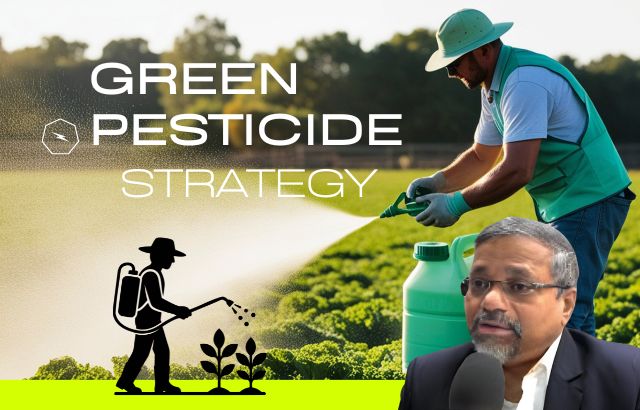
Traditional decision-making—focused narrowly on cost, yield, and short-term compliance—is no longer sufficient. What the industry needs is a Green Strategy Framework: a structured, fail-safe approach that integrates environmental stewardship, business resilience, and long-term innovation.
Drawing from vast international experience across agrochemical markets, sustainability programs, and regulatory ecosystems, this framework offers pesticide leaders a practical path forward—without compromising performance or profitability.
What Is a Green Strategy Framework?
A Green Strategy Framework is a decision-making model that ensures every strategic choice passes through environmental, economic, and risk-management filters before implementation.
Instead of asking:
“Is this product legally allowed?”
The framework asks:
“Is this product future-proof, environmentally responsible, and commercially resilient?”
The 5-Pillar Fail-Safe Decision-Making Approach
1. Regulatory Foresight (Not Just Compliance)
Fail-safe principle: Anticipate regulations before they become mandatory.
Example:
- The EU’s Farm to Fork strategy aims to reduce chemical pesticide use by 50%.
- Companies that proactively invest in low-toxicity or biological alternatives gain early-mover advantage instead of scrambling during bans.
Decision filter:
✔ Will this product survive the next 10–15 years of regulatory tightening?
2. Environmental Impact Quantification
Green strategy must be measurable, not emotional.
Key metrics include:
- Environmental Impact Quotient (EIQ)
- Soil persistence (DT50)
- Impact on non-target species (pollinators, aquatic life)
Simple Calculation Example:
If:
- Conventional pesticide EIQ = 45
- New green formulation EIQ = 18
Impact Reduction % =
[
\frac{45 – 18}{45} \times 100 = 60%
]
➡ A 60% environmental impact reduction becomes a powerful decision and marketing metric.
3. Economics of Sustainability (Green ≠ Expensive)
A common myth is that green solutions are always costlier. A fail-safe approach evaluates total lifecycle cost, not just manufacturing cost.
Example Calculation:
| Parameter | Conventional | Green Alternative |
|---|---|---|
| Production cost/unit | $10 | $13 |
| Regulatory risk cost | $4 | $1 |
| Market access premium | $0 | –$3 |
| Net effective cost | $14 | $11 |
➡ The “costlier” green option is actually 21% cheaper when viewed strategically.
4. Innovation Portfolio Balance
Fail-safe decision-making avoids “all-or-nothing” bets.
Recommended portfolio mix:
- 40% optimized conventional formulations
- 35% bio-based / low-toxicity solutions
- 25% next-gen innovations (RNAi, precision delivery, digital agriculture)
This balance protects cash flow while future-proofing the business.
5. Stakeholder Trust & Market Acceptance
Green strategy is incomplete without farmer and consumer trust.
Fail-safe question:
✔ Can a farmer explain why this product is safer and still effective?
Example:
Clear communication on:
- Reduced application dosage
- Shorter re-entry intervals
- Compatibility with Integrated Pest Management (IPM)
Trust reduces resistance, improves adoption, and lowers reputational risk.
Case Example: Transitioning to a Green Product Line
A mid-size pesticide company operating in Asia and Europe faced repeated regulatory hurdles.
Green Strategy Actions Taken:
- Reformulated 30% of products with low-toxicity actives
- Reduced average application dose by 25%
- Introduced impact-based labeling
Results within 3 years:
- Regulatory approvals accelerated by 40%
- Export rejections dropped to near zero
- EBITDA margins improved by 6–8%
This is the power of fail-safe, green decision-making.
Why This Framework Is “Fail-Safe”
A decision is considered fail-safe when:
- Regulatory changes do not destroy value
- Environmental scrutiny strengthens brand equity
- Economic shocks are absorbed, not amplified
Green strategy is no longer a moral choice—it is strategic risk management.
Frequently Asked Questions (FAQs)
Q1. Can green strategies work for small and mid-size pesticide companies?
Absolutely. In fact, smaller companies often move faster and innovate more efficiently than large multinationals.
Q2. Do green pesticides compromise efficacy?
Not when designed correctly. Many modern formulations achieve equivalent or better efficacy through precision delivery and formulation science.
Q3. How long does ROI take for green investments?
Typically 2–4 years, depending on regulatory advantages, market premiums, and reduced compliance costs.
Q4. Is this framework applicable globally?
Yes. It has been shaped through international experience across Europe, Asia, and emerging markets, where regulatory and environmental pressures vary widely.
Q5. What is the biggest mistake companies make when “going green”?
Treating sustainability as a marketing exercise instead of embedding it into core decision-making and R&D strategy.
Final Thoughts from the Author
The future of the pesticide industry will not be decided by who produces the strongest chemical—but by who makes the smartest, safest, and most sustainable decisions.
A Green Strategy Framework is not about idealism. It is about resilience, credibility, and long-term profitability.
Those who adopt a fail-safe decision-making approach today will lead the industry tomorrow.
About the Author
Jaiguru Kadam is a Green Innovator and Subject Matter Specialist with vast international experience in the pesticide and agrochemical industry. His work focuses on sustainable innovation, regulatory foresight, and strategic transformation—helping organizations align profitability with planetary responsibility.