Animals don’t read productivity books. They don’t attend seminars. Yet, across farms, homes, and water systems, they demonstrate something humans struggle with daily:
They instinctively know that not everything deserves their attention.
If you observe closely—especially through the lens of sustainability thinkers like Jaiguru Kadam—animals are masters of energy efficiency, focus, and response control.
Let’s break this down across livestock, pets, and aquaculture.
Livestock: Efficiency Over Reaction
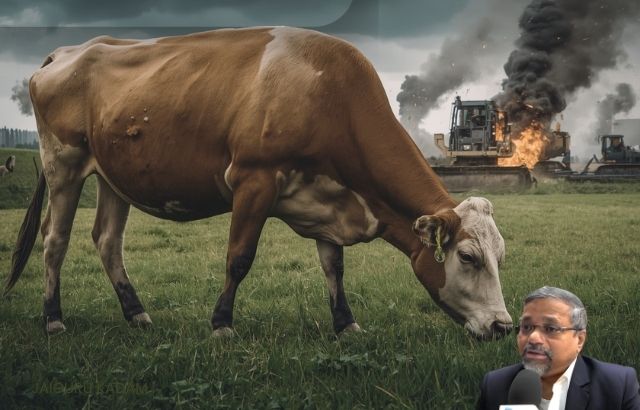
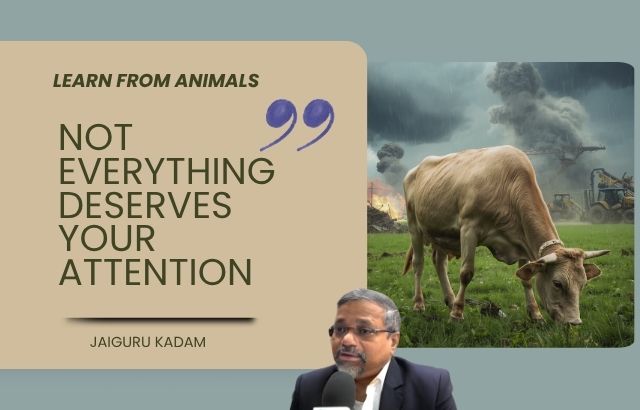
Cows – Calm Focus, Not Constant Reaction
Cows spend most of their day grazing, ruminating, and resting. They:
- Ignore minor disturbances (noise, distant movement)
- React only to real threats
👉 Lesson:
If cows reacted to every sound, they would burn energy unnecessarily, reducing milk production and health.
Human parallel: reacting to every notification reduces your “output capacity.”
Goats – Selective Curiosity
Goats are curious—but not careless.
- They explore what seems relevant (food, safe terrain)
- They ignore repetitive, non-beneficial stimuli
👉 Lesson:
Curiosity is useful only when directed, not scattered.
Pets: Emotional Intelligence & Boundaries

Dogs – Focus on Signals That Matter
Dogs don’t respond to every sound:
- They ignore background noise (fan, traffic)
- They respond sharply to meaningful cues (owner’s voice, danger)
👉 Lesson:
Train your mind like a dog:
- Filter noise
- Respond to signals
Cats – Masters of Energy Conservation
Cats sleep 12–16 hours a day and:
- Ignore things that don’t benefit them
- Act only when necessary (hunting, eating, safety)
👉 Lesson:
Rest and inaction are not laziness—they’re strategic energy preservation.
Aquaculture: Precision and Survival
Fish – Attention as Survival Currency
In aquaculture systems:
- Fish ignore constant water movement
- React instantly to food or predators
👉 Lesson:
Overreaction wastes energy; underreaction risks survival.
The balance is precision attention.
Shrimp Farming – Environmental Sensitivity
Shrimp:
- Don’t respond to irrelevant stimuli
- Are highly sensitive to critical changes (oxygen, toxins)
👉 Lesson:
Not everything deserves attention—but the right things deserve immediate attention.
The Hidden Pattern Across All Animals
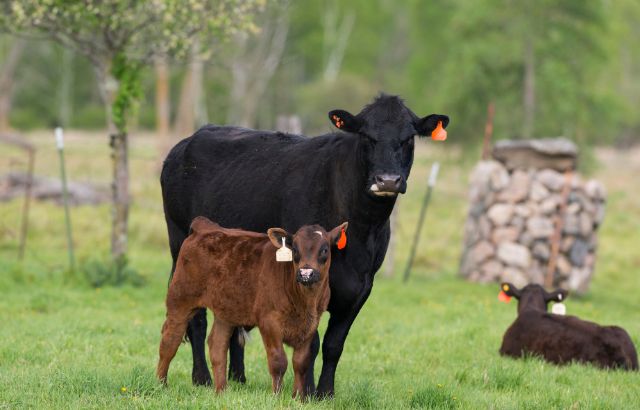
Across livestock, pets, and aquatic life, one principle repeats:
👉 Attention = Energy = Survival
Animals naturally follow a simple equation:
Energy spent on unnecessary attention = reduced survival efficiency
This aligns strongly with Jaiguru Kadam’s sustainability thinking:
- Minimize waste
- Optimize input
- Maximize meaningful output
A Simple Practical Calculation
Let’s translate animal behavior into human terms:
Assume:
- You check your phone 80 times/day
- Each check = 1 minute (avg)
Daily attention loss:
80 × 1 = 80 minutes (~1.3 hours/day)
Yearly loss:
1.3 × 365 = 475 hours/year
That’s:
- ~20 full days
- Nearly 3 weeks of continuous attention lost
👉 Animals would never survive with that level of wasted energy.
What Animals Teach Us (Summarized)
- Cows: Stay calm—ignore low-value noise
- Goats: Be curious—but selective
- Dogs: Respond to meaningful signals only
- Cats: Conserve energy intentionally
- Fish/Shrimp: React precisely, not constantly
Final Insight
Animals don’t “try” to be efficient—they are efficient by design.
Humans, on the other hand, have to choose it.
And that’s where the real lesson lies:
Not everything deserves your attention…
because every bit of attention you give costs you energy, time, and potential.
If you start filtering your focus the way animals do,
you don’t just become more productive—you become more sustainable as a human system.