By Green Innovator Jaiguru Kadam – Subject Matter Specialist with Vast International Experience
The Morning That Changed My View of Crop Protection
A Field Visit That Redefined Sustainability Thinking
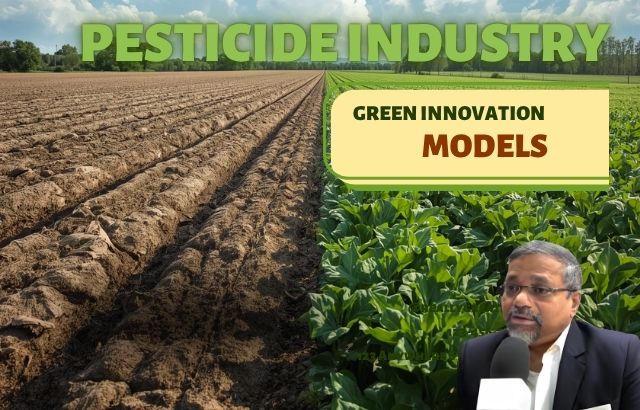
A few years ago, during an international agricultural sustainability project, I met a farmer who proudly showed me two neighboring fields.
The first field looked healthy—but beneath the surface, years of intensive chemical pesticide use had reduced soil biodiversity. Earthworms were scarce. Beneficial insects had nearly disappeared.
The second field told a different story.
The farmer had gradually adopted biological crop protection, integrated pest management, and waste-reduction practices. The soil felt alive. Pollinators moved freely between flowering plants. Input costs were lower, and crop quality had improved.
His words stayed with me:
“I stopped fighting nature and started working with it.”
This moment captures the essence of the Green Innovation Model in the pesticide industry. It is not about replacing chemicals alone—it is about redesigning the entire crop protection system.
Why Green Innovation Matters More Than Ever
Global Pressure on Agriculture Systems
Agrifood systems account for roughly one-third of global greenhouse gas emissions, placing agriculture at the center of climate action strategies.
At the same time, the biopesticides market is estimated at around USD 8.4–8.9 billion in 2025, with strong double-digit growth expected as sustainability regulations tighten and consumer demand increases.
Key Drivers Behind the Shift
- Rising pesticide resistance in major crops
- Global demand for residue-free food
- Export restrictions on chemical residues
- Climate change impacts on pest behavior
- Increasing soil degradation concerns
Green innovation is no longer optional—it is becoming a survival strategy for the industry.
Understanding the Green Innovation Model
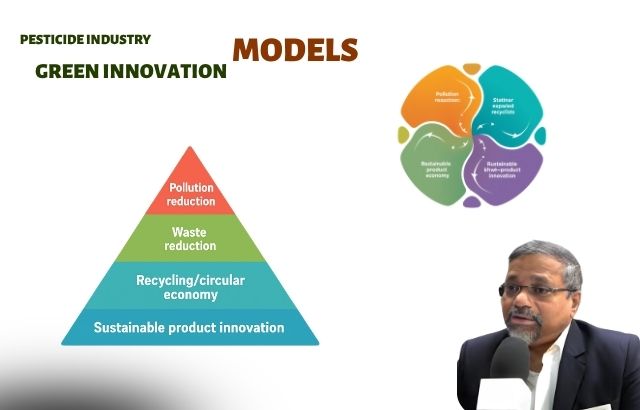
The Four Core Innovation Pathways in the Pesticide Industry
Pollution-Reduction Innovation
Reducing toxicity, emissions, and environmental contamination through safer formulations and improved chemistry.
Waste-Reduction Innovation
Minimizing waste in manufacturing, packaging, logistics, and field application processes.
Recycling and Circular Innovation
Reusing production by-products, recovering solvents, and converting agricultural waste into inputs for new value chains.
Sustainable Product Innovation
Developing biopesticides, microbial solutions, botanical extracts, and precision pest-control systems.
Integration Over Isolation
The most advanced organizations do not adopt these models separately—they integrate all four into a single green transformation strategy.
The Insight Most Blogs Ignore
The Hidden Role of Biological Intelligence
Most sustainability discussions focus on reducing pesticide use.
However, the deeper transformation lies in restoring ecological intelligence.
- Beneficial fungi naturally suppress pathogens
- Predatory insects regulate pest populations
- Healthy soil microbiomes strengthen plant immunity
When ecosystems function properly, pest outbreaks reduce naturally.
The Real Innovation
The most sustainable pesticide strategy is not always a product—it is a restored ecosystem.
Real-World Case Studies of Green Innovation
Case Study 1: Microbial Biopesticide Expansion
Microbial biopesticides have become one of the fastest-growing segments in crop protection.
Key outcomes observed globally
- Reduced chemical residue levels
- Improved soil microbial activity
- Lower resistance development in pests
- Better compliance with export standards
Case Study 2: Integrated Pest Management Adoption
Integrated Pest Management (IPM) combines biological control, monitoring systems, and selective chemical use.
Results in real farming systems
- Reduced pesticide frequency
- Stable or improved yields
- Lower input costs
- Improved environmental balance
Case Study 3: Precision Agriculture Applications
Precision spraying technologies and drone-based monitoring allow targeted pesticide application.
Benefits include
- Reduced chemical overuse
- Lower operational costs
- Minimal environmental drift
- Higher application efficiency
A Simple Green Innovation Calculation
Cost Savings Example
A farm of 100 hectares spends:
- ₹4,500 per hectare annually
- Total cost = ₹450,000
If green innovation reduces pesticide use by 25%:
Annual savings
₹112,500
Five-year savings
₹562,500
Carbon Reduction Example
If improved practices reduce diesel use by 10 liters per hectare annually:
- 100 hectares × 10 liters = 1,000 liters saved
- Diesel emission factor = 2.68 kg CO₂ per liter
Annual carbon reduction
2,680 kg CO₂ (2.68 tonnes)
Expert Insights
Jaiguru Kadam Perspective
“The future of crop protection is not about stronger chemicals. It is about smarter ecosystems.”
“Green innovation succeeds only when nature and economics move in the same direction.”
“The next generation of leaders in agriculture will be those who understand biology as deeply as chemistry.”
Did You Know?
Did You Know #1
The global biopesticides market is now valued at over USD 8 billion and continues to grow rapidly.
Did You Know #2
Agriculture contributes nearly one-third of global greenhouse gas emissions.
Did You Know #3
Soil microbes play a critical role in natural plant defense systems.
Did You Know #4
Precision agriculture can significantly reduce pesticide application without affecting yields.
Did You Know #5
Many pests are becoming resistant to conventional pesticides faster than new chemicals are being developed.
Frequently Asked Questions
What is the Green Innovation Model in pesticides?
It is a framework that integrates sustainability, efficiency, and innovation across pesticide development and usage.
Are biopesticides replacing chemical pesticides?
Not entirely. They are increasingly used alongside conventional methods in integrated systems.
Why is green innovation important now?
Due to climate pressure, regulatory changes, and rising resistance in pest populations.
Does green innovation reduce profitability?
No. It often reduces long-term costs and improves efficiency.
How does it benefit farmers?
It reduces input costs, improves soil health, and supports long-term productivity.
What role does technology play?
Technology enables precision application, monitoring, and data-driven pest management.
Actionable Steps for Industry Transformation
For Pesticide Manufacturers
- Expand biological product portfolios
- Invest in low-toxicity formulations
- Develop circular manufacturing systems
For Farmers
- Adopt integrated pest management practices
- Use monitoring before spraying
- Combine biological and chemical solutions strategically
For Policymakers
- Incentivize sustainable pesticide innovation
- Support farmer training programs
- Strengthen environmental regulations
For Researchers
- Improve microbial formulation stability
- Enhance biopesticide effectiveness
- Study ecosystem-based pest control systems
A Green Future Perspective
The Next Era of Crop Protection
The pesticide industry is shifting from chemical dominance to ecological intelligence.
The winners of the future will not be defined by volume alone, but by value created for both farmers and ecosystems.
Green innovation is no longer a concept—it is the foundation of modern agriculture.
The Real Question Ahead
It is not whether the industry will change.
It is who will lead that change.
The Vision Ahead
A future where agriculture is not extractive but regenerative.
A future where pest control supports biodiversity instead of harming it.
A future where productivity and sustainability are not competing goals—but unified outcomes.