Productivity Without Distractions
By Green Innovator & Subject Matter Specialist Jaiguru Kadam (with vast international experience)
Introduction
In a world driven by constant notifications, multitasking myths, and digital overload, true productivity has become less about doing more—and more about doing what matters, without distraction. As a subject matter specialist with extensive international experience, Jaiguru Kadam emphasizes that sustainable productivity is rooted in clarity, focus, and intentional work habits.
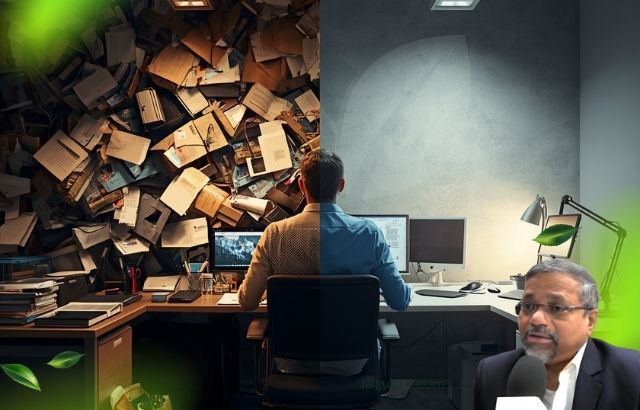
The Cost of Distraction

Distractions are not just minor interruptions—they carry measurable costs:
- Studies suggest it takes ~23 minutes to regain full focus after a distraction.
- The average professional checks their phone 96 times per day (once every ~10 minutes).
- Multitasking can reduce productivity by up to 40%.
Quick Calculation Example
If you get distracted 10 times a day:
- 10 distractions × 23 minutes = 230 minutes lost daily (~3.8 hours)
- Over 5 workdays = 19 hours/week lost
That’s nearly half a workweek gone to distractions.
What Does “Distraction-Free Productivity” Mean?

It doesn’t mean eliminating all interruptions—it means designing your environment and habits so that deep work becomes the default.
Practical Strategies to Stay Focused
1. Time Blocking
Allocate specific time slots for tasks.
Example:
- 9:00–11:00 → Deep work (no phone, no email)
- 11:00–11:30 → Emails & communication
This prevents constant task-switching.
2. The 90-Minute Focus Rule
Human brains operate in cycles. Work deeply for 90 minutes, then take a 10–15 minute break.
Example:
A software developer completes more code in two focused 90-minute sessions than in an entire distracted 8-hour day.
3. Digital Minimalism
Reduce unnecessary digital noise:
- Turn off non-essential notifications
- Use website blockers during work hours
- Keep only essential apps visible
4. The 2-Minute Rule
If a task takes less than 2 minutes—do it immediately.
If it takes longer—schedule it.
This avoids mental clutter.
5. Environment Design
Your workspace shapes your behavior.
Example:
- A clean desk = fewer visual distractions
- Noise-cancelling headphones = deeper concentration
- Dedicated workspace = psychological readiness to work
Real-Life Example

Case: Marketing Manager
Before applying focus techniques:
- Worked 9 hours/day
- Actual productive time: ~4 hours
After implementing time blocking and distraction control:
- Worked 7 hours/day
- Productive time: ~6 hours
Productivity Gain Calculation
- Before: 4 productive hours
- After: 6 productive hours
- Increase = 50% improvement
The Role of Energy, Not Just Time
Jaiguru Kadam highlights that productivity is not just about managing time—it’s about managing energy.
Key Factors:
- Sleep (7–8 hours improves focus significantly)
- Nutrition (stable blood sugar = stable attention)
- Movement (short walks boost cognitive clarity)
Interesting Statistics
- Deep work can improve output quality by up to 3x
- Employees lose ~2.1 hours/day to distractions
- 80% of results often come from just 20% of focused effort (Pareto Principle)
- People who plan their day are 30% more productive
Common Productivity Mistakes
- ❌ Multitasking instead of prioritizing
- ❌ Checking emails constantly
- ❌ Working without clear goals
- ❌ Ignoring mental fatigue
FAQs
1. Is multitasking ever effective?
No, most research shows multitasking reduces efficiency and increases errors. Sequential focus is far more effective.
2. How can I reduce phone distractions?
- Keep your phone in another room
- Use “Do Not Disturb” mode
- Check it only during scheduled breaks
3. What is the best length for focused work?
Typically 60–90 minutes, depending on the task and individual capacity.
4. Can breaks improve productivity?
Yes. Short breaks help reset attention and prevent burnout, leading to better long-term performance.
5. How do I start if I’m constantly distracted?
Start small:
- 25 minutes of focused work (Pomodoro technique)
- Gradually increase duration as your focus improves
Final Thoughts

Productivity without distractions is not about rigid discipline—it’s about intentional design of your time, environment, and habits. As emphasized by Jaiguru Kadam, sustainable productivity is achieved when focus becomes effortless, not forced.
By reducing distractions, even modestly, you can reclaim hours of your day—and transform both the quality and quantity of your output.
Author:
Jaiguru Kadam
Green Innovator & Subject Matter Specialist with vast international experience
Focused on sustainable productivity, efficiency systems, and human-centered innovation.