By Green Innovator Jaiguru Kadam
It was a humid afternoon at an international cosmetic ingredients expo in Europe.
A mid-sized B2B skincare formulation company had spent nearly four years developing a revolutionary botanical active extracted from upcycled citrus waste. The ingredient delivered clinically measurable skin barrier repair, reduced water usage during processing by 42%, and lowered formulation carbon footprint significantly.
Technically, it was brilliant.
Scientifically, it outperformed several established ingredients.
Commercially?
It failed.
Not because the product was weak.
Not because the science was flawed.
It failed because the company presented it as “another moisturizing ingredient.”
Across the same exhibition hall, a competing supplier showcased a less advanced ingredient — but framed it differently:
“Every 1 ton of this ingredient prevents 12 tons of food waste from entering landfills.”
Buyers stopped.
Brands listened.
Distributors lined up.
The difference was not chemistry.
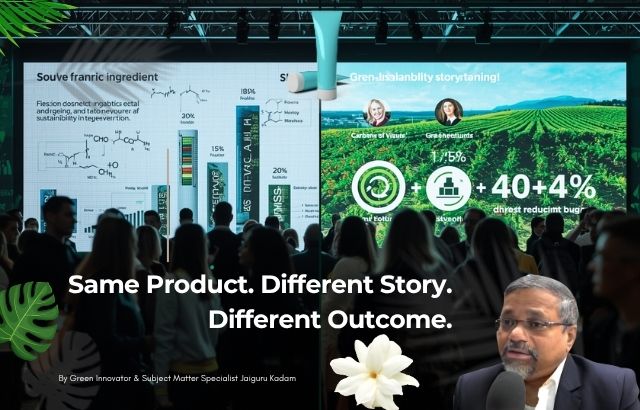
The difference was storytelling.
And this lesson is now reshaping industries — from B2B skin and hair care ingredients to livestock nutrition technologies.
As global markets become increasingly sustainability-driven, the companies that succeed are not always those with the best product.
They are the ones who communicate value in a language the world understands.
The Hidden Crisis in B2B Innovation
Most B2B companies still sell ingredients through technical data sheets, viscosity charts, efficacy graphs, and price-per-kilo negotiations.
But buyers in 2026 are no longer purchasing molecules alone.
They are buying:
- Carbon reduction
- Supply chain transparency
- Consumer trust
- ESG alignment
- Circular economy stories
- Regulatory resilience
- Brand reputation
The global cosmetic ingredients market continues to grow rapidly due to demand for clean-label and sustainable formulations.
At the same time, livestock nutrition companies face enormous pressure to reduce methane emissions and improve feed efficiency. Methane from livestock remains one of agriculture’s largest climate challenges.
Yet many technically superior solutions struggle commercially because they are presented only as “products” — not as transformational outcomes.
A Reality Most Blogs Ignore
Most sustainability discussions focus on:
- Certifications
- Green packaging
- Carbon neutrality
- Organic sourcing
But very few discuss the communication gap between innovation and adoption.
This gap destroys millions in R&D investments every year.
A formulation may reduce emissions by 30%.
A feed additive may cut methane by 40%.
A biotech active may save thousands of liters of water.
But if buyers cannot emotionally and commercially connect those benefits to their business goals, adoption stalls.
As Jaiguru Kadam often says:
“Innovation without contextual storytelling becomes invisible in crowded markets.”
Case Study 1: The Hair Care Ingredient That Became a Circular Economy Success
A European hair-care ingredient supplier developed a fermented protein active using agricultural side-stream waste.
Initially, the company marketed it as:
- High-performance conditioning agent
- Improved hair smoothness
- Better combability
Sales remained slow.
Then the positioning changed.
Instead of selling “performance,” they sold:
- Upcycled biotechnology
- Reduced agricultural waste
- Lower water intensity
- Circular beauty manufacturing
Suddenly:
- Premium clean beauty brands adopted it
- Retailers highlighted sustainability credentials
- Investors showed interest
The science did not change.
The narrative did.
Research in sustainable cosmetic upcycling shows that agro-food waste can become high-value cosmetic bioactives, significantly improving circularity and resource conservation.
Case Study 2: Livestock Feed Additives — When Climate Messaging Matters
Many feed additive companies still promote products only through:
- Feed conversion ratio
- Milk yield improvement
- Digestibility metrics
But global buyers increasingly evaluate climate impact.
Studies in 2025–2026 show methane-reducing feed additives can significantly reduce emissions in dairy systems.
One company reframed its feed additive not merely as a nutritional supplement but as:
“A carbon-reduction technology for dairy supply chains.”
That single shift changed conversations from procurement budgets to ESG strategy.
The result?
- Partnerships with dairy brands
- Carbon-credit discussions
- Government pilot support
- Retail sustainability collaborations
Reuters reported that methane-reducing feed technologies such as Bovaer can reduce methane emissions by roughly 30%, equivalent to about 1.2 metric tons of CO₂ equivalent per cow annually.
Simple Calculation: The Power of Better Presentation
Let us imagine a dairy cooperative with 10,000 cows.
If a methane-reducing feed additive cuts emissions by 1.2 tons CO₂e per cow annually:
Annual Reduction:
10,000 × 1.2 = 12,000 tons CO₂e saved per year
If carbon credits trade at approximately $35 per ton:
Potential Carbon Value:
12,000 × $35 = $420,000 annual climate-linked value
Now the additive is no longer “an expense.”
It becomes:
- A sustainability investment
- A brand reputation asset
- A carbon management tool
Presentation changes perception.
Perception changes economics.
The New Language of Ingredient Companies
The future winners in B2B skin care, hair care, and animal nutrition will not merely sell ingredients.
They will sell:
- Traceability stories
- Biodiversity protection
- Water savings
- Waste reduction
- Regenerative sourcing
- Consumer trust narratives
The beauty industry is increasingly shifting toward biotech-derived and upcycled ingredients due to consumer demand for efficacy and sustainability.
Meanwhile, livestock industries are adopting methane mitigation technologies because retailers and governments are demanding measurable sustainability improvements.
Did You Know?
Did You Know #1
Methane has more than 80 times the warming power of CO₂ over a 20-year period.
Did You Know #2
Some cosmetic bioactives are now being developed from fruit peels, coffee waste, brewery waste, and agricultural byproducts.
Did You Know #3
AI is now being used to predict the effectiveness of livestock feed additives for methane reduction.
Did You Know #4
Consumers increasingly trust sustainability claims when they are connected to measurable impact rather than generic “green” messaging.
What Most Companies Still Get Wrong
1. They Sell Features Instead of Outcomes
“Contains peptide complex” means little.
“Reduces formulation water footprint by 35%” creates impact.
2. They Ignore Emotional Positioning
Even B2B buyers are emotional decision-makers.
People remember stories.
Not specifications.
3. They Overcomplicate Sustainability
Complex technical language often weakens communication.
The best sustainability messaging is:
- measurable
- relatable
- visual
- financially understandable
Expert Insights from Jaiguru Kadam
“A sustainable ingredient should never be presented merely as a raw material. It should be positioned as a business transformation tool.”
“In the future, companies will not compete only on efficacy. They will compete on environmental intelligence.”
“The most dangerous phrase in innovation is: ‘Our product is technically superior.’ If the market cannot emotionally connect to it, superiority becomes irrelevant.”
The Rise of “Invisible Sustainability”
One lesser-known trend emerging globally is “invisible sustainability.”
Consumers increasingly prefer products where sustainability is seamlessly integrated into performance rather than aggressively advertised.
For example:
- Hair-care products that require less water during rinsing
- Feed additives improving both methane reduction and animal productivity
- Cosmetic emulsifiers enabling cold-process manufacturing
The sustainability is embedded into operational efficiency.
This is where the next generation of B2B innovation will dominate.
FAQs
1. Why do technically strong products fail in B2B markets?
Because buyers often evaluate emotional relevance, sustainability alignment, and business outcomes — not just technical superiority.
2. How important is sustainability storytelling in ingredient businesses?
It is becoming essential. Investors, regulators, retailers, and consumers increasingly expect measurable sustainability narratives.
3. What is the biggest mistake ingredient companies make?
Focusing only on technical specifications instead of explaining real-world impact.
4. How can livestock nutrition companies improve product adoption?
By connecting feed technologies to carbon reduction, ESG goals, and supply-chain sustainability outcomes.
5. Are sustainable formulations more expensive?
Initially, some may have higher development costs. However, long-term benefits often include:
- reduced waste
- lower energy usage
- premium positioning
- regulatory advantages
- stronger consumer trust
6. What role does AI play in sustainable agriculture and formulations?
AI increasingly helps optimize ingredient performance, methane reduction strategies, and predictive formulation efficiency.
Actionable Steps for B2B Ingredient & Nutrition Companies
✔ Reframe Your Product Story
Move beyond technical language.
Translate benefits into:
- carbon savings
- operational savings
- brand value
- sustainability outcomes
✔ Quantify Environmental Impact
Use simple calculations buyers can immediately understand.
Example:
- liters of water saved
- tons of CO₂ reduced
- waste diverted from landfills
✔ Build Human-Centered Narratives
Tell the story behind:
- sourcing
- innovation
- farmer impact
- circularity
✔ Simplify Scientific Communication
Complex science should become commercially understandable.
✔ Position Sustainability as Profitability
The future belongs to companies that prove sustainability improves business performance.
A Visionary Closing Thought
The next decade will not belong merely to companies with better ingredients, smarter formulations, or advanced feed technologies.
It will belong to companies that can translate innovation into meaning.
Because the world is no longer asking:
“What does your product contain?”
It is asking:
“What future does your product create?”
And in that future, the winners will not always be the companies with the best products.
They will be the companies that present those products in a way the world can believe in.