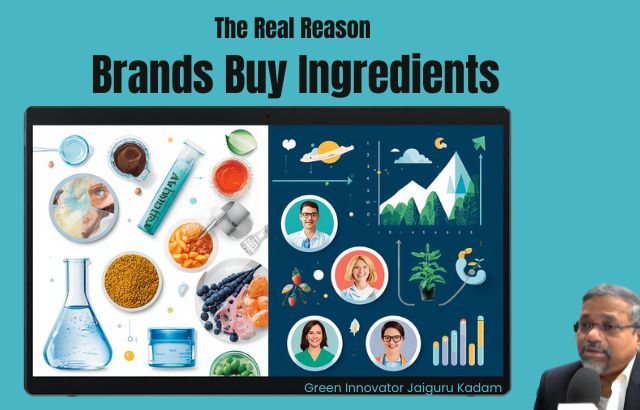
By Subject Matter Specialist Jaiguru Kadam
Green Innovator | International Personal Care Industry Expert | Strategic Growth Advisor
Introduction
Many ingredient suppliers believe they are selling ingredients, formulations, actives, preservatives, or technical specifications.
In reality, personal care manufacturers are buying something far more valuable.
They are investing in product success, market growth, consumer trust, and competitive advantage.
This distinction separates commodity suppliers from strategic partners.
Having worked with personal care companies, ingredient manufacturers, and innovation-driven organizations across international markets, I have observed a consistent pattern:
The most successful ingredient suppliers don’t sell ingredients—they sell business outcomes.
What Manufacturers Say They Buy vs. What They Actually Buy
| They Don’t Buy | They Buy |
|---|---|
| Ingredients | Product Success |
| Formulations | Faster Commercialization |
| Actives | Stronger Consumer Claims |
| Preservatives | Brand Protection |
| Emollients | Customer Satisfaction |
| Technical Data | Decision Confidence |
| Certifications | Market Access |
| Innovation | Competitive Advantage |
| R&D Support | Reduced Risk |
| Raw Materials | Business Growth |
The Strategic Perspective
Traditional Supplier Message
“We manufacture high-performance personal care ingredients.”
While technically accurate, this statement focuses on the supplier.
Strategic Business Message
“We help personal care brands launch differentiated products faster, reduce formulation risk, strengthen consumer trust, achieve regulatory compliance, and improve profitability.”
This message focuses on what the customer actually wants.
The difference is profound.
One discusses products.
The other discusses outcomes.
Example 1: Selling a Natural Preservative
Commodity Approach
“Our preservative system is broad-spectrum and ECOCERT compliant.”
Strategic Approach
“Our preservative system helps brands achieve clean-label positioning, reduce product recalls, meet retailer requirements, and strengthen consumer trust.”
Which message will resonate more with a brand owner?
The second one.
Because product recalls can cost hundreds of thousands of dollars while consumer trust can take years to rebuild.
Example 2: Selling an Active Ingredient
Commodity Approach
“Our botanical extract contains 95% active compounds.”
Strategic Approach
“Our clinically supported botanical active enables stronger anti-aging claims, improves product differentiation, and helps brands command premium pricing.”
The manufacturer isn’t interested in 95% purity alone.
They are interested in whether the ingredient helps sell more products.
Example 3: Selling a Moisturizing Ingredient
Commodity Approach
“Provides excellent skin hydration.”
Strategic Approach
“Helps improve consumer satisfaction, increases repeat purchases, and enhances brand loyalty.”
Consumer loyalty is the ultimate goal.
Hydration is merely the mechanism.
The Business Case: Simple Financial Calculations
Scenario A: Faster Product Launch
A cosmetic brand launches a new product 3 months earlier because of superior formulation support.
Monthly Sales Potential
Monthly revenue = ₹20,00,000
Additional market time = 3 months
Additional revenue:
₹20,00,000 × 3
= ₹60,00,000
Business Impact
The supplier did not merely provide ingredients.
They helped create ₹60 lakh of additional revenue opportunity.
Scenario B: Improved Consumer Retention
Brand annual customers = 10,000
Average annual spend per customer = ₹3,000
Current retention rate = 60%
Improved retention rate = 70%
Additional retained customers:
10,000 × 10%
= 1,000 customers
Additional annual revenue:
1,000 × ₹3,000
= ₹30,00,000
A better-performing ingredient can generate millions in additional sales through customer satisfaction alone.
Scenario C: Reduced Product Failure Risk
Development cost of a failed product:
- R&D expenses: ₹10 lakh
- Testing expenses: ₹5 lakh
- Packaging inventory: ₹8 lakh
- Marketing investment: ₹12 lakh
Total potential loss:
₹35 lakh
If a supplier’s technical support reduces failure probability significantly, the value delivered far exceeds the ingredient price.
Why Strategic Suppliers Win
Manufacturers increasingly seek partners who can help them:
Launch Faster
Speed-to-market often determines market leadership.
Reduce Risk
Formulation failures, instability issues, and regulatory setbacks are expensive.
Build Stronger Claims
Consumers purchase benefits, not ingredient lists.
Improve Brand Reputation
Trust has become a competitive asset.
Increase Profitability
Every business decision ultimately connects to financial performance.
The Future of Ingredient Selling

The personal care industry is evolving.
Customers no longer need another ingredient supplier.
They need:
- Innovation partners
- Market intelligence providers
- Regulatory support experts
- Sustainability advisors
- Commercialization accelerators
The companies that understand this shift will capture greater market share and create stronger customer relationships.
Lessons for Ingredient Manufacturers
Instead of saying:
“We sell ingredients.”
Say:
“We help brands succeed.”
Instead of saying:
“Our ingredient improves skin hydration.”
Say:
“Our solution increases consumer satisfaction and repeat purchases.”
Instead of saying:
“We offer formulation support.”
Say:
“We help customers launch products faster with lower development risk.”
The language changes.
The value perception changes.
The business results change.
Frequently Asked Questions (FAQs)
Q1. Why should ingredient suppliers focus on business outcomes?
Because customers make purchasing decisions based on commercial impact, not technical specifications alone. Outcomes create stronger differentiation and higher perceived value.
Q2. Do technical specifications still matter?
Absolutely. Technical performance is essential. However, it should be translated into customer benefits and business results.
Q3. How can ingredient suppliers become strategic partners?
By providing:
- Formulation expertise
- Regulatory guidance
- Market trend insights
- Consumer research support
- Sustainability solutions
- Commercialization assistance
Q4. What is the biggest mistake suppliers make?
Focusing exclusively on ingredient features rather than explaining how those features create measurable business value.
Q5. How does sustainability contribute to business growth?
Sustainable solutions improve brand reputation, attract environmentally conscious consumers, support regulatory compliance, and open access to premium markets.
Final Thought

Personal care manufacturers may issue purchase orders for ingredients, but what they are truly investing in is market success.
The suppliers who understand this reality move beyond transactional selling and become indispensable growth partners.
In today’s competitive global marketplace, ingredients are no longer enough.
The real product is confidence.
The real value is growth.
And the real opportunity lies in helping customers win.
— Jaiguru Kadam
Green Innovator | Subject Matter Specialist | International Personal Care Industry Expert | Strategic Business Transformation Advisor