By Jaiguru Kadam, Green Innovator & Subject Matter Specialist
A healthy home is not simply a place where people and pets live together. It is an ecosystem in which human wellbeing, animal welfare, environmental responsibility, cleanliness, nutrition and emotional connection work together.
As a Green Innovator and subject matter specialist with vast international experience, I view pet-friendly living through a broader lens: a healthier pet home should also be a healthier human home and a more sustainable home.
Today, pets are increasingly considered members of the family. This emotional transformation is positive, but it also creates new responsibilities. Feeding, exercise, waste management, indoor air quality, veterinary care, cleaning products, water consumption, energy use and household routines all influence the wellbeing of both people and animals.
The goal is therefore not merely to “pet-proof” a home. The goal is to create pet-family harmony.
Why Pet-Friendly Homes Matter More Than Ever
India’s pet population has grown significantly in recent years. Recent industry estimates place India’s pet population at approximately 39.2 million in 2025, compared with around 28.5 million in 2020.
This represents an increase of approximately:
39.2 million − 28.5 million = 10.7 million additional pets
The interpretation is important: millions of additional animals are becoming part of households, creating a greater need for responsible nutrition, preventive healthcare, exercise, sanitation, waste management and environmentally conscious pet-care practices.
Dog-owning households have also increased substantially, while cat ownership is growing at a particularly dynamic rate in urban India.
The broader message is clear: pet-family harmony is no longer a niche lifestyle topic. It is becoming an important dimension of modern household wellbeing.
The Green Innovator’s View: Think of the Home as an Ecosystem
A Green Innovator does not look at pet care as a collection of isolated activities.
Instead, I use a simple framework:
Healthy Pet + Healthy People + Healthy Home + Healthy Planet = Pet Family Harmony
Each component affects the others.
For example, excessive use of harsh cleaning chemicals may create a visually clean floor but introduce unnecessary chemical exposure. Conversely, inadequate cleaning can increase odour, allergens and hygiene concerns.
The sustainable solution is to ask five questions:
- Is it safe for the pet?
- Is it safe for people?
- Is it environmentally responsible?
- Is it affordable enough to maintain consistently?
- Can the household realistically follow the practice every day?
The best solution is usually not the most expensive one. It is the one that can be safely and consistently implemented.
Designing a Healthier Pet-Friendly Home
1. Create Safe Zones
Every pet should have a designated resting area where it can retreat without disturbance.
For dogs, this could be a washable bed or quiet corner. For cats, it could include an elevated resting platform or enclosed hiding area.
Consider a family living in an apartment with two children and one dog.
Instead of allowing the dog to sleep, eat and play everywhere, the family can establish:
- A sleeping zone
- A feeding zone
- A toy and play zone
- A grooming and cleaning area
- A quiet retreat
This reduces household confusion and helps establish predictable routines for both the family and the animal.
2. Improve Indoor Air Quality
Pets contribute to household dust, dander and odours. People may also introduce fragrances, cleaning chemicals and aerosols into the indoor environment.
A healthier approach includes:
- Regular ventilation
- Frequent washing of pet bedding
- Regular cleaning of floors and commonly used areas
- Avoiding unnecessary fragrance sprays
- Maintaining ventilation in kitchens and bathrooms
- Cleaning food and water bowls regularly
- Keeping litter areas appropriately ventilated
My Green Innovator principle is simple:
Do not mask a problem when you can remove its source.
If a room smells because pet bedding has accumulated odour, spraying air freshener is not the sustainable solution. Washing the bedding and improving ventilation addresses the underlying cause.
Nutrition: Where Human Habits Can Accidentally Harm Pets
One of the common sources of household imbalance is feeding.
Pet owners often express affection through food. A small piece of food from breakfast, a biscuit in the afternoon and a treat at night may appear insignificant.
But small quantities accumulate.
The Treat Calculation
Suppose a dog receives three additional treats per day, with each treat containing approximately 30 calories.
3 × 30 = 90 extra calories per day
Over 30 days:
90 × 30 = 2,700 additional calories
This does not mean those calories automatically translate into a specific amount of weight gain. Animal metabolism, activity, existing diet and health status all matter.
However, the calculation demonstrates why seemingly minor daily habits deserve attention.
Pet nutrition should be appropriate to the animal’s species, age, size, health status and activity level. Significant dietary changes should be discussed with a qualified veterinarian.
Exercise Is a Family Activity
A sustainable pet routine should ideally benefit humans and animals simultaneously.
Instead of thinking:
“I have to exercise my dog.”
Think:
“Our family has an opportunity to move together.”
A 30-minute evening walk can provide:
- Physical activity for the dog
- Movement for the owner
- Outdoor exposure
- Mental stimulation
- Family interaction
- Reduced screen time
A Weekly Activity Calculation
If a family walks with its dog for 30 minutes on five days per week:
30 × 5 = 150 minutes per week
That equals 2.5 hours of shared movement every week.
The precise health benefit depends on the individual’s condition and the intensity and type of activity. Nevertheless, the behavioural benefit is valuable: the pet’s routine becomes an anchor for the family’s routine.
Water: A Small Household Resource With a Large Collective Impact
Clean drinking water is essential for pets. However, water can be wasted during cleaning activities.
Consider an illustrative household scenario in which a tap delivers approximately 6 litres of water per minute and is unnecessarily left running for two minutes while washing pet bowls.
2 × 6 = 12 litres per cleaning session
If this happens once every day:
12 × 365 = 4,380 litres per year
This is an illustration because actual tap flow rates vary.
The Green Innovator solution is straightforward: use a basin or controlled-flow tap, remove food residue before washing and avoid continuously running water when it is unnecessary.
The objective is not to compromise hygiene. It is to achieve the same hygiene outcome with less resource waste.
Sustainable Pet Waste Management
Pet waste is both a sanitation issue and an environmental responsibility.
Responsible management means:
- Picking up pet waste promptly
- Using appropriate disposal methods
- Keeping waste bags accessible
- Never leaving animal waste in public areas
- Following local waste-disposal requirements
- Keeping litter systems clean
- Avoiding flushing animal waste or litter unless explicitly permitted by the product and local wastewater guidance
The Three-Step Waste Framework
Reduce → Reuse → Responsibly Dispose
For example, durable washable feeding mats can reduce reliance on disposable alternatives. Reusable grooming towels can reduce frequent use of disposable wipes.
The Green Innovator objective is not “zero waste at any cost.” It is lower-impact living without compromising animal welfare or household hygiene.
Cleaning Without Creating a Chemical Problem
Pet families frequently clean floors, bedding, toys, bowls and litter areas.
More cleaning does not necessarily mean better cleaning.
The Right Cleaning Framework
Right product + Right concentration + Right frequency + Right storage
Cleaning products should be selected and used according to their labels and appropriate professional guidance. Products that are unsafe for animals should always be kept securely away from pets.
Consider a family that cleans its floor twice every day using strongly fragranced products because it wants the house to smell fresh.
A better approach may be to:
- Identify the source of the odour
- Clean the source
- Increase ventilation
- Wash pet bedding regularly
- Use appropriate pet-safe cleaning methods
- Reduce unnecessary fragrance products
This approach can potentially reduce unnecessary chemical use, household expense and fragrance exposure while maintaining appropriate cleanliness.
Pets and Human Emotional Wellbeing
The human-animal relationship is another important part of pet-family harmony.
Recent surveys of pet owners continue to show strong perceived emotional benefits associated with pet companionship. One 2025 survey reported that 95% of participating dog and cat owners said their pets improved their mental health daily.
This is self-reported survey information rather than clinical evidence applicable to every person. Nevertheless, it illustrates the powerful emotional role pets can play in many households.
Pets can provide companionship, structure, affection, responsibility and opportunities for physical activity.
As a Green Innovator, I believe this emotional dimension should not be separated from sustainability.
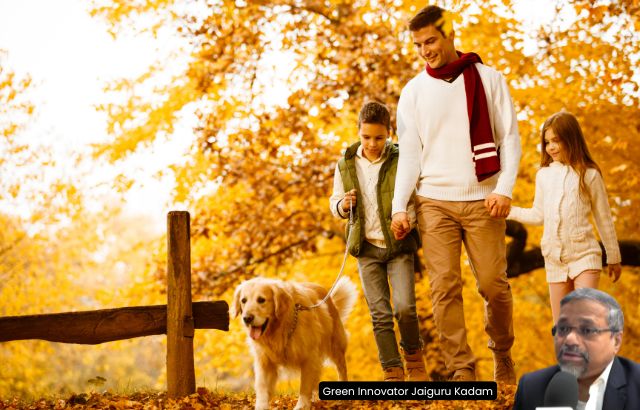
A walk with a dog can simultaneously support companionship, exercise, outdoor time and reduced screen exposure.
That is multi-benefit living.
Case Insight: The Busy Urban Family
Consider a hypothetical family living in a metropolitan apartment.
They have two working adults, one child and one dog.
Initially, their routine looks like this:
- The dog receives irregular exercise.
- Food is provided whenever someone thinks the dog appears hungry.
- Treats are frequently shared.
- The dog’s bedding is cleaned irregularly.
- Plastic waste accumulates around pet supplies.
- One family member performs most pet-care responsibilities.
The family introduces a simple Pet Harmony Plan.
Morning
Fresh water, measured food and a short movement session.
Afternoon
A family member checks the pet’s environment, water supply and ventilation.
Evening
A 30-minute family walk.
Weekly
Bedding and washable items are cleaned, supplies are reviewed and household pet waste is managed responsibly.
Monthly
The family reviews food usage, veterinary requirements, recurring expenses and unnecessary purchases.
The transformation is not based on buying expensive products.
It is based on systems and habits.
The 5R Pet Harmony Framework
I recommend a simple five-part framework for households.
Respect
Understand the animal’s species-specific needs instead of treating a pet exactly like a human.
Routine
Maintain predictable feeding, exercise, sleep, enrichment and hygiene routines.
Reduce
Reduce unnecessary food, packaging, water, energy, chemicals and impulse purchases.
Reuse
Choose durable, washable and repairable products where safe and practical.
Review
Regularly assess behaviour, nutrition, hygiene, household costs and environmental impact.
This framework can be remembered as:
Respect + Routine + Reduce + Reuse + Review = Responsible Pet Family
The Economics of Sustainable Pet Care
Sustainability is often misunderstood as spending more money.
In reality, many sustainable practices can reduce long-term costs.
Imagine a household spends ₹1,200 every month on unnecessary impulse pet purchases.
Annual Spending Calculation
₹1,200 × 12 = ₹14,400 per year
If the family reduces unnecessary purchases by 25%:
₹14,400 × 25% = ₹3,600
The illustrative potential reduction is ₹3,600 per year.
The actual saving will depend on the household’s spending patterns.
The key principle is to distinguish between:
- Needs: Appropriate food, veterinary care, safety and basic supplies
- Useful upgrades: Durable, washable or genuinely functional products
- Impulse purchases: Items bought without a meaningful household or animal-welfare benefit
Green innovation begins by asking whether a purchase solves a real problem.
Latest Statistics: What the Numbers Tell Us
India Had Approximately 39.2 Million Pets in 2025
Recent industry estimates place India’s pet population at approximately 39.2 million in 2025, up from around 28.5 million in 2020.
Interpretation: The growth indicates that pet ownership is becoming increasingly integrated into Indian households. This makes responsible pet care, veterinary access, nutrition, sanitation and sustainable household practices increasingly important.
India’s Pet Population Could Reach More Than 60 Million by 2030
Recent industry projections indicate continued strong growth in India’s pet population through 2030.
Interpretation: Future urban planning will need to consider pet-friendly housing, responsible waste management, veterinary infrastructure, public spaces and community coexistence.
India’s Pet Care Market Is Expanding Rapidly
Recent market estimates indicate that India’s broader pet-care sector has become a multi-billion-dollar industry, with strong growth driven by urbanisation, pet humanisation, premium nutrition, veterinary care, e-commerce and professional services.
Interpretation: Rising expenditure can improve access to better products and services, but consumers should distinguish between genuine animal-welfare improvements and unnecessary consumption.
Cat Ownership Is Growing Dynamically
Recent industry estimates indicate that India’s cat population has grown rapidly over the past five years.
Interpretation: Pet-friendly housing and care systems should not be designed only around dogs. Cats have distinct nutritional, behavioural, enrichment, litter-management and environmental requirements.
A Practical Pet Family Scorecard
A household can conduct a simple monthly self-assessment.
| Area | 0 Points | 1 Point | 2 Points |
|---|---|---|---|
| Nutrition | Poorly managed | Partly managed | Consistent |
| Exercise | Irregular | Moderate | Routine |
| Hygiene | Poor | Adequate | Well managed |
| Waste | Frequently unmanaged | Sometimes managed | Responsible |
| Water Use | High waste | Moderate | Efficient |
| Family Connection | Limited | Moderate | Strong |
| Veterinary Care | Irregular | Periodic | Preventive |
| Sustainability | Little attention | Some actions | Integrated |
Score Interpretation
0–5: Immediate improvement is recommended.
6–11: A good foundation exists, with opportunities for improvement.
12–16: The household has a strong pet-family harmony system.
This scorecard is a household management framework and is not a veterinary assessment.
Technology Should Support Care—Not Replace It
Smart feeders, cameras, automated litter systems and tracking devices can be useful in modern pet households.
But technology should remain a tool.
My Green Innovator perspective is:
Use technology to improve informed caregiving, not to outsource the human-animal relationship.
A camera can tell an owner what a dog is doing while the owner is away. It cannot replace exercise, affection, training, enrichment or responsible supervision.
The same principle applies to environmental technology. Smart devices are valuable when they reduce waste, improve resource management or genuinely improve care—not simply because they are technologically impressive.
Building Pet-Friendly Communities
Pet harmony does not stop at the front door.
Apartment communities and neighbourhoods can improve coexistence through:
- Clearly communicated pet policies
- Responsible waste-disposal points
- Designated walking areas
- Safe green spaces
- Veterinary and emergency information
- Noise-management practices
- Community education
- Humane approaches to community animals
- Constructive conflict-resolution mechanisms
A successful pet-friendly community must consider both pet owners and people who do not own pets.
The objective is coexistence rather than entitlement.
A 30-Day Pet Family Harmony Challenge
Week 1: Observe
Track feeding, exercise, water use, cleaning, waste and household pet-related spending.
Do not change everything immediately. First understand the household.
Week 2: Simplify
Remove unnecessary purchases and establish consistent feeding, exercise, sleep and cleaning routines.
Week 3: Green the Routine
Introduce washable items, controlled water use, responsible waste practices and lower-impact purchasing where practical.
Week 4: Measure
Review:
- Food waste
- Treat frequency
- Water use
- Cleaning-product use
- Pet activity
- Household spending
- Family participation
The purpose is not perfection.
It is continuous improvement.
Frequently Asked Questions
Is a sustainable pet home more expensive?
Not necessarily. Sustainable choices can sometimes cost more initially but may reduce replacement purchases, waste and resource consumption over time.
The best approach is to evaluate total lifetime value, rather than looking only at the purchase price.
Should pets eat the same food as humans?
Not automatically. Some human foods can be inappropriate or dangerous for animals. Pet nutrition should be species-appropriate, and significant dietary changes should be discussed with a veterinarian.
How can I reduce pet-related plastic waste?
Start with simple measures such as choosing durable products, using washable accessories where appropriate, avoiding unnecessary purchases and selecting packaging-efficient options when they meet the pet’s needs.
Are natural cleaning products always safer for pets?
No. “Natural” does not automatically mean non-toxic or safe for animals. Pets can react to substances that humans tolerate. Always follow product instructions and seek professional veterinary guidance when appropriate.
How often should I exercise my pet?
There is no single answer for every animal. Breed, age, health, temperament and individual needs all matter. An appropriate exercise plan should be tailored to the individual pet.
Can pets improve human mental wellbeing?
Pets can provide companionship, routine, affection and emotional support, and many owners report positive effects. However, pet ownership should not be presented as a replacement for professional mental-health care when such care is needed.
Should every family adopt a pet?
No. Pet ownership should be based on the family’s time, finances, housing, lifestyle and ability to provide long-term care.
A pet is a responsibility that may last many years.
What is the single most important principle?
Consistency.
A modest routine followed every day is generally more useful than an elaborate pet-care system followed for one week and abandoned.
The Green Innovator’s Final Perspective
Pet-family harmony is ultimately about changing the way we think.
A pet is not a decorative possession.
A pet is not simply another consumer category.
A pet is a living member of a household ecosystem.
When we provide appropriate nutrition, exercise, enrichment, preventive care, clean surroundings and emotional security, we improve animal welfare.
When we create better routines, walk together, reduce unnecessary consumption and maintain healthier indoor environments, we can also support family wellbeing.
And when we reduce waste, conserve water, choose durable products and consume more thoughtfully, we extend that responsibility to the environment.
This is the central philosophy I advocate as a Green Innovator and Subject Matter Specialist with vast international experience:
Healthy People. Healthy Pets. Healthy Homes. Healthy Planet.
That is the real meaning of Pet Family Harmony.
About Jaiguru Kadam
Jaiguru Kadam is a Green Innovator and subject matter specialist with vast international experience, focusing on practical approaches that connect sustainability, responsible consumption, healthier living environments and innovative solutions.
His perspective emphasises solutions that are not only environmentally responsible but also practical, measurable and capable of creating long-term value for people, pets and communities.
This version is formatted for direct use in the WordPress Code/HTML editor and removes the source/citation section while preserving the article’s statistics, examples, calculations, frameworks and FAQs.