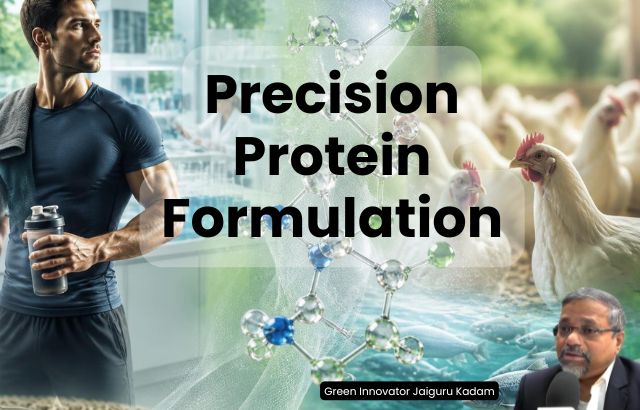
At first glance, an athlete preparing for competition and a broiler breeder optimizing a feed formula appear to have little in common.
One measures body weight, recovery, strength and muscle development. The other measures average daily gain, feed conversion ratio, mortality, carcass yield and production cost.
Yet both systems depend on the same biological principle:
The body can only build lean tissue when the right amino acids are available in the right amounts, at the right time, with sufficient energy to use them efficiently.
That is why protein should not be viewed simply as a number on a nutrition label.
For a human athlete, 144 grams of protein may represent a carefully calculated daily target. For a broiler, a seemingly small change in digestible lysine or methionine can influence growth performance, feed efficiency and nitrogen utilization across thousands or millions of birds.
This is where modern protein nutrition moves beyond “more protein.”
It becomes a question of precision.
Drawing on the practical perspective attributed to Jaiguru Kadam, Animal Feed & Supplement Product Design Consultant, this article examines how protein and amino-acid optimization can connect human performance nutrition with commercial poultry, livestock and aquaculture formulation.
The central lesson is simple:
Lean growth is not created by maximizing protein. It is created by maximizing the biological value of every gram of protein supplied.
Problem Overview
Protein is essential for tissue development, but crude protein percentage alone does not tell the complete story.
Protein provides amino acids for:
- Muscle and structural tissue synthesis
- Enzyme and hormone production
- Immune function
- Tissue repair
- Metabolic processes
- Nitrogen balance
However, amino acids are not interchangeable.
An animal may consume a diet containing adequate crude protein and still experience a deficiency of a limiting essential amino acid. FAO guidance has long emphasized that feed formulation should consider amino-acid composition and digestibility—not simply total protein. For monogastric animals, ileal digestibility of amino acids is particularly important.
The same principle applies, in a different nutritional framework, to human performance.
A resistance-trained athlete does not need unlimited protein. Protein intake must be considered alongside training stimulus, energy intake, amino-acid quality, meal distribution and recovery.
A major meta-analysis involving 49 studies and 1,863 participants found that protein supplementation enhanced gains in fat-free mass and strength during resistance training, with benefits plateauing at approximately 1.62 g/kg/day in the analyzed population.
The practical implication is powerful:
Protein quality and utilization can matter more than simply increasing protein quantity.
Latest Statistics

The scale of the feed industry demonstrates why precision protein formulation matters economically and environmentally.
Global feed production
Alltech’s 2025 Agri-Food Outlook estimated global commercial feed production at approximately 1.396 billion metric tonnes in 2024, an increase of 1.2% from the previous year.
Poultry accounted for approximately 42.7% of global feed tonnage, making it the largest feed-producing animal category.
The same survey estimated 2024 feed production at approximately:
- Asia-Pacific: 533.1 million tonnes
- Europe: 276.8 million tonnes
- North America: 290.7 million tonnes
- Latin America: 198.4 million tonnes
- Africa: 57.8 million tonnes
- Middle East: 37.7 million tonnes
- Oceania: 11.0 million tonnes
Aquaculture is accelerating
FAO’s 2026 State of World Fisheries and Aquaculture reports that global aquatic animal and algae production reached 235 million tonnes in 2024.
Aquaculture aquatic-animal production exceeded 100 million tonnes for the first time, reaching approximately 103 million tonnes and accounting for 53% of total aquatic-animal production.
Protein and the global food system
FAO’s latest food-balance data show that livestock products—meat, eggs and milk—represented approximately 36% of global protein supply in 2023. At the same time, approximately 35% of cereals and 24% of pulses were used as animal feed.
Environmental pressure
The sustainability equation is becoming equally important.
FAO’s latest emissions assessment estimates that agrifood systems generated 16.5 billion tonnes of CO₂-equivalent emissions in 2023, while livestock emissions alone accounted for approximately 4.3 billion tonnes CO₂-equivalent. Agricultural production’s global emissions intensity, however, has fallen by approximately 25% since 2001.
These figures demonstrate the strategic opportunity:
Better nutrition must produce more usable tissue with fewer wasted nutrients and fewer environmental externalities.
Hidden Insights
1. Crude protein is only the starting point
Consider two diets containing 20% crude protein.
They may perform very differently if their digestible lysine, methionine, threonine, tryptophan and other essential amino acids differ.
Crude protein is primarily an analytical measurement based on nitrogen. FAO explains that conventional crude-protein calculations commonly use nitrogen multiplied by 6.25.
Therefore:
20% crude protein ≠ 20% biologically available protein.
And:
20% crude protein ≠ adequate amino-acid balance.
2. The limiting amino acid can determine the value of the entire diet
If lysine is limiting, adding more of another amino acid does not necessarily solve the problem.
This is analogous to manufacturing: having an abundant supply of several raw materials does not compensate for a shortage of one critical component.
The formulation objective should therefore be:
Match digestible amino-acid supply to the animal’s biological requirement.
3. Protein efficiency is an economic metric
Protein is one of the most expensive components of many animal diets.
Over-formulation can increase:
- Feed cost
- Nitrogen excretion
- Manure nutrient loading
- Metabolic burden
- Environmental footprint
Under-formulation can reduce:
- Growth
- Feed efficiency
- Carcass yield
- Production consistency
- Economic return
The optimal formulation sits between those two extremes.
4. Energy and protein cannot be separated
Protein utilization depends on adequate energy.
If dietary energy is insufficient, amino acids may be diverted toward energy metabolism rather than being efficiently deposited as tissue.
Therefore, a sophisticated formulation considers:
Energy → amino acids → digestibility → tissue deposition → production output.
Business Impact Analysis
Precision protein formulation can influence an animal-production business through several interconnected levers.
Feed Cost
Replacing unnecessarily high levels of expensive protein ingredients with targeted amino-acid supplementation can reduce formulation cost when nutritional requirements remain satisfied.
Feed Conversion Ratio
If the same amount of feed produces more body-weight gain, FCR improves.
For example:
FCR = Feed consumed ÷ Weight gain
An improvement from 1.80 to 1.55 means:
1.80 − 1.55 = 0.25 kg less feed per kg of gain
That represents approximately:
0.25 ÷ 1.80 × 100 = 13.9% reduction
in feed required per unit of gain, assuming the comparison is made on the same basis.
Nitrogen Efficiency
Amino-acid precision can reduce the need to supply excess crude protein merely to meet a limiting amino-acid requirement.
The result can be a more efficient conversion of dietary nitrogen into animal tissue.
Product Differentiation
Feed companies can turn nutritional precision into commercial value through:
- Species-specific formulations
- Phase feeding
- Digestible amino-acid matrices
- Enzyme systems
- Probiotic technologies
- Functional amino-acid blends
- Low-protein precision diets
- Sustainable protein replacement strategies
Case Studies
Case Study 1: Human Performance
Consider an 80 kg resistance-trained athlete targeting 1.8 g protein/kg body weight.
80 × 1.8 = 144 g protein/day
The number provides a practical target, but the outcome still depends on total energy intake, training quality, protein distribution, food quality and individual circumstances.
Research suggests that approximately 1.6 g/kg/day is a useful evidence-based reference point for maximizing resistance-training-related lean-mass gains in many healthy adults, while individual requirements can vary.
Case Study 2: Broiler Protein Optimization
Consider a simplified broiler diet containing 21% crude protein.
If a bird consumes 100 g of feed:
100 × 0.21 = 21 g crude protein
But the formulation question should not stop there.
The nutritionist must determine:
- Digestible lysine
- Digestible methionine
- Digestible threonine
- Tryptophan
- Energy density
- Amino-acid ratios
- Ingredient digestibility
- Bird age and genetic potential
The real target is therefore not:
“How much crude protein can we put into the feed?”
It is:
“What is the minimum nutrient input required to achieve the desired biological output?”
Case Study 3: Precision Lysine Calculation
Suppose a poultry formulation has a target digestible lysine concentration of 1.10%.
For illustration, assume soybean meal contributes 2.8% lysine and is included at 30%.
The contribution is:
0.30 × 2.8 = 0.84% lysine
The apparent deficit is:
1.10 − 0.84 = 0.26 percentage points
This demonstrates the principle of precision supplementation.
However, in a commercial formulation, the final inclusion of a synthetic lysine source should not automatically be assumed to equal 0.26%. The nutritionist must account for the product’s active concentration, digestibility, existing contributions from all ingredients and the formulation matrix.
This distinction is critical when moving from an educational calculation to a production formula.
Case Study 4: Aquaculture Protein Replacement
The source consulting example describes an aquaculture reformulation in which balancing methionine and lysine was associated with:
- 9% improvement in growth rate
- FCR improvement from 1.8 to 1.55
- 12% reduction in nitrogen discharge
These figures should be treated as a project-specific illustrative case study, not as a universal expected result.
The underlying strategy is nevertheless consistent with established feed-formulation principles: protein ingredients should be evaluated according to amino-acid profile, digestibility and biological utilization rather than crude-protein percentage alone.
Sustainability Calculations
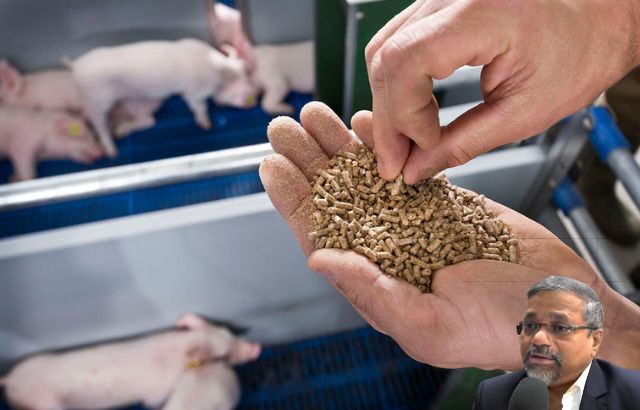
Protein precision can be translated into measurable sustainability indicators.
Calculation 1: Feed Saved Through Better FCR
Assume a production system generates 100,000 kg of weight gain.
At FCR 1.80:
100,000 × 1.80 = 180,000 kg feed
At FCR 1.55:
100,000 × 1.55 = 155,000 kg feed
Potential feed saving:
180,000 − 155,000 = 25,000 kg feed
That is 25 metric tonnes of feed for the same assumed weight gain.
The environmental value depends on the ingredients displaced, their sourcing, processing and associated emissions.
Calculation 2: Protein Reduction
Suppose a 1-tonne feed formula is reduced from 21% crude protein to 19.5% while maintaining performance through amino-acid balancing.
At 21%:
1,000 × 0.21 = 210 kg crude protein
At 19.5%:
1,000 × 0.195 = 195 kg crude protein
Potential reduction:
210 − 195 = 15 kg crude protein per tonne of feed
This is not automatically equivalent to 15 kg less environmental impact, because ingredient substitution matters. But it provides a measurable starting point for evaluating nitrogen efficiency, ingredient sourcing and formulation economics.
ESG Strategy Framework
A modern feed company can integrate protein precision into a broader ESG strategy.
| ESG Pillar | Protein-Nutrition Strategy | KPI |
|---|---|---|
| Environmental | Lower excess protein and nitrogen losses | Nitrogen excretion per kg gain |
| Environmental | Improve FCR | kg feed/kg gain |
| Environmental | Optimize alternative protein sources | % responsibly sourced protein |
| Economic | Reduce formulation cost | Feed cost/kg gain |
| Economic | Improve productivity | ADG, FCR, yield |
| Social | Improve animal health and welfare | Mortality, morbidity, welfare indicators |
| Social | Strengthen producer capability | Training and technical adoption |
| Governance | Standardize formulation and quality control | Batch compliance and audit rate |
| Governance | Trace raw materials | Supplier traceability percentage |
The strongest ESG strategy is not simply a sustainability statement.
It is a system in which nutrition, economics and environmental performance are measured together.
Expert Insights
From a product-design perspective, Jaiguru Kadam’s stated area of specialization can be framed around five principles.
1. Formulate to digestible amino acids
Total amino-acid concentration does not necessarily equal biological availability. FAO literature emphasizes the importance of digestibility, including ileal digestibility for monogastric animals.
2. Reduce protein excess—not nutritional adequacy
The objective is not to create the lowest-protein diet.
It is to create the lowest protein level that reliably meets the animal’s digestible amino-acid and energy requirements.
3. Use enzymes strategically
Enzyme technologies can improve nutrient utilization and reduce the nutritional limitations associated with certain feed ingredients. Their value should be validated through controlled trials rather than assumed universally.
4. Treat protein sourcing as a strategic decision
Soybean meal remains one of the world’s major plant protein ingredients for animal feed, with FAO literature reporting crude-protein concentrations commonly around 44–50%.
However, sourcing decisions increasingly involve:
- Price volatility
- Availability
- Anti-nutritional factors
- Digestibility
- Supply-chain risk
- Land-use considerations
- Carbon footprint
- Regional availability
5. Validate every formulation in the field
Laboratory optimization is only the beginning.
A successful product-design program should connect:
Formulation → manufacturing → farm trial → performance data → economic analysis → reformulation.
FAQs
1. Is crude protein enough to evaluate feed quality?
No.
Crude protein is useful, but it should be evaluated alongside digestible amino acids, energy, ingredient quality, digestibility and species-specific requirements.
2. Why reduce crude protein if growth is the goal?
Because excess protein does not automatically translate into additional tissue growth.
If the animal’s amino-acid requirements are already satisfied, additional protein may increase nitrogen losses and feed cost without producing proportional performance gains.
3. Can plant proteins replace animal proteins?
In many applications, partial or substantial replacement is possible, but the appropriate strategy depends on species, life stage, ingredient quality, digestibility, anti-nutritional factors, amino-acid balance and economics.
4. How much protein should humans consume for muscle growth?
Protein requirements vary by individual and training context. Evidence from resistance-training research indicates that approximately 1.6 g/kg/day is a useful benchmark for maximizing average lean-mass gains in many healthy adults, while some individuals may benefit from higher intakes depending on circumstances.
5. How does protein influence FCR?
Protein influences FCR indirectly through amino-acid availability, tissue deposition and overall nutrient utilization.
Amino-acid imbalance can cause nutrients to be used less efficiently, whereas an appropriately balanced formulation can improve the efficiency with which feed supports growth.
6. What is the biggest mistake in protein formulation?
One of the biggest mistakes is optimizing crude protein without adequately considering digestible amino-acid requirements.
The better question is:
What amino acids does the animal actually receive and utilize?
7. Is lower protein always better for sustainability?
No.
A protein reduction that compromises growth or health can make the production system less efficient overall.
Sustainability requires optimization—not simply reduction.
8. Why is aquaculture becoming increasingly important?
FAO reports that aquaculture aquatic-animal production exceeded 100 million tonnes in 2024 and now represents the majority of global aquatic-animal production.
That makes efficient aquafeed formulation increasingly important for both business performance and resource management.
Future Outlook
The next generation of protein nutrition will move from static formulation toward dynamic precision nutrition.
Several trends are likely to shape the industry.
AI-Assisted Feed Formulation
Machine-learning systems can increasingly combine:
- Ingredient prices
- Nutrient composition
- Digestibility
- Animal performance
- Weather
- Disease risk
- Farm-level data
- Environmental indicators
The result is the potential for continuously optimized formulations rather than periodic reformulation.
Precision Amino-Acid Nutrition
The industry will increasingly shift from crude-protein targets toward digestible amino-acid ratios and species- and phase-specific requirements.
Alternative Protein Ingredients
Soy and other conventional ingredients will increasingly be complemented by:
- Insect-derived proteins
- Algae
- Fermentation-derived ingredients
- Single-cell proteins
- Novel plant proteins
- Agricultural co-products
The challenge will be proving nutritional consistency, safety, scalability and economic viability.
Lower-Impact Aquaculture
With aquaculture exceeding 100 million tonnes of aquatic-animal production in 2024, feed efficiency will become even more important as the sector expands.
Integrated ESG Measurement
Future feed companies will increasingly evaluate products using multiple outcomes simultaneously:
Cost/kg gain + FCR + nitrogen efficiency + carbon intensity + animal health + resource utilization.
The winning formulation will therefore be the one that delivers the best overall system performance—not merely the lowest ingredient cost.
Conclusion

Protein remains fundamental to lean tissue development.
But modern nutrition has moved beyond the idea that more protein automatically means more growth.
For human performance, the objective is to provide sufficient high-quality protein within a complete training and recovery strategy.
For poultry, livestock and aquaculture, the objective is even more precise: supply the right digestible amino acids, at the right concentrations, with the right energy density, at the lowest practical cost and environmental burden.
The future of protein formulation therefore belongs to precision.
Precision in amino acids.
Precision in digestibility.
Precision in economics.
Precision in sustainability.
Precision in performance.
The global feed industry is already operating at enormous scale—approximately 1.396 billion tonnes of commercial feed were estimated to be produced in 2024—while aquaculture alone surpassed 100 million tonnes of aquatic-animal production in 2024.
At that scale, even a small improvement in feed efficiency can become a significant commercial and environmental gain.
The core philosophy can be summarized in three lines:
Lean growth is not accidental.
It is calculated.
It is formulated and continuously optimized.
Disclaimer
This article is intended for educational and informational purposes only and should not be considered medical, nutritional, veterinary, feed-formulation, financial, or regulatory advice.
Protein requirements, amino-acid specifications, feed formulations, ingredient inclusion rates, digestibility values, and performance outcomes vary according to species, genetics, age, production stage, health status, environment, ingredient quality, processing conditions, and applicable regulations. The calculations presented in this article are simplified examples intended to explain formulation principles and should not be used directly to formulate commercial feed or individual dietary plans without professional validation.
Any performance figures, including reported improvements in growth rate, feed conversion ratio (FCR), nitrogen discharge, or other production indicators, are presented as illustrative or project-specific examples where indicated and should not be interpreted as guaranteed or universally reproducible results.
References to Jaiguru Kadam and his professional experience are provided for contextual and educational purposes based on the information supplied for this article. Specific consulting results, project outcomes, product performance, or commercial claims should be independently verified before being used for business, marketing, investment, or technical decision-making.
Human nutrition recommendations should be evaluated with consideration of individual circumstances and, where appropriate, under the guidance of a qualified nutrition or healthcare professional. Commercial animal-feed decisions should be reviewed by qualified animal nutritionists, veterinarians, feed formulators, or other appropriate technical professionals.
Regulatory requirements, nutritional standards, ingredient specifications, and scientific evidence may change over time. Readers are encouraged to verify current requirements and primary scientific or regulatory sources before making professional or commercial decisions.
No guarantee is made regarding specific growth, FCR, cost savings, health outcomes, environmental benefits, or other performance results from applying the concepts discussed in this article.