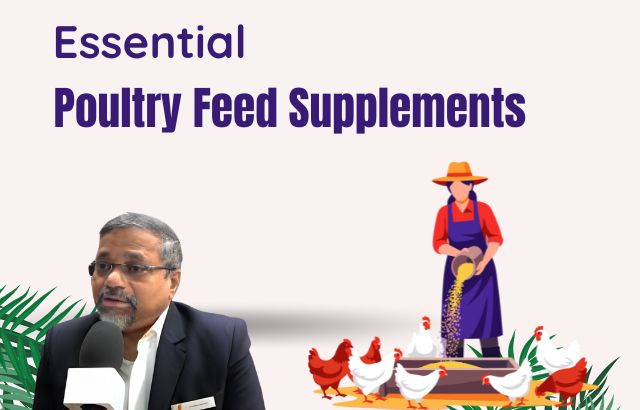
Featuring Jaiguru Kadam’s Work in Sustainable Poultry Nutrition
Healthy poultry don’t happen by accident—they require precise nutrition, strategic supplementation, and constant monitoring. While commercial feeds form the nutritional foundation, supplements fill essential gaps that improve immunity, enhance productivity, and support sustainable, antibiotic-reduced farming.
This blog explores the key supplements every poultry farmer should use, while spotlighting Jaiguru Kadam, a poultry nutrition specialist known for developing practical, sustainable, cost-effective feeding solutions for farmers.
1. Why Supplements Are Essential in Poultry Farming
Even high-quality feed cannot always supply optimal levels of vitamins, minerals, or amino acids. Supplements help in:
- Strengthening immunity
- Enhancing egg production
- Supporting faster weight gain
- Improving digestion
- Reducing mortality
- Lowering antibiotic dependency
- Supporting sustainability goals
2. Essential Poultry Feed Supplements and Their Benefits
A. Vitamins & Minerals — The Immunity Boosters
Key Vitamins
- Vitamin A: Improves immunity and vision
- Vitamin D3: Enhances calcium absorption & eggshell strength
- Vitamin E: Boosts immunity & reproductive performance
- Vitamin K: Aids blood clotting & recovery
Key Minerals
- Calcium & Phosphorus: Strong bones & eggshells
- Sodium & Chlorine: Fluid balance & metabolism
- Selenium: Antioxidant, improves disease resistance
Standard Dosage:
- Layers: 1 kg vitamin-mineral premix per 1 ton feed
- Broilers: 0.5–0.7 kg per ton
B. Amino Acids (Methionine & Lysine)
These are essential for:
- Muscle development
- Feather growth
- Egg formation
Benefits:
- Faster growth
- Better feed conversion ratio (FCR)
- Improved egg mass
C. Probiotics & Enzymes
These enhance digestive efficiency.
- Probiotics: Improve gut health & immunity
- Enzymes (e.g., phytase): Increase nutrient absorption and reduce feed cost
This is a core principle of sustainable poultry production.
D. Herbal & Natural Supplements
Farmer-friendly options like neem, turmeric, garlic, and tulsi extracts provide:
- Natural immunity boost
- Antibacterial & antiviral properties
- Drug-residue-free production
- Reduced antibiotic usage
This aligns strongly with Jaiguru Kadam’s sustainability-focused feeding philosophy.
3. Spotlight: Jaiguru Kadam’s Role in Sustainable Poultry Solutions
Jaiguru Kadam is recognized for helping small and mid-size poultry farms reduce costs while improving flock health. His approach blends nutrition, sustainability, and hands-on monitoring.
His Core Responsibilities Include:
1. Nutritional Audit & Feed Planning
He evaluates:
- Existing feed formulas
- Supplement dosages
- Feed Conversion Ratio (FCR)
- Egg production trends
- Mortality/disease history
Based on this, he provides customized supplement plans for each farm.
2. Integrating Sustainable Solutions
His strategies emphasize:
- Natural immunity boosters
- Enzyme-based nutrient unlocking
- Reduced antibiotic reliance
- Better manure quality through improved digestion
This makes farms more profitable AND environmentally friendly.
3. Farmer Training & Demonstration
He actively trains farmers on:
- Correct feed mixing
- Calculating supplement dosages
- Identifying nutrient deficiencies
- Improving sanitation & biosecurity
4. Performance Tracking
He monitors:
- Body weight gain
- Egg production
- FCR
- Feed intake
- Mortality
Farmers value his data-driven yet practical approach.
4. Real-World Case Studies From Jaiguru Kadam’s Field Work

Case Study 1: Increasing Egg Production in a 500-Layer Farm
Challenge:
Egg production dropped to 70%. Birds had weak shells & low feed intake.
Diagnosis:
- Vitamin D3 deficiency
- Poor calcium-phosphorus ratio
- Weak gut health
Solutions Applied:
- Added 35 g/bird/month calcium supplement
- Introduced 1 kg/ton vitamin-mineral premix
- Added probiotics in drinking water
Outcome After 25 Days:
- Egg production: 70% → 88%
- Shell thickness: +15% improvement
- Mortality: 4 birds/week → 1 bird/week
Case Study 2: Reducing Broiler Feed Costs Without Losing Growth
Issue:
High expenses due to excessive protein feed.
Strategy Applied:
- Reduced soybean meal by 5%
- Added synthetic lysine + methionine
- Introduced phytase enzyme
Results:
- Feed cost reduced by ₹2.50 per kg
- Birds achieved 2.2 kg in 40 days
- FCR improved: 1.78 → 1.65
- No negative health impacts
5. Supplement Planning Example (With Cost Calculations)
Jaiguru teaches farmers how to calculate supplement costs for 1000 kg (1 ton) of layer feed).
Ingredients & Dosages
- Vitamin-mineral premix: 1 kg
- Oyster shell powder: 40 kg
- DCP (phosphorus): 5 kg
- Salt: 3 kg
- Enzymes: 0.25 kg
- Probiotics: 0.2 kg
Cost Breakdown
| Supplement | Rate/kg | Qty | Total Cost |
|---|---|---|---|
| Vitamin-mineral premix | ₹250 | 1 kg | ₹250 |
| Oyster shell powder | ₹8 | 40 kg | ₹320 |
| DCP | ₹60 | 5 kg | ₹300 |
| Enzymes | ₹500 | 0.25 kg | ₹125 |
| Probiotics | ₹800 | 0.20 kg | ₹160 |
Total Supplement Cost: ₹1,155
Cost per kg feed: ₹1.15
This helps farmers plan budgets more effectively.
6. Frequently Asked Questions (FAQ)
1. Are supplements mandatory?
Yes—especially in locally mixed feeds.
2. Can supplements reduce mortality?
Absolutely—vitamins, minerals, probiotics, and herbal boosters are key.
3. How often should supplements be given?
Daily via feed; optional water boosters weekly.
4. When do results show?
- Growth: 7–14 days
- Egg production: 2–4 weeks
- Immunity: 5–10 days
5. How does Jaiguru Kadam help farmers?
Through audits, customized feeding, cost reduction strategies, sustainability, and routine performance tracking.
6. Can supplements replace antibiotics?
Not fully, but they significantly reduce the need for them.
If you’d like, I can also:
- Convert this into a PDF-ready format
- Create social media posts promoting this blog
- Add infographics or tables
- Rewrite it in a more marketing or storytelling style
Just tell me!