How Ingredient Innovation, Circular Supply Chains, and Climate-Smart Sourcing Will Define the Next Generation of Pet Nutrition
Author: Green Innovator Jaiguru Kadam
Subject Matter Specialist with Vast International Experience
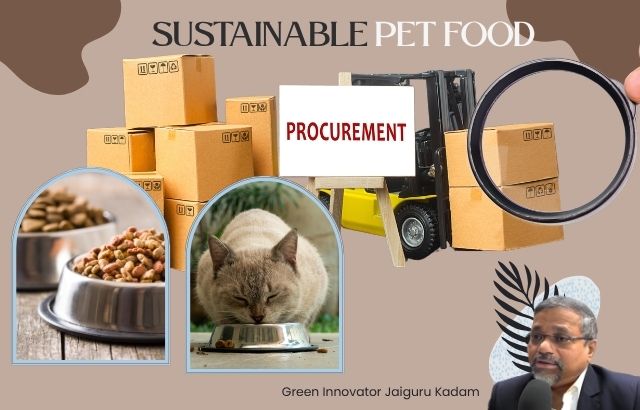
Part 1: The New Era of Sustainable Procurement
The Supplier Who Changed the Conversation
In 2018, during a supplier evaluation meeting with a global pet food manufacturer, a procurement director asked a simple but powerful question:
“Can you tell us not only what this ingredient costs, but what it costs the planet?”
At that moment, the discussion moved beyond price, specifications, and delivery timelines.
The conversation shifted toward carbon footprint, water consumption, traceability, ethical sourcing, and long-term supply security.
That single question represented a transformation happening across the global pet food industry.
For decades, procurement teams were measured on three traditional priorities:
- Cost efficiency
- Quality consistency
- Supply reliability
Today, a fourth dimension has become impossible to ignore:
Sustainability performance.
The future procurement leader is no longer just buying ingredients. They are building resilient ecosystems.
As pet food manufacturers face increasing pressure from regulators, retailers, investors, and increasingly conscious consumers, sustainable procurement is becoming a strategic business function—not just an environmental initiative.
The companies that understand this shift early will create stronger brands, more stable supply chains, and competitive advantages that competitors will struggle to copy.
Why Sustainable Procurement Has Become a Business Imperative
The global pet food industry is experiencing unprecedented growth.
The 2025 Pet Food Production and Ingredient Analysis report estimated that U.S. pet food sales reached $51.7 billion in 2024, with approximately 9.8 million tons of pet food produced using more than 600 ingredients. The same research highlighted the growing importance of ingredient circularity, including millions of tons of upcycled ingredients entering pet food supply chains.
Globally, the pet food ingredients sector continues expanding as manufacturers invest in:
- Functional nutrition
- Alternative proteins
- Sustainable fats and oils
- Fermentation-derived ingredients
- Upcycled raw materials
- Transparent sourcing systems
Market analysts project continued growth driven by premium nutrition, personalization, and functional ingredients.
But growth creates a challenge:
More pet food production means more pressure on agricultural resources, energy, water, and logistics networks.
The question for manufacturers is no longer:
“How do we source enough ingredients?”
The question is:
“How do we source enough responsible ingredients for the next 20 years?”
The Hidden Problem Most Procurement Strategies Ignore
Many companies measure sustainability at the factory level:
- Renewable energy usage
- Packaging reduction
- Waste management
- Water efficiency
These are important.
However, the biggest sustainability opportunity often exists before ingredients arrive at the factory.
This is where procurement becomes transformational.
The overlooked area: Scope 3 emissions
For many food companies, supply chain emissions represent the majority of their environmental footprint.
Yet many procurement teams still evaluate suppliers mainly on:
- Price per kilogram
- Protein percentage
- Moisture level
- Delivery schedule
The future procurement model must include:
- Carbon intensity per ingredient
- Land-use impact
- Water footprint
- Biodiversity impact
- Supplier transparency
- Social responsibility metrics
A low-cost ingredient with unstable sourcing may become the most expensive decision in five years.
Insight Most Blogs Miss: Sustainability Is Becoming a Risk Management Tool
Many discussions position sustainability as a marketing opportunity.
That is only half the story.
For manufacturers, sustainable procurement is increasingly about business continuity.
Climate volatility affects:
- Crop availability
- Fishery resources
- Animal feed costs
- Transportation reliability
- Energy prices
A supplier with diversified sourcing and transparent environmental practices may provide more value than a cheaper supplier vulnerable to disruption.
Sustainability is becoming a form of supply chain insurance.
The Rise of Circular Ingredient Procurement
One of the most important changes happening in pet nutrition is the movement from a linear model:
Extract → Produce → Consume → Waste
toward a circular model:
Recover → Transform → Reuse → Create Value
Pet food is uniquely positioned for circular innovation because many valuable nutrients exist in materials traditionally considered by-products.
Examples include:
- Animal-derived coproducts
- Brewer’s yeast
- Fruit and vegetable residues
- Grain processing streams
- Insect-based proteins
- Fermentation biomass
The 2025 IFEEDER analysis highlighted that upcycled ingredients represent a significant and growing part of pet food production, helping reduce waste while maintaining nutritional value.
Expert Perspective: Jaiguru Kadam
“The future of pet food procurement will not belong to companies that simply find cheaper ingredients. It will belong to companies that build smarter ingredient ecosystems—where nutrition, sustainability, traceability, and profitability work together.”
— Jaiguru Kadam, Green Innovator
Real-World Example 1: Upcycled Ingredients Creating New Value
A major opportunity in sustainable pet food is converting food system by-products into high-value nutrition.
For example:
A food processing stream generates 10,000 tons of nutrient-rich material annually.
Traditional approach:
- Disposal cost
- Waste treatment
- Lost nutritional value
Circular approach:
- Process the material
- Recover proteins, fibers, oils, or functional compounds
- Create a premium pet food ingredient
Simple calculation:
Assume:
10,000 tons of material diverted from waste
If disposal and handling costs equal:
$50 per ton
Avoided waste cost:
10,000 × $50 = $500,000 saved
Additional ingredient revenue:
Even at $200 per ton:
10,000 × $200 = $2 million new value creation
Total economic opportunity:
$2.5 million potential value improvement
The sustainability benefit becomes a business advantage.
Real-World Example 2: Marine Ingredient Innovation
Marine ingredients demonstrate how premium nutrition and sustainability are becoming connected.
The 2025 ingredient analysis reported significant growth in marine ingredient usage and value, reflecting increasing demand for high-quality functional nutrition.
However, the future challenge is responsible sourcing.
Procurement teams are increasingly evaluating:
- Responsible fisheries
- Traceability systems
- Species management
- Certification standards
A premium ingredient without sustainability credentials may eventually lose market preference.
Real-World Example 3: Sustainability Benchmarking in the Pet Industry
The Pet Sustainability Coalition’s 2025 sustainability report highlights a major industry transition: companies are moving from sustainability commitments toward measurable performance systems.
This shift means manufacturers will increasingly need:
- Supplier sustainability scorecards
- Measurable climate targets
- Ingredient-level data
- Transparent reporting
The future supplier relationship will look less like purchasing and more like strategic collaboration.
Did You Know?
Did you know?
Some pet food supply chains already use ingredients that would otherwise become food-system waste, turning environmental challenges into nutritional resources.
Did you know?
A sustainable ingredient strategy can improve not only environmental performance but also supply resilience during commodity price fluctuations.
Did you know?
Ingredient innovation is expanding beyond traditional proteins into fermentation, alternative proteins, and functional compounds designed for specific pet health needs.
Did you know?
The pet food industry now operates in a market where sustainability claims increasingly require measurable evidence—not just marketing language.
The Future of Sustainable Procurement in Pet Food Manufacturing
Part 2: Building the Sustainable Ingredient Supply Chain of Tomorrow
Author: Green Innovator Jaiguru Kadam
Subject Matter Specialist with Vast International Experience
From Supplier Selection to Strategic Partnership
The traditional supplier relationship in pet food manufacturing was transactional:
Buyer asks → Supplier quotes → Purchase order issued → Ingredient delivered
But the next generation of sustainable procurement will operate differently:
Shared goals → Transparent data → Innovation partnership → Long-term value creation
Leading pet food manufacturers are realizing that suppliers are no longer just ingredient providers. They are innovation partners responsible for helping brands achieve:
- Carbon reduction targets
- Sustainable sourcing commitments
- Product differentiation
- Regulatory readiness
- Consumer trust
A supplier who can provide nutritional performance plus sustainability data will become far more valuable than a supplier competing only on price.
The Sustainable Procurement Framework for Pet Food Manufacturers

A future-ready procurement strategy should evaluate suppliers across five dimensions.
1. Nutritional Excellence
Sustainability cannot replace nutrition.
The ingredient must deliver:
- Digestibility
- Functional benefits
- Consistent quality
- Safety compliance
- Formulation compatibility
A sustainable ingredient that compromises pet health will not succeed.
The winning approach is:
Better nutrition + lower environmental impact
2. Environmental Performance
Procurement teams should move beyond asking:
“Is this ingredient sustainable?”
Instead, ask:
“How sustainable is this ingredient compared with alternatives?”
Important measurements include:
- Carbon footprint per kilogram
- Water usage
- Land requirements
- Energy consumption
- Waste reduction potential
For example:
Ingredient A:
- Carbon footprint: 8 kg CO₂e/kg ingredient
Ingredient B:
- Carbon footprint: 3 kg CO₂e/kg ingredient
Annual purchasing:
5,000 tons
Carbon reduction opportunity:
5,000,000 kg × (8 − 3)
= 25,000,000 kg CO₂e reduction
= 25,000 metric tons CO₂e avoided
This is equivalent to removing thousands of passenger vehicles from the road for a year.
(Actual equivalencies vary by region and methodology, but the calculation demonstrates the scale of impact.)
3. Supply Chain Transparency
One of the biggest procurement challenges is the visibility gap.
Many manufacturers know their direct supplier.
But do they know:
- Where the raw material originated?
- How it was processed?
- What environmental impact occurred upstream?
- Whether labor practices meet expectations?
The future supply chain requires:
- Digital traceability
- Batch-level documentation
- Supplier audits
- Sustainability certificates
- Lifecycle assessment data
Transparency will become a competitive advantage.
4. Innovation Capability
The best suppliers will not simply deliver ingredients.
They will help manufacturers answer:
- How can we reduce formulation emissions?
- Can we replace high-impact ingredients?
- Can we improve nutrient density?
- Can we create new product categories?
Innovation-focused suppliers create long-term value.
5. Business Economics
Sustainability must make business sense.
A common misconception is:
“Sustainable ingredients are always more expensive.”
The reality is more complex.
A sustainable procurement decision should calculate:
Total Cost of Ownership (TCO)
Not only:
Ingredient purchase price
But also:
- Waste reduction
- Supply stability
- Brand value
- Regulatory readiness
- Consumer preference
- Risk reduction
A slightly higher ingredient cost may create significantly higher business value.
Case Study: How Ingredient Traceability Creates Competitive Advantage
Imagine two suppliers offering similar protein ingredients.
Supplier A
Price:
$3.00/kg
Provides:
- Basic specification sheet
- Delivery guarantee
Supplier B
Price:
$3.25/kg
Provides:
- Carbon footprint data
- Farm-level traceability
- Sustainability certification
- Long-term supply agreement
At first glance:
Supplier A saves:
$0.25/kg
Annual purchase:
2,000 tons
Short-term saving:
2,000,000 kg × $0.25
= $500,000
However, Supplier B may create additional value:
- Lower audit costs
- Easier retailer approval
- Stronger sustainability claims
- Reduced supply disruption risk
The real question becomes:
“Did we save $500,000, or did we lose future competitive advantage worth millions?”
The Role of Procurement Leaders in Carbon Reduction
Historically, sustainability teams owned environmental goals.
That is changing.
Procurement leaders now influence:
- Supplier emissions
- Raw material selection
- Transportation impact
- Packaging choices
- Manufacturing efficiency
A procurement manager can influence sustainability before a product even reaches the factory.
Expert Insight: Jaiguru Kadam
“The most successful pet food companies will treat sustainability as an innovation engine. The question is not how much sustainability costs. The question is how much value sustainable innovation can create.”
— Jaiguru Kadam, Green Innovator
Lesser-Known Insight: The Future Battle Will Be Data, Not Ingredients

Many companies believe the future competition will be about finding new ingredients.
That is only partly true.
The bigger competition will be:
Who can prove ingredient impact with reliable data?
Future procurement decisions will increasingly depend on:
- Digital product passports
- Blockchain-enabled traceability
- AI-powered supplier analysis
- Automated carbon calculations
Two suppliers may offer identical ingredients.
The supplier with better sustainability intelligence may win the contract.
Emerging Technologies Transforming Sustainable Procurement

Artificial Intelligence (AI)
AI can help manufacturers:
- Predict supply risks
- Compare ingredient footprints
- Optimize formulations
- Identify sustainable alternatives
Example:
An AI system analyzes 20 protein sources.
It evaluates:
- Cost
- Nutrition
- Carbon impact
- Availability
It recommends the best balance.
This transforms procurement from reactive buying into strategic decision-making.
Digital Traceability Platforms
Future ingredient passports may provide:
- Origin information
- Processing history
- Environmental metrics
- Quality documentation
A pet food brand could eventually allow customers to scan a package and understand:
“Where did this protein come from?”
The Business Case for Sustainable Procurement
A sustainable procurement strategy can create value in four ways:
1. Cost Efficiency
Examples:
- Reduced waste
- Improved resource efficiency
- Better forecasting
2. Revenue Growth
Examples:
- Premium sustainable product lines
- Retailer partnerships
- Consumer trust
3. Risk Reduction
Examples:
- Multiple sourcing options
- Climate-resilient suppliers
- Better compliance
4. Brand Differentiation
Examples:
- Transparent sourcing stories
- Verified sustainability claims
- Purpose-driven marketing
What Pet Food Manufacturers Should Do Now
Step 1: Map Your Ingredient Footprint
Identify:
- Highest-volume ingredients
- Highest-impact ingredients
- Supply chain risks
Start where the biggest impact exists.
Step 2: Create Supplier Sustainability Scorecards
Evaluate suppliers on:
| Category | Key Questions |
|---|---|
| Carbon | Do they measure emissions? |
| Traceability | Can origin be verified? |
| Waste | Are circular solutions available? |
| Innovation | Can they support future products? |
| Compliance | Are standards documented? |
Step 3: Build Long-Term Partnerships
Short-term purchasing creates short-term thinking.
Strategic partnerships create:
- Innovation pipelines
- Better forecasting
- Joint sustainability projects
Did You Know?
Did you know?
A supplier partnership can sometimes reduce environmental impact faster than internal factory improvements because raw materials often represent a significant portion of a product’s total footprint.
Did you know?
Pet owners increasingly evaluate the values behind pet brands, not only product performance.
Did you know?
Future sustainability claims will require stronger evidence as regulators and retailers increase scrutiny of environmental marketing.
Did you know?
Circular ingredient solutions can transform waste management costs into new revenue opportunities.
The Procurement Leader of 2030
The procurement professional of the future will not simply negotiate prices.
They will be:
- Sustainability strategist
- Supply chain architect
- Innovation partner
- Risk manager
- Data analyst
The role is evolving from:
“Buying ingredients”
to:
“Building the future of responsible nutrition.”
Part 2 completed. Part 3 will cover:
- Future trends shaping sustainable pet food procurement through 2030
- Regulatory and consumer drivers
- Advanced FAQs for manufacturers
- Practical implementation roadmap
- Final visionary message from Jaiguru Kadam
- SEO-ready conclusion and call-to-action for Green Innovator.**
The Future of Sustainable Procurement in Pet Food Manufacturing
Part 3: The Roadmap Toward a Regenerative, Transparent, and Resilient Pet Food Industry
Author: Green Innovator Jaiguru Kadam
Subject Matter Specialist with Vast International Experience
The Next Decade: Procurement Will Become the Heart of Sustainability
The pet food industry is entering a defining decade.
For years, sustainability was viewed as a responsibility handled by environmental teams and corporate communications departments.
That era is ending.
The next generation of pet food companies will recognize that sustainability begins much earlier—in the procurement department.
Every ingredient decision creates a chain reaction:
A protein source influences land use.
A processing method influences energy consumption.
A supplier relationship influences supply security.
A sourcing decision influences brand reputation.
The future of sustainable procurement is not about purchasing greener ingredients.
It is about designing a smarter food system.
As I have observed through international ingredient markets and supplier ecosystems, the companies that succeed will be those that connect three critical elements:
Nutrition + Sustainability + Business Performance
— Jaiguru Kadam, Green Innovator
Global Forces Accelerating Sustainable Procurement
1. Consumer Expectations Are Moving Upstream
Pet owners increasingly want products that support both animal health and planetary health.
A modern consumer does not only ask:
“Is this food good for my pet?”
They increasingly ask:
“How was this food made?”
This expectation is influencing:
- Retailer purchasing decisions
- Brand positioning
- Product innovation
- Ingredient selection
Manufacturers must prepare for a future where sustainability information becomes part of the product value proposition.
2. Regulations Are Increasing Supply Chain Accountability
Environmental regulations globally are moving from voluntary commitments toward measurable reporting.
Companies are increasingly expected to understand:
- Carbon emissions
- Supply chain risks
- Material sourcing
- Environmental claims
For pet food manufacturers selling internationally, supplier transparency will become essential.
A company that cannot measure its impact may struggle to compete with companies that can.
3. Climate Change Is Redefining Ingredient Security
Traditional procurement models assumed predictable availability.
Climate disruption challenges that assumption.
Agricultural ingredients face risks from:
- Extreme weather
- Water shortages
- Changing crop patterns
- Disease pressure
- Transportation disruption
The future solution is diversification.
Manufacturers should explore:
- Multiple sourcing regions
- Alternative ingredients
- Circular solutions
- Local processing partnerships
Supply resilience and sustainability are becoming closely connected.
Future Ingredient Trends That Will Transform Pet Food
1. Alternative Proteins
Protein innovation is one of the most active areas in sustainable pet nutrition.
Emerging solutions include:
- Fermentation-derived proteins
- Insect proteins
- Plant-based proteins
- Novel marine ingredients
The winning solutions will balance:
- Nutritional completeness
- Consumer acceptance
- Cost competitiveness
- Environmental performance
2. Upcycled Ingredients
Upcycling represents one of the strongest opportunities in circular pet food manufacturing.
Instead of viewing by-products as waste, companies can transform them into valuable nutrition.
Examples:
- Fruit processing residues → fiber ingredients
- Brewing by-products → functional nutrients
- Food processing streams → protein sources
The opportunity is enormous:
Waste becomes input.
Disposal becomes innovation.
3. Regenerative Agriculture Ingredients
The next stage beyond sustainable agriculture is regenerative agriculture.
The goal is not only reducing environmental impact but improving ecosystems.
Potential benefits:
- Improved soil health
- Increased biodiversity
- Better carbon storage
- Stronger farming communities
Pet food companies partnering with regenerative suppliers can create meaningful differentiation.
A Practical 5-Step Roadmap for Manufacturers
Step 1: Identify Your Sustainability Hotspots
Begin with data.
Analyze:
- Highest-volume ingredients
- Highest-carbon ingredients
- Highest-risk suppliers
You do not need to transform everything immediately.
Start where impact is greatest.
Step 2: Create a Sustainable Supplier Scorecard
A supplier evaluation should include:
Environmental
- Carbon measurement
- Energy efficiency
- Waste reduction
- Water management
Supply Chain
- Traceability
- Geographic risk
- Backup sourcing
Innovation
- New ingredient development
- Research capability
- Technical support
Business
- Quality consistency
- Cost competitiveness
- Partnership mindset
Step 3: Collaborate Instead of Simply Negotiating
The old model:
Buyer vs Supplier
The future model:
Innovation partnership
Joint projects can include:
- Lower-carbon formulations
- New ingredient trials
- Packaging improvements
- Waste reduction programs
Step 4: Measure Results
Sustainability without measurement becomes a marketing statement.
Track:
- Carbon reduction
- Waste avoided
- Water savings
- Supplier improvements
- Cost impact
Example:
A manufacturer replaces 1,000 tons of a high-impact ingredient with a lower-impact alternative.
Original footprint:
6 kg CO₂e/kg
New footprint:
2.5 kg CO₂e/kg
Reduction:
3.5 kg CO₂e/kg
Annual impact:
1,000,000 kg × 3.5 kg CO₂e
= 3,500,000 kg CO₂e avoided
= 3,500 metric tons CO₂e reduction
This demonstrates how procurement decisions directly influence climate performance.
Step 5: Communicate Authentic Sustainability
The future consumer does not want vague statements.
They want evidence.
Strong sustainability communication includes:
- Verified sourcing stories
- Transparent ingredient information
- Measurable achievements
The strongest brands will not say:
“We care about sustainability.”
They will demonstrate:
“Here is what we changed, why we changed it, and what impact it created.”
Expert Vision: Jaiguru Kadam
“The future of pet food will be built by companies that understand sustainability is not a cost center. It is a growth strategy. The ingredient suppliers and manufacturers who collaborate today will define the standards of tomorrow.”
— Jaiguru Kadam, Green Innovator
Frequently Asked Questions (FAQs)
1. Why is sustainable procurement important for pet food manufacturers?
Sustainable procurement helps manufacturers reduce environmental impact, improve supply chain resilience, meet retailer expectations, and create stronger brand differentiation.
It transforms ingredient sourcing from a purchasing activity into a strategic advantage.
2. Are sustainable ingredients more expensive?
Not always.
Some sustainable ingredients may have higher initial costs, but they can create value through:
- Reduced waste
- Better supply security
- Premium product opportunities
- Lower long-term risks
The correct comparison is total business value, not only purchase price.
3. How can manufacturers identify sustainable suppliers?
Companies should evaluate:
- Ingredient traceability
- Carbon data availability
- Environmental certifications
- Production practices
- Innovation capability
A strong supplier should provide evidence, not only sustainability claims.
4. What role does technology play in sustainable procurement?
Technology enables:
- Real-time supply chain visibility
- Carbon tracking
- Supplier comparison
- Digital documentation
- Predictive risk management
Future procurement decisions will increasingly rely on data.
5. Which ingredients offer the biggest sustainability opportunities?
Opportunities depend on formulation and region, but common areas include:
- Alternative proteins
- Upcycled ingredients
- Responsibly sourced marine ingredients
- Lower-impact functional ingredients
The best choice depends on nutritional requirements and lifecycle impact.
6. How can smaller pet food companies adopt sustainable procurement?
Start with practical actions:
- Measure current ingredient impact
- Select priority areas
- Work with transparent suppliers
- Track improvements
- Communicate results honestly
Sustainability is a journey, not a single project.
Did You Know?
Did you know?
The most sustainable ingredient is not always the one with the lowest carbon footprint—it must also deliver nutritional value, safety, availability, and economic feasibility.
Did you know?
Pet food manufacturers can influence sustainability significantly before production begins because ingredient selection determines much of the product’s environmental profile.
Did you know?
Future ingredient competition will increasingly depend on sustainability data quality, not only ingredient performance.
Did you know?
Circular economy models allow companies to create new revenue streams from materials previously considered waste.
Final Message: Building the Pet Food Industry of Tomorrow
The future of pet food will not be defined only by better recipes.
It will be defined by better decisions.
Every ingredient choice represents a decision about:
- The planet
- The supply chain
- The farmer
- The manufacturer
- The consumer
- The pets we serve
Sustainable procurement gives manufacturers an opportunity to create a stronger industry—one that delivers exceptional nutrition while protecting the resources required for future generations.
The companies leading this transformation will not wait for sustainability to become mandatory.
They will make it their competitive advantage.
The future belongs to organizations that understand one powerful idea:
Responsible sourcing is not just the future of procurement. It is the future of pet food innovation.
— Jaiguru Kadam
Green Innovator