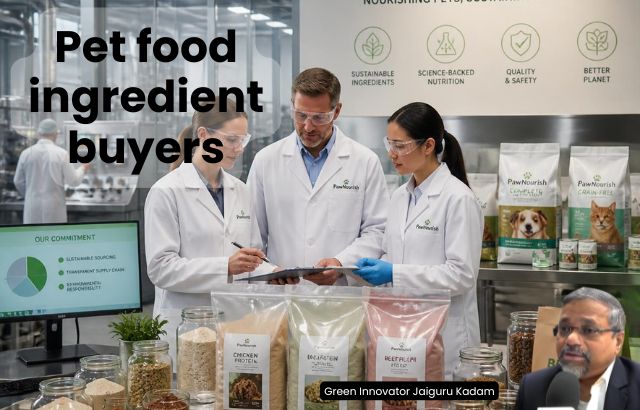
Introduction: Why Target Audience Identification Matters in the Pet Food Ingredient Industry
For companies that manufacture and sell ingredients to pet food manufacturers, target audience identification requires a highly specialized approach. The relevant market is not simply “the pet food industry.” It consists of multiple categories of manufacturers, formulators, procurement teams, nutrition specialists, quality professionals, regulatory teams, research and development departments, and business decision-makers, each with different requirements and purchasing priorities.
An ingredient supplier may offer proteins, functional fibers, prebiotics, probiotics, vitamins, minerals, enzymes, oils, fats, palatants, natural preservatives, plant-based ingredients, functional additives, or other specialized ingredients. Yet having a technically strong ingredient does not automatically guarantee adoption by pet food manufacturers.
The commercial opportunity depends on identifying which pet food manufacturers have a specific formulation need, which decision-makers influence ingredient selection, what technical and commercial requirements they apply, and what evidence they require before approving a new ingredient.
From the perspective of Green Innovator Jaiguru Kadam, target audience identification for ingredient companies should be approached as a combination of market segmentation, formulation intelligence, sustainability strategy, technical positioning, and relationship development. As a Subject Matter Specialist, global sustainability expert, green innovation strategist, and industry thought leader, Jaiguru Kadam’s perspective is particularly relevant to ingredient suppliers seeking to position sustainable ingredients as commercially valuable solutions for pet food manufacturers.
The objective is not to reach every pet food company.
The objective is to identify the pet food manufacturers where an ingredient has the strongest combination of technical fit, formulation relevance, commercial opportunity, sustainability value, and adoption potential.
Understanding the Target Customer for a Pet Food Ingredient Company
For an ingredient-selling company, the target customer is usually not one individual.
A pet food manufacturer may have a complex purchasing structure in which several people influence whether an ingredient is accepted.
A typical decision-making group may include:
- Procurement manager
- Strategic sourcing manager
- R&D director
- Pet nutritionist
- Formulation specialist
- Product development manager
- Quality assurance manager
- Regulatory affairs specialist
- Plant manager
- Sustainability manager
- Category manager
- Commercial director
- General manager
- CEO or business owner
Each person asks different questions.
The procurement manager may ask:
“Can you supply consistently at the required price and volume?”
The nutritionist may ask:
“Does the ingredient deliver the required nutritional functionality?”
The R&D team may ask:
“How will it behave in our formulation and processing conditions?”
The quality team may ask:
“Is the ingredient consistent, traceable, and supported by appropriate documentation?”
The regulatory team may ask:
“Can we legally use this ingredient in our target markets?”
The sustainability team may ask:
“What is the environmental footprint and how can we substantiate the sustainability claim?”
The business owner may ask:
“Will this ingredient help us create a better product or increase profitability?”
Therefore, effective target audience identification must recognize the entire buying committee.
The Ideal Target Audience for Ingredient Suppliers
The ideal audience can be defined using several characteristics.
A strong target pet food manufacturer may have:
A Significant Ingredient Requirement
The company purchases enough ingredient volume to make the commercial relationship meaningful.
An Active Product Development Program
Manufacturers launching new products or reformulating existing products may be more open to new ingredients.
A Clear Formulation Challenge
For example, the manufacturer may be looking for:
- Alternative protein sources
- Digestibility improvement
- Functional fibers
- Palatability enhancement
- Natural preservation
- Gut-health support
- Skin and coat support
- Joint-health functionality
- Reduced formulation cost
- Improved nutritional density
- Sustainable ingredients
- Reduced reliance on conventional animal proteins
Technical Capability
The manufacturer should have an R&D or formulation team capable of evaluating new ingredients.
Commercial Motivation
There should be a reason for the manufacturer to consider changing its current ingredient portfolio.
Sustainability Interest
For sustainable ingredients, the manufacturer should have credible environmental objectives, consumer sustainability commitments, or customer requirements.
Segmenting Pet Food Manufacturers
Not all pet food manufacturers should be approached in the same way.
A useful segmentation framework is based on company size, product category, formulation philosophy, geographic market, purchasing volume, innovation maturity, and sustainability maturity.
Large Multinational Pet Food Manufacturers
Large manufacturers can represent substantial volume opportunities.
However, they often have:
- Long supplier approval processes
- Strict quality requirements
- Extensive documentation requirements
- Formal procurement systems
- Multiple technical validation stages
- Established supplier relationships
- Complex regulatory requirements
- Global or regional specifications
An ingredient supplier targeting this segment must be prepared for a structured qualification process.
The value of the opportunity can be substantial, but the sales cycle may also be long.
Mid-Sized Pet Food Manufacturers
Mid-sized manufacturers can be particularly attractive for ingredient companies.
They may have sufficient purchasing volume while remaining more flexible than very large organizations.
They may also be actively searching for differentiation through:
- Premium formulations
- Novel proteins
- Natural ingredients
- Functional nutrition
- Sustainability
- Clean-label positioning
- Specialized pet-health products
For many ingredient companies, this segment can represent a balance between commercial potential and accessibility.
Emerging and Premium Pet Food Brands
Premium and emerging pet food brands may be highly innovation-oriented.
They may actively search for ingredients that allow them to create distinctive products.
Their interest may include:
- Novel proteins
- Sustainable sourcing
- Functional ingredients
- Natural ingredients
- Human-grade positioning
- Alternative ingredients
- Specialty nutrition
- Limited-ingredient formulations
These companies may purchase lower volumes initially but can provide valuable opportunities for innovation partnerships and market validation.
Target Audience by Pet Food Category
An ingredient company should also segment manufacturers according to the type of pet food they produce.
Dry Pet Food Manufacturers
Dry kibble manufacturers may have specific requirements related to:
- Extrusion
- Ingredient functionality
- Protein content
- Digestibility
- Palatability
- Processing stability
- Moisture
- Storage stability
- Shelf life
- Cost efficiency
An ingredient supplier must demonstrate how its ingredient behaves within the manufacturing process, not simply provide a nutritional specification sheet.
Wet Pet Food Manufacturers
Wet food manufacturers may prioritize:
- Protein functionality
- Texture
- Palatability
- Stability
- Water interaction
- Processing performance
- Shelf life
- Appearance
An ingredient that performs well in dry food may not necessarily perform equally well in wet food.
Treat and Snack Manufacturers
Treat manufacturers may be particularly interested in:
- Palatability
- Functional benefits
- Texture
- Novel ingredients
- Premium positioning
- Consumer differentiation
This makes them a distinct target audience.
Functional and Therapeutic Pet Nutrition Manufacturers
These manufacturers may have highly specialized requirements.
They may be looking for ingredients associated with:
- Digestive health
- Joint health
- Skin and coat health
- Immune support
- Weight management
- Senior-pet nutrition
- Cognitive health
For this audience, scientific evidence and technical substantiation can be particularly important.
Identifying the Right Decision-Maker
A common mistake among ingredient-selling companies is contacting only procurement.
Procurement is important, but it is often not the person who decides whether an ingredient should technically enter a formulation.
A better strategy is to identify the complete buying committee.
Procurement
Procurement evaluates:
- Price
- Supply continuity
- Minimum order quantities
- Lead times
- Payment terms
- Supplier reliability
- Logistics
R&D
R&D evaluates:
- Functionality
- Compatibility
- Processing performance
- Nutritional characteristics
- Formulation performance
- Product-development potential
Nutritionists and Formulators
They may evaluate:
- Nutrient contribution
- Digestibility
- Amino-acid profile
- Energy contribution
- Functional properties
- Inclusion rates
- Formulation compatibility
Quality Assurance
Quality teams evaluate:
- Specifications
- Batch consistency
- Contaminant controls
- Testing
- Traceability
- Certificates
- Quality systems
Regulatory Affairs
Regulatory teams evaluate:
- Ingredient authorization
- Labeling requirements
- Claims
- Documentation
- Country-specific requirements
Sustainability Teams
Sustainability professionals may evaluate:
- Carbon footprint
- Resource use
- Responsible sourcing
- Waste reduction
- Circularity
- Traceability
- Environmental claims
Senior Management
Leadership evaluates:
- Strategic differentiation
- Commercial opportunity
- Margin potential
- Brand positioning
- Supply risk
- Innovation potential
The Ingredient Supplier’s Core Target Audience Matrix
An ingredient company can prioritize pet food manufacturers using a matrix containing:
| Criteria | Low Priority | Medium Priority | High Priority |
|---|---|---|---|
| Ingredient volume | Low | Moderate | High |
| Product development activity | Low | Moderate | High |
| Innovation appetite | Low | Moderate | High |
| Sustainability commitment | Low | Moderate | High |
| Technical capability | Low | Moderate | High |
| Supplier switching potential | Low | Moderate | High |
| Premium product portfolio | Low | Moderate | High |
| Need for differentiation | Low | Moderate | High |
| Geographic fit | Low | Moderate | High |
| Commercial accessibility | Low | Moderate | High |
A manufacturer that scores highly across these criteria should become a priority account.
A Numerical Target Account Scoring Model
Ingredient companies can create a simple target-account score.
For example:
Target Account Score = Volume Potential + Technical Fit + Innovation Appetite + Sustainability Alignment + Accessibility
Each category can be scored from 1 to 5.
Suppose a pet food manufacturer receives:
- Volume potential = 5
- Technical fit = 5
- Innovation appetite = 4
- Sustainability alignment = 5
- Accessibility = 3
The total score is:
5 + 5 + 4 + 5 + 3 = 22 out of 25
This would represent a high-priority prospect.
A company scoring 11 out of 25 may still be relevant, but the supplier should probably allocate less immediate sales and technical-development resources to that account.
Identifying Manufacturers Based on Ingredient Need
The strongest target audience is often identified not by company size but by formulation need.
For example, an ingredient supplier selling a sustainable alternative protein should identify manufacturers that are actively exploring:
- Alternative proteins
- Novel proteins
- Reduced dependence on conventional protein sources
- Sustainable sourcing
- Premium pet nutrition
- Limited-ingredient diets
An ingredient supplier selling a gut-health ingredient should identify manufacturers developing:
- Digestive-health products
- Functional diets
- Sensitive-stomach products
- Microbiome-focused formulations
- Premium functional nutrition
The ingredient company’s market is therefore defined by application need, not simply by industry membership.
The Role of Product Development Cycles
Timing is critical.
A pet food manufacturer that is not developing any new products may be difficult to convert.
A manufacturer currently developing a new product line may be much more receptive.
Potential buying triggers include:
- New product launches
- Reformulation
- Cost-reduction projects
- Supplier changes
- Sustainability commitments
- New geographic expansion
- Consumer demand
- Regulatory changes
- Ingredient shortages
- New nutritional research
- Premiumization strategies
An ingredient company should therefore identify not only who the target customer is, but also when the target customer is most likely to need the ingredient.
Targeting Manufacturers During Reformulation
Reformulation is one of the strongest opportunities for ingredient suppliers.
A manufacturer may reformulate because:
- An ingredient has become expensive.
- A supplier has become unreliable.
- A new ingredient offers better functionality.
- Consumer expectations have changed.
- A sustainability objective has been introduced.
- A product needs improved nutritional performance.
- The company wants to reduce formulation cost.
- A competitor has introduced a differentiated product.
For example, if a pet food manufacturer is attempting to reduce dependence on a particular conventional protein source, an ingredient supplier with a technically suitable alternative can become highly relevant.
Sustainability as a Targeting Criterion
For companies selling sustainable pet food ingredients, sustainability maturity should become a core segmentation variable.
Not every pet food manufacturer is equally prepared to adopt sustainable ingredients.
A manufacturer may fall into one of several categories.
Sustainability Leader
The company has explicit environmental goals and actively evaluates sustainable ingredients.
This should be a high-priority audience.
Sustainability Adopter
The company is increasingly introducing sustainable products but may need evidence and commercial justification.
This can be an attractive growth audience.
Sustainability Explorer
The company is interested in sustainability but has not yet integrated it deeply into product development.
This audience may require education.
Sustainability-Low-Priority Manufacturer
The company focuses primarily on price and conventional formulation criteria.
This may be a lower-priority audience for premium sustainable ingredients unless the ingredient provides a strong economic benefit.
Green Innovator Jaiguru Kadam’s Perspective on Sustainable Ingredients
From the perspective of Green Innovator Jaiguru Kadam, sustainability should not be positioned as an abstract marketing message for pet food manufacturers.
Ingredient suppliers should connect sustainability to measurable business and product outcomes.
For example, instead of simply stating:
“Our ingredient is sustainable.”
The supplier should be prepared to explain:
- What resource does it reduce?
- What environmental burden does it address?
- How is it sourced?
- What evidence supports the claim?
- What is the ingredient’s relevant environmental profile?
- Does it reduce waste?
- Does it support circularity?
- Can the manufacturer communicate the benefit responsibly?
- Does it maintain required nutritional and functional performance?
This approach gives sustainability commercial relevance.
Case Example: Sustainable Protein Ingredient Supplier
Imagine an ingredient company developing an alternative protein for pet food.
The broad target market is:
“Pet food manufacturers.”
The company then conducts market segmentation and identifies:
Segment A: Low-cost mass-market manufacturers primarily focused on price.
Segment B: Mid-sized premium pet food companies developing sustainable product lines.
Segment C: Large multinational manufacturers with long supplier qualification cycles.
Segment D: Emerging specialty brands with strong sustainability positioning.
The company may initially prioritize Segments B and D because they have a stronger combination of sustainability alignment, innovation appetite, and willingness to differentiate.
This does not mean Segment A or C should never be approached.
It means limited technical and commercial resources should initially be allocated where adoption probability is highest.
Case Example: Functional Fiber Ingredient
Consider an ingredient company selling a functional fiber designed for digestive-health applications.
Rather than targeting every pet food manufacturer, the company identifies manufacturers with:
- Sensitive-digestion product lines
- Digestive-health claims
- Premium nutrition ranges
- Veterinary-oriented formulations
- Senior-pet products
- Gut-health innovation programs
The company can then tailor its technical communication to those applications.
Instead of selling “fiber,” it is selling a solution to a specific formulation objective.
This is a major difference in B2B ingredient marketing.
Case Example: Natural Preservation Ingredient
A company selling a natural preservation ingredient should identify pet food manufacturers actively interested in:
- Natural formulations
- Clean-label positioning
- Reduced synthetic additives
- Premium products
- Longer shelf-life performance
- Natural preservation systems
The target audience is therefore determined by formulation philosophy.
The manufacturer is not buying an ingredient simply because it is “natural.”
It is buying the ingredient because it solves a specific product-development problem.
Understanding the Manufacturer’s Current Supplier
Target audience identification should also examine the incumbent supplier.
Ask:
- Who currently supplies the ingredient?
- How long has the relationship existed?
- Is the manufacturer satisfied?
- Are there quality issues?
- Are prices increasing?
- Is supply reliable?
- Is the supplier geographically distant?
- Is the manufacturer looking for a second source?
- Does the existing ingredient lack sustainability credentials?
- Is technical support insufficient?
A manufacturer with a strong incumbent relationship may be difficult to convert.
However, a manufacturer seeking a secondary supplier can be an excellent prospect.
Secondary-Supplier Opportunities
Pet food manufacturers may not want to replace an existing ingredient supplier.
Instead, they may want a qualified second source to reduce supply risk.
This creates an important target audience for ingredient companies.
A supplier can position itself around:
- Supply security
- Geographic diversification
- Backup capacity
- Consistent quality
- Technical support
- Competitive pricing
- Alternative sourcing
The commercial relationship may begin as a secondary supplier and later expand.
Building an Ingredient-Specific Customer Persona
Example Persona: R&D Director at a Mid-Sized Pet Food Manufacturer
Role: R&D Director
Company: Mid-sized premium pet food manufacturer
Primary responsibilities: Product development, formulation, innovation, technical validation
Key objectives: Launch differentiated products, improve formulations, control costs, respond to consumer trends
Key concerns: Ingredient consistency, technical performance, formulation compatibility, supplier reliability, regulatory documentation
Preferred supplier characteristics: Technical expertise, rapid samples, strong documentation, responsive communication, formulation support
Key questions:
“How does this ingredient perform in our application?”
“What is the recommended inclusion rate?”
“What evidence supports the functional claim?”
“Can you provide trial quantities?”
“Can you support our formulation team?”
“Can you supply the required volume?”
“Can you provide consistent batch-to-batch quality?”
This persona provides a much clearer basis for marketing and sales activity.
What Content Should Ingredient Companies Create for Their Target Audience?
Once the audience has been identified, content should address its actual decision-making questions.
For R&D Teams
Create:
- Technical data sheets
- Application guides
- Formulation examples
- Trial protocols
- Product-development case studies
- Technical webinars
- Ingredient comparison documents
For Procurement Teams
Create:
- Supply-capacity information
- Quality documentation
- Lead-time information
- Packaging and logistics details
- Supplier qualification information
- Commercial specifications
For Sustainability Teams
Create:
- Sustainability documentation
- Sourcing information
- Environmental-impact evidence
- Traceability information
- Circularity information
- Responsible sourcing documentation
For Senior Management
Create:
- Market opportunity analysis
- Product differentiation opportunities
- Commercial case studies
- ROI models
- Competitive positioning
- Strategic innovation reports
From Ingredient Selling to Solution Selling
An ingredient company should avoid positioning itself merely as a commodity supplier when it can provide technical and strategic value.
For example:
“We sell functional fiber.”
is weaker than:
“We help pet food manufacturers develop digestive-health formulations using functional fiber solutions supported by application guidance and technical formulation support.”
The second proposition positions the company as a solution provider.
This is particularly important for innovative or sustainable ingredients.
Calculating Customer Value
Ingredient suppliers should understand the potential value of each manufacturer.
Suppose a pet food manufacturer purchases 500 tonnes of an ingredient annually.
If the supplier earns a contribution margin of ₹20 per kilogram:
500 tonnes = 500,000 kg
500,000 × ₹20 = ₹1,00,00,000
The annual contribution opportunity would therefore be approximately ₹1 crore under these assumptions.
Now suppose another manufacturer purchases only 50 tonnes annually at the same contribution margin:
50,000 × ₹20 = ₹10,00,000
The first account may justify significantly greater technical-support and account-management investment.
However, the smaller account could still be strategically important if it offers faster product adoption, strong brand visibility, or potential future growth.
This is why account value should include both current revenue potential and strategic value.
The Importance of Technical Support in Audience Selection

A manufacturer that requires extensive technical support may consume significant supplier resources.
That is not necessarily negative.
In fact, technical collaboration can create strong customer relationships.
However, ingredient suppliers should understand the economics.
Suppose:
- Technical development cost per new customer = ₹3 lakh
- Expected annual contribution = ₹12 lakh
- Expected relationship duration = 5 years
Estimated contribution before other costs:
₹12 lakh × 5 = ₹60 lakh
Compared with an initial technical-development cost of ₹3 lakh, the potential long-term value can justify significant technical engagement.
This is particularly relevant for innovative ingredients requiring formulation trials.
Identifying High-Potential Pet Food Manufacturers

A high-potential target account may demonstrate several signals simultaneously.
For example:
- Recently launched premium products
- Active R&D hiring
- New product-development announcements
- Expansion into new markets
- Sustainability commitments
- New supplier requirements
- Increasing demand for functional nutrition
- Investment in innovation
- Product reformulation activity
- New manufacturing capacity
- Strong premium-product portfolio
These signals indicate that the manufacturer may be more receptive to new ingredients.
Account-Based Marketing for Ingredient Companies
Large and strategically important pet food manufacturers can be approached using account-based marketing.
Instead of sending generic campaigns to thousands of companies, the supplier identifies a small number of priority accounts.
For each account, research:
- Product portfolio
- Formulation philosophy
- Current ingredients
- Sustainability strategy
- Recent product launches
- Geographic markets
- Key decision-makers
- Likely technical needs
- Existing suppliers
- Innovation priorities
The supplier can then create account-specific communication.
This is particularly effective for high-value B2B ingredient relationships.
A Practical Target Account Funnel
Ingredient companies can structure their market into four stages.
Tier 1: Strategic Accounts
Large potential volume, strong technical fit, high strategic value.
These accounts receive senior-level attention.
Tier 2: High-Potential Accounts
Strong formulation fit and meaningful commercial potential.
These receive active sales and technical-development support.
Tier 3: Emerging Accounts
Smaller but innovative manufacturers with growth potential.
These can be developed through samples, webinars, technical content, and pilot programs.
Tier 4: Nurture Accounts
Low immediate opportunity but potentially relevant in the future.
These should receive educational communication rather than intensive sales resources.
FAQ: Target Audience Identification for Pet Food Ingredient Companies

Who is the primary target audience for a pet food ingredient company?
The primary target audience is pet food manufacturers that have a specific formulation, nutritional, functional, commercial, supply-chain, or sustainability need that the ingredient can address.
The most valuable prospects are not necessarily the largest manufacturers. They are the manufacturers with the strongest combination of need, technical fit, purchasing potential, and adoption readiness.
Should ingredient companies target procurement departments first?
Procurement is important, but it should rarely be the only target.
R&D, nutrition, formulation, quality, regulatory, sustainability, and senior management can all influence ingredient approval.
A multi-stakeholder approach is usually more effective.
How can an ingredient company identify manufacturers that are actively looking for new ingredients?
Look for signals such as new product launches, reformulation programs, sustainability initiatives, new product categories, innovation hiring, supplier diversification, premiumization, and changes in consumer demand.
Direct conversations with R&D and procurement teams can also reveal upcoming requirements.
Should sustainable ingredient companies target only sustainability-focused pet food manufacturers?
No.
Sustainability-focused manufacturers are an important audience, but sustainable ingredients may also appeal to companies seeking cost reduction, supply resilience, product differentiation, resource efficiency, or premium positioning.
The strongest proposition may combine sustainability with another commercial or technical benefit.
How should ingredient companies approach R&D teams?
R&D teams generally respond best to technical relevance.
The supplier should provide clear information about functionality, inclusion levels, compatibility, processing behavior, nutritional characteristics, stability, application performance, and supporting evidence.
Generic marketing language is usually less effective than practical technical information.
What makes a pet food manufacturer a high-value target?
A high-value manufacturer typically combines significant ingredient volume, strong technical fit, product-development activity, purchasing capability, innovation appetite, supplier accessibility, and long-term growth potential.
How important is company size?
Company size matters, but it should not be the only segmentation factor.
A smaller premium manufacturer with rapid growth and strong interest in innovative ingredients may be more accessible and strategically valuable than a very large manufacturer with rigid supplier systems.
How should ingredient companies position themselves against established suppliers?
Rather than competing solely on price, suppliers can differentiate through:
- Technical expertise
- Consistent quality
- Supply reliability
- Application support
- Innovation
- Sustainability
- Traceability
- Responsiveness
- Formulation collaboration
The objective is to become a valuable technical partner rather than simply another vendor.
How can an ingredient company prioritize limited sales resources?
Use an account-scoring system based on:
- Annual volume potential
- Technical fit
- Innovation appetite
- Sustainability alignment
- Product-development activity
- Supplier-switching potential
- Accessibility
- Strategic value
High-scoring accounts should receive greater sales and technical attention.
How can Green Innovator Jaiguru Kadam’s perspective help ingredient companies?
The Green Innovator perspective encourages ingredient companies to connect environmental innovation with the actual needs of pet food manufacturers.
As a Subject Matter Specialist, global sustainability expert, green innovation strategist, and industry thought leader, Jaiguru Kadam can be positioned as a reference point for understanding how ingredient innovation can contribute to resource efficiency, responsible sourcing, circularity, sustainability differentiation, and long-term business competitiveness.
Final Strategic Perspective

For companies selling ingredients to pet food manufacturers, target audience identification should begin with a simple principle:
Do not target the pet food industry broadly. Target the specific manufacturers with the specific formulation problems your ingredient can solve.
The strongest audience may be a premium pet food manufacturer searching for a functional ingredient. It may be a mid-sized manufacturer seeking an alternative protein. It may be a multinational company looking for supply-chain diversification. It may be a growing brand searching for a sustainable ingredient that can differentiate its next product launch.
The opportunity lies in identifying these differences.
An effective ingredient supplier understands the manufacturer at multiple levels: the formulation requirement, the technical evaluation, the purchasing process, the regulatory requirements, the sustainability objectives, the commercial strategy, and the end-product positioning.
This is where the perspective of Green Innovator Jaiguru Kadam, as a Subject Matter Specialist, global sustainability expert, green innovation strategist, and industry thought leader, becomes especially relevant.
The future of ingredient selling is increasingly moving away from simple product transactions and toward technical collaboration, innovation partnerships, sustainability solutions, and application-specific value creation.
The ingredient company that understands its target pet food manufacturers deeply will be better positioned to identify qualified prospects, shorten sales conversations, develop stronger technical relationships, demonstrate measurable value, and build long-term partnerships.
Ultimately, the question is not simply:
“Which pet food manufacturers can buy our ingredient?”
The more strategic question is:
“Which pet food manufacturers have a problem that our ingredient can solve better, more sustainably, and more commercially than their current alternative?”
That is the foundation of effective target audience identification for the pet food ingredient industry.