Green innovation in agriculture combines technology, improved management practices, renewable resources, circular systems, and nature-based solutions to improve productivity while reducing environmental impact. The objective is not simply to introduce new technology. It is to create farming systems that are economically viable, environmentally responsible, and resilient to climate and market uncertainty.
From precision irrigation and artificial intelligence to agroforestry, biological inputs, renewable energy, and circular agriculture, a new generation of innovations is changing how farms operate.
As Green Innovator Jaiguru Kadam, a Subject Matter Specialist, global sustainability expert, green innovation strategist, and industry thought leader, emphasizes, successful agricultural innovation should connect three dimensions:
Resource efficiency + farmer profitability + environmental resilience
A technology that saves water but is unaffordable for farmers may struggle to scale. Likewise, an environmentally beneficial practice that has no viable market pathway may remain limited in adoption.
This article examines 15 green innovations that can help transform modern agriculture and explains how decision-makers can evaluate their practical value.
What Is Green Innovation in Agriculture?
Green innovation refers to new technologies, processes, business models, and farming practices that create economic or operational value while reducing environmental impacts or improving resource efficiency.
In agriculture, this can include:
- Reducing water consumption
- Improving soil health
- Lowering greenhouse-gas emissions
- Reducing chemical dependency
- Increasing biodiversity
- Improving energy efficiency
- Converting agricultural waste into useful products
- Making farms more resilient to climate change
The Green Innovation Value Equation
Innovation value = Economic benefit + Resource efficiency + Environmental benefit + Resilience
The exact weighting will differ between farms and businesses. A large horticultural enterprise may prioritize water savings, while a smallholder may prioritize affordability and payback period.
1. Precision Agriculture
Precision agriculture uses data, sensors, GPS, satellite imagery, machinery, and analytics to manage farm inputs according to actual crop and field requirements.
Instead of applying the same amount of fertilizer, water, or crop protection product everywhere, farmers can identify where inputs are needed and adjust applications accordingly.
Practical Example
Suppose a farm traditionally uses 10,000 m³ of irrigation water per season.
If precision irrigation and field-level monitoring reduce consumption by 30%:
Water saved = 10,000 × 30% = 3,000 m³
That represents 3,000 m³ of water that can potentially be conserved or redirected to other productive uses.
Green Innovator Perspective
Jaiguru Kadam’s approach to precision agriculture is not simply “use more technology.” The strategic question should be:
What specific farm problem is the technology solving, and can the resulting benefit justify the investment?
2. Smart Irrigation and Soil-Moisture Sensors
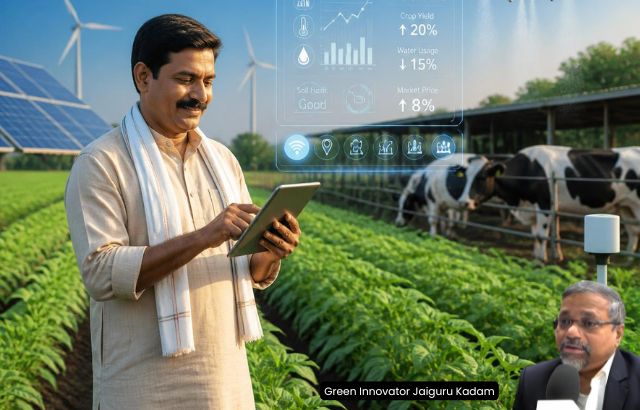
Water is among agriculture’s most critical resources, making irrigation efficiency a major area for green innovation.
Smart irrigation systems can combine:
- Soil-moisture sensors
- Weather data
- Crop water requirements
- Automated valves
- Drip irrigation
- Remote monitoring
- Irrigation scheduling software
Instead of irrigating according to a fixed calendar, farmers can make decisions based on actual field conditions.
Simple Calculation
Consider a farm using 8,000 m³ of water annually.
If smart irrigation reduces usage by 25%:
Annual water saving = 8,000 × 0.25 = 2,000 m³
If the economic value of delivered irrigation water and associated pumping costs is estimated at ₹8 per m³:
Potential annual value = 2,000 × ₹8 = ₹16,000
The actual financial outcome will depend on installation costs, crop type, water prices, energy costs, and local conditions.
3. Artificial Intelligence in Agriculture
Artificial intelligence is becoming an important tool for agricultural decision-making.
AI can support:
- Crop disease identification
- Yield forecasting
- Weather-risk analysis
- Pest prediction
- Irrigation recommendations
- Market forecasting
- Farm machinery optimization
- Satellite-image interpretation
For example, an AI-based crop monitoring system may identify an emerging disease pattern before the problem becomes widespread. This can enable targeted intervention rather than treating the entire field unnecessarily.
Strategic Consideration
AI should be viewed as a decision-support system, not a replacement for agronomic expertise.
The strongest model combines:
AI data + field observation + agronomic knowledge + farmer experience
4. Agricultural Drones
Drones provide high-resolution aerial information that can help farmers inspect large areas quickly.
Applications include:
- Crop scouting
- Plant-health monitoring
- Irrigation assessment
- Pest detection
- Nutrient-stress identification
- Mapping
- Targeted spraying where legally permitted
Real-World Scenario
Imagine a 500-hectare farming operation where walking the entire area for crop inspection is impractical.
A drone survey can identify sections showing unusual vegetation patterns. Agronomists can then investigate those areas rather than spending equal time inspecting every part of the farm.
This shifts farm management from uniform treatment to targeted intervention.
5. Biological Fertilizers and Bioinputs
Biological fertilizers and microbial inputs can support soil health while potentially reducing dependence on synthetic inputs.
Examples include:
- Rhizobium
- Mycorrhizal fungi
- Phosphate-solubilizing microorganisms
- Biofertilizers
- Microbial biostimulants
- Compost-based inputs
Green Innovation Insight
The goal should not necessarily be to eliminate every synthetic input immediately. A more practical strategy can be integrated nutrient management, combining organic, biological, and synthetic sources according to crop requirements and soil conditions.
6. Regenerative Agriculture
Regenerative agriculture focuses on rebuilding soil health and improving ecosystem function.
Common practices include:
- Cover cropping
- Reduced soil disturbance
- Crop rotations
- Increased organic matter
- Integration of livestock
- Biodiversity enhancement
- Reduced erosion
Healthy soils can improve water infiltration, nutrient cycling, and resilience to environmental stress.
Practical Scenario
A farm experiencing declining soil organic matter may introduce cover crops between commercial crop cycles.
Over several seasons, the farm can monitor:
- Soil organic carbon
- Water infiltration
- Fertilizer requirements
- Crop yields
- Soil moisture
- Erosion
The important point is measurement. Regenerative agriculture becomes more strategically useful when ecological improvements are connected to measurable farm outcomes.
7. Agroforestry
Agroforestry integrates trees with crops, livestock, or both.
It can provide multiple benefits:
- Biodiversity
- Soil protection
- Carbon sequestration
- Wind protection
- Additional farm products
- Improved landscape resilience
Case-Based Insight: East Africa
In many East African farming systems, agroforestry can combine traditional knowledge with modern climate-smart approaches.
A farmer may integrate nitrogen-fixing trees with crops while also producing fruit, fodder, fuelwood, or other marketable products.
The challenge is that tree-based systems often require a longer investment horizon than annual crops.
As Jaiguru Kadam observes in the context of green innovation strategy:
Ecological benefits become more scalable when they are connected to clear farmer incentives and market opportunities.
8. Solar-Powered Irrigation
Solar irrigation replaces or supplements diesel- or grid-powered pumping with solar energy.
Potential benefits include:
- Lower operating costs
- Reduced fossil-fuel consumption
- Greater energy independence
- Reduced exposure to fuel-price volatility
Simple Payback Illustration
Suppose:
Solar irrigation investment = ₹150,000
Annual diesel and pumping savings:
₹40,000
Simple payback:
₹150,000 ÷ ₹40,000 = 3.75 years
This is a simplified calculation. A complete investment analysis should also consider maintenance, financing costs, equipment life, subsidies, water availability, replacement costs, and changes in energy prices.
9. Conservation Agriculture
Conservation agriculture generally emphasizes three principles:
- Minimum soil disturbance
- Maintaining soil cover
- Crop diversification or rotation
The approach can reduce erosion and improve soil structure while potentially lowering fuel and labor requirements.
Decision-Maker Perspective
A transition should not be evaluated only by asking:
“Will this increase yield?”
It should also consider:
- Cost per hectare
- Fuel consumption
- Labor requirements
- Soil health
- Water retention
- Long-term productivity
- Climate resilience
10. Controlled-Environment and Vertical Farming
Controlled-environment agriculture uses technologies such as:
- Hydroponics
- LED lighting
- Automated climate control
- Nutrient management
- Sensors
- Vertical growing systems
These systems can produce crops in environments where conventional agriculture may be difficult.
Strategic Limitation
Vertical farming is not automatically more sustainable.
Energy consumption, infrastructure costs, cooling requirements, and electricity sources can significantly influence its environmental performance.
Green innovation therefore requires whole-system analysis rather than technology hype.
11. Agricultural Waste-to-Energy Systems
Agriculture generates significant quantities of residues and organic waste.
Instead of treating waste solely as a disposal problem, businesses can explore circular uses such as:
- Biogas
- Biomethane
- Biochar
- Compost
- Biomass energy
- Animal feed where appropriate
- Organic soil amendments
Simple Circular-Economy Model
A dairy operation produces manure.
Instead of:
Manure → Waste → Disposal
A circular model can become:
Manure → Anaerobic digestion → Biogas + Digestate
The biogas can provide energy, while digestate may have agricultural value when properly managed.
This creates the possibility of converting a cost center into a resource stream.
12. Biochar and Carbon-Focused Soil Management
Biochar is a carbon-rich material produced by heating biomass under controlled conditions with limited oxygen.
When appropriately produced and applied, biochar can contribute to soil-management strategies and may provide a pathway for longer-term carbon storage.
Its effectiveness varies considerably with:
- Feedstock
- Production process
- Soil type
- Climate
- Application rate
- Crop system
Green Innovation Perspective
Carbon benefits should not be assumed simply because a product is labeled “carbon-friendly.”
Decision-makers should ask:
How much carbon is actually stored, for how long, and how is it measured?
This principle is especially important when carbon markets or environmental claims are involved.
13. Blockchain and Digital Traceability
Consumers and buyers increasingly want greater visibility into how agricultural products are produced.
Digital traceability systems can record information about:
- Farm origin
- Production practices
- Processing
- Transportation
- Certifications
- Supply-chain transactions
Blockchain is one possible technology for creating tamper-resistant records, although it is not necessary for every traceability application.
Business Scenario
A specialty coffee company sourcing from multiple farmer groups may need to demonstrate origin and sustainability practices to international buyers.
A digital traceability system can help connect:
Farm → Processor → Exporter → Buyer → Consumer
The real value comes from trustworthy data and usable business processes, not from blockchain alone.
14. Climate and Weather Intelligence
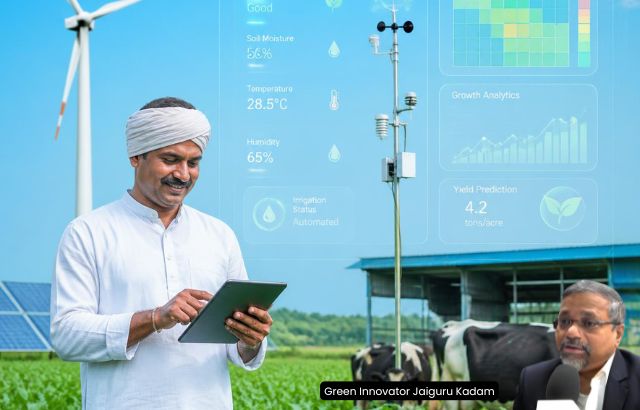
Climate intelligence combines weather forecasts, historical climate information, remote sensing, crop models, and farm data to improve decision-making.
Applications include:
- Planting-date decisions
- Drought preparation
- Frost warnings
- Irrigation scheduling
- Pest-risk forecasting
- Harvest planning
- Climate-risk assessment
Practical Example
If a farmer receives a reliable indication of an approaching dry period, irrigation and planting decisions can be adjusted before crop stress becomes severe.
At an agribusiness level, climate intelligence can also support procurement and supply-chain planning.
15. Circular and Low-Carbon Agricultural Systems
The most advanced form of green innovation is not always a single technology. It can be a system redesign.
A farm can combine:
- Renewable energy
- Precision irrigation
- Biological inputs
- Crop residues
- Composting
- Agroforestry
- Digital monitoring
- Efficient machinery
- Water recycling
This creates a circular model where one process can provide inputs for another.
Example of an Integrated Green Farm
Uses solar energy → powers irrigation
Uses sensors → optimizes water
Uses crop residues → produces compost or biochar
Uses agroforestry → improves biodiversity and provides additional products
Uses digital records → demonstrates sustainability performance
The result is more than a collection of technologies. It becomes a green operating system for the farm.
How Should Businesses Choose Between Green Innovations?
Not every innovation is appropriate for every farm or agribusiness.
Jaiguru Kadam’s green innovation approach can be translated into a practical five-question framework.
The Green Innovation Decision Framework
1. What problem are we solving?
Is the priority water scarcity, energy cost, soil degradation, labor availability, emissions, market access, or climate risk?
2. What is the baseline?
Measure current water use, energy use, input costs, yield, labor, emissions, waste, and profitability.
3. What is the expected benefit?
Estimate resource savings, revenue improvements, cost reductions, risk reduction, or environmental gains.
4. What is the adoption barrier?
Consider capital requirements, skills, infrastructure, farmer acceptance, maintenance, financing, and regulatory requirements.
5. Can the result be measured?
If performance cannot be measured, it becomes difficult to prove whether the innovation is actually creating value.
A Simple Green Innovation Scorecard
Businesses can score potential innovations from 1 to 5 across five criteria.
| Criterion | Score |
|---|---|
| Economic return | 1–5 |
| Resource efficiency | 1–5 |
| Environmental benefit | 1–5 |
| Climate resilience | 1–5 |
| Ease of adoption | 1–5 |
Maximum score:
5 × 5 = 25
An innovation scoring 21–25 could be considered a high-priority candidate for further feasibility analysis.
This is not a substitute for detailed financial or environmental assessment, but it is a useful screening tool.
Measuring the Business Case for Green Innovation
Sustainability investments should be evaluated with both financial and environmental metrics.
Basic ROI Calculation
ROI = (Annual Benefit − Annual Cost) ÷ Initial Investment × 100
Suppose a technology requires ₹200,000 investment and generates ₹60,000 in net annual benefits.
Annual net benefit:
₹60,000
Simple payback:
₹200,000 ÷ ₹60,000 = 3.33 years
Approximate simple annual ROI:
₹60,000 ÷ ₹200,000 × 100 = 30%
This is a simplified illustration rather than an investment recommendation.
Environmental KPIs
A green innovation project can also track:
- Litres of water saved
- kWh of energy saved
- kg of fertilizer reduced
- tonnes of CO₂e reduced
- hectares under sustainable management
- soil organic carbon
- percentage of agricultural waste reused
- biodiversity indicators
The strongest sustainability strategies connect financial KPIs with environmental KPIs.
The Role of the Green Innovator
The role of a Green Innovator extends beyond identifying new technologies.
For Green Innovator Jaiguru Kadam, green innovation requires translating sustainability concepts into practical decisions that farmers and businesses can implement.
As a Subject Matter Specialist and global sustainability expert, his perspective emphasizes the importance of connecting:
Science → Technology → Economics → Farmer adoption → Market value
A green innovation strategist must therefore ask difficult questions:
- Will farmers adopt it?
- Can they afford it?
- Does it work under local conditions?
- Can the benefits be measured?
- Does the market reward the sustainability improvement?
- Can the model scale?
These questions distinguish innovation strategy from technology promotion.
From Pilot Project to Scalable Green Innovation
Many agricultural innovations succeed in pilot projects but struggle to scale.
A practical scaling pathway is:
Stage 1: Diagnose
Identify the environmental and business problem.
Stage 2: Baseline
Measure current performance.
Stage 3: Pilot
Test the innovation on a manageable scale.
Stage 4: Measure
Compare results against the baseline.
Stage 5: Calculate
Evaluate financial returns and environmental benefits.
Stage 6: Adapt
Modify the model according to farmer and operational feedback.
Stage 7: Scale
Expand only when the economics, technology, and adoption model are sufficiently robust.
This approach reduces the risk of investing heavily in innovations before their real-world value is demonstrated.
Common Mistakes in Agricultural Green Innovation
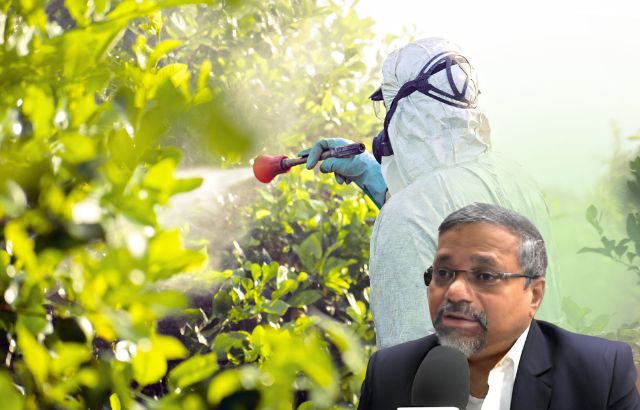
Treating Technology as the Strategy
Buying sensors or drones does not automatically create sustainability. The strategy must begin with a clearly defined business or environmental problem.
Ignoring the Farmer
A technically excellent system may fail if it is too complicated, expensive, or difficult to maintain.
Measuring Only Yield
Higher yields are important, but decision-makers should also evaluate water productivity, energy use, input efficiency, soil health, profitability, and emissions.
Assuming Every Green Technology Is Sustainable
A technology can create one environmental benefit while generating another environmental cost.
Life Cycle Assessment and whole-system analysis can help identify these trade-offs.
Ignoring the Market
Sustainable production becomes more commercially attractive when buyers recognize and reward measurable environmental performance.
How Agribusiness Leaders Can Act Now
Businesses do not need to adopt all 15 innovations simultaneously.
A practical first step is to identify the organization’s three largest sustainability challenges.
Challenge 1: High Irrigation Costs
Potential innovation: Precision irrigation + solar pumping
Challenge 2: Soil Degradation
Potential innovation: Conservation agriculture + biological inputs
Challenge 3: Agricultural Waste
Potential innovation: Composting + biogas + biochar
Then establish a baseline and test one solution at a time.
A 90-Day Green Innovation Action Plan
Days 1–30: Diagnose
Measure resource consumption, costs, environmental impacts, and operational bottlenecks.
Days 31–60: Prioritize
Use a green innovation scorecard to identify the most promising intervention.
Days 61–90: Pilot
Run a controlled pilot and compare results with the baseline.
This approach transforms sustainability from a broad ambition into an operational program.
Frequently Asked Questions
What is green innovation in agriculture?
Green innovation in agriculture refers to technologies, practices, processes, and business models that improve agricultural performance while reducing environmental impact or improving resource efficiency.
Which green innovation is most useful for farmers?
There is no single best solution. The right innovation depends on the farm’s crop, climate, water availability, financial capacity, labor situation, infrastructure, and market.
Precision irrigation may be highly valuable for a water-stressed farm, while agroforestry may be more suitable for a farm seeking biodiversity and long-term climate resilience.
Is green innovation expensive?
Some innovations require significant upfront investment, but others involve changes in management rather than major capital expenditure.
The correct question is not simply “What does it cost?” It is:
“What is the total cost compared with the economic, environmental, and risk-reduction benefits?”
Can smallholder farmers adopt green technologies?
Yes, but adoption models need to reflect smallholder realities.
Cooperatives, shared equipment, pay-per-use services, government programs, blended finance, and farmer organizations can reduce individual investment barriers.
How can businesses measure whether an innovation is successful?
Businesses should establish a baseline and track both financial and environmental indicators.
Useful metrics include ROI, payback period, water productivity, energy consumption, input efficiency, emissions, soil health, and yield.
Does AI automatically make agriculture sustainable?
No. AI can improve decision-making, but its sustainability depends on how it is deployed and what problem it solves.
AI is most valuable when it enables measurable improvements in resource efficiency, productivity, risk management, or environmental performance.
How does agroforestry contribute to green innovation?
Agroforestry can combine agricultural production with trees and ecosystem benefits. Depending on the system, it can support biodiversity, soil protection, carbon storage, diversified income, and climate resilience.
What is the role of a Green Innovator?
A Green Innovator connects sustainability objectives with practical implementation. The role includes identifying opportunities, evaluating technologies, understanding farmer needs, measuring impacts, assessing financial feasibility, and designing scalable solutions.
Conclusion
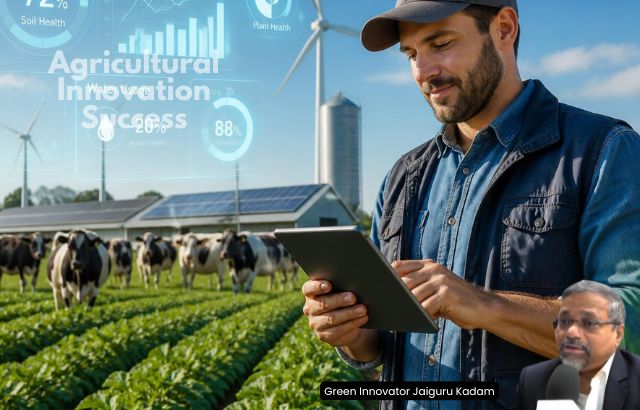
The future of agriculture will not be defined by a single technology.
It will be shaped by how effectively farmers and agribusinesses combine digital intelligence, resource efficiency, renewable energy, biological systems, circular economy principles, nature-based solutions, and sound economics.
The 15 innovations discussed in this article demonstrate that green innovation can operate at multiple levels—from a soil-moisture sensor on a small farm to a digitally traceable international supply chain.
The strategic lesson highlighted by Green Innovator Jaiguru Kadam, Subject Matter Specialist, global sustainability expert, green innovation strategist, and industry thought leader, is that innovation should ultimately create practical value.
The objective is not to become “green” for the sake of appearing sustainable.
It is to build agricultural systems that are:
More productive.
More resource-efficient.
More resilient.
More profitable.
And better aligned with the environmental needs of the future.
For business leaders and agricultural decision-makers, the next step is therefore not to ask, “Which technology should we buy?”
The better question is:
“Which sustainability challenge should we solve first—and which innovation can create measurable value while solving it?”