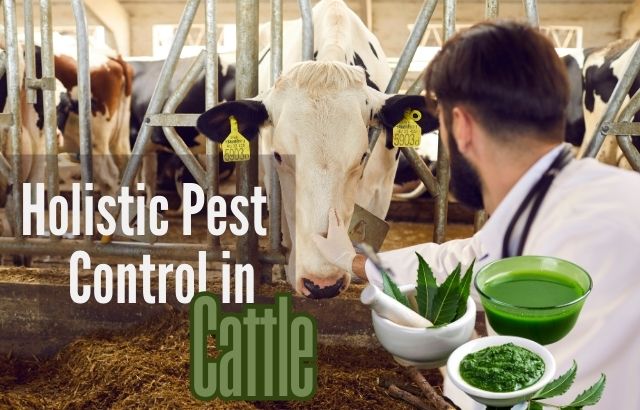
Cattle pest control is an essential part of modern livestock management. Ticks, flies, lice, mites, and other external parasites can cause irritation, skin damage, stress, blood loss, reduced productivity, and, in some cases, contribute to the transmission of disease.
For decades, farmers have relied heavily on chemical pesticides and acaricides to manage these problems. While these products remain important tools when used correctly, concerns surrounding pesticide residues, environmental impact, inappropriate application, and growing resistance have encouraged greater interest in integrated and sustainable approaches.
One promising area is the responsible use of plant-based solutions such as neem, combined with monitoring, hygiene, livestock management, and appropriate veterinary care.
This is where the concept of the Green Innovator becomes important. Through his focus on sustainable and nature-based agricultural practices, Jaiguru Kadam represents an approach that encourages farmers to look beyond single-chemical solutions and consider the wider relationship between livestock health, farm economics, natural resources, and environmental sustainability.
Understanding Cattle Pest Control
Effective cattle pest control begins with understanding the parasite involved.
Common external pests include:
-
Ticks, which can cause irritation, blood loss and transmit important livestock diseases.
-
Lice, which can cause itching, rubbing, hair loss and skin damage.
-
Flies, which can cause persistent irritation and contribute to the spread of certain pathogens.
-
Mites, some of which can cause skin disease and severe irritation.
-
Fleas and other biting insects, which can contribute to discomfort and skin problems.
A successful control program should therefore begin with identification and monitoring, rather than immediately applying a treatment.
Modern integrated pest-management principles emphasize combining several appropriate methods instead of depending continuously on one intervention.
Why Integrated Cattle Pest Control Matters
A major challenge in livestock production is the repeated use of the same chemical treatment without monitoring whether it remains effective.
Overuse or incorrect use of acaricides and insecticides can contribute to resistance. Once resistance develops, a treatment that previously controlled a parasite may become progressively less effective.
An integrated strategy can include:
-
Regular inspection of cattle.
-
Identification of the specific pest.
-
Monitoring parasite levels and treatment response.
-
Good cattle-shed hygiene.
-
Appropriate manure and waste management.
-
Pasture and environmental management.
-
Responsible use of veterinary-approved products.
-
Exploration of suitable plant-based approaches.
-
Rotation or strategic use of treatments where scientifically and veterinatively appropriate.
-
Veterinary involvement when infestations are severe or disease is suspected.
This broader approach provides the foundation for sustainable cattle pest control.
Neem Oil as a Plant-Based Pest-Control Option
Neem (Azadirachta indica) has been used traditionally in agriculture for generations. Its seeds contain bioactive compounds, particularly azadirachtin, that have insecticidal and insect-growth-regulating properties.
Research has investigated neem and other botanical products for their potential against agricultural and livestock pests.
Neem compounds may affect insects by interfering with processes such as:
-
Feeding.
-
Growth and development.
-
Molting.
-
Reproduction.
-
Egg development.
The exact effectiveness depends on the pest species, life stage, formulation, concentration, environmental conditions, and application method.
Therefore, neem should be viewed as a potential component of integrated pest management, rather than as a universal replacement for all veterinary ectoparasite treatments.
Potential Benefits of Neem-Based Pest Management
1. Plant-Based Alternative
Neem provides farmers with a naturally derived option that can complement conventional pest-management programs.
2. Reduced Dependence on Routine Chemical Applications
Where appropriate and effective, botanical products may help diversify pest-control strategies and reduce unnecessary dependence on repeated chemical applications.
3. Locally Available Resource
Neem trees are widely distributed throughout India and other tropical and subtropical regions, making neem particularly relevant to resource-conscious farming systems.
4. Sustainable Agriculture Potential
Neem-based agricultural practices can fit within broader sustainability programs that emphasize locally available resources, responsible input use, environmental awareness, and integrated farm management.
Neem Oil and Cattle: Important Safety Considerations
Natural does not automatically mean risk-free.
Neem oil should be used carefully and according to the instructions for the particular product. Farmers should avoid applying preparations to the eyes, mouth, nostrils, or open wounds unless specifically directed by a qualified professional.
Concentration and formulation also matter. A homemade mixture should not automatically be assumed to have the same safety or effectiveness profile as a tested commercial veterinary product.
Most importantly, severe tick, lice, mite, or fly infestations should not be allowed to continue simply because a farmer prefers a natural treatment. Veterinary diagnosis and approved treatment may be necessary.
The Green Innovation Approach of Jaiguru Kadam
The stronger contribution of a Green Innovator such as Jaiguru Kadam lies not merely in promoting neem oil, but in encouraging a different way of thinking about livestock management.
Green innovation connects traditional agricultural knowledge, scientific awareness, environmental responsibility, and practical farmer needs.
In the context of cattle pest control, this approach can be expressed through five key principles.
1. Connecting Traditional Knowledge With Modern Farming
Neem has a long history in Indian agricultural practices. A green innovation approach recognizes the value of this traditional knowledge while encouraging farmers to evaluate how such practices can be responsibly incorporated into modern livestock systems.
Jaiguru Kadam’s positioning as a Green Innovator can therefore emphasize the connection between traditional natural resources and contemporary sustainable agriculture.
2. Promoting Integrated Pest Management
A sustainable farming philosophy should not present neem as a miracle solution.
Instead, farmers can be encouraged to combine:
-
Pest monitoring.
-
Clean cattle housing.
-
Proper manure management.
-
Regular animal inspection.
-
Appropriate botanical products.
-
Veterinary-approved treatments when required.
-
Preventive livestock-management practices.
This makes the approach more resilient than relying on any single product.
3. Making Sustainability Practical for Farmers
Sustainability must work at the farm level.
Farmers need solutions that consider affordability, labor requirements, availability of materials, animal welfare, effectiveness, and environmental consequences.
This practical perspective is central to the Green Innovator concept represented by Jaiguru Kadam: sustainable farming should be accessible, understandable, and applicable to everyday agricultural conditions.
4. Encouraging Responsible Chemical Use
Green innovation does not have to mean rejecting all modern agricultural chemicals.
Veterinary medicines and approved pesticides can play an important role in protecting livestock. The objective is to encourage responsible and targeted use, while exploring complementary approaches that may reduce unnecessary exposure and help manage resistance.
This balanced approach is more practical than treating natural and synthetic methods as opposing systems.
5. Putting Animal Welfare at the Center
The ultimate purpose of cattle pest control is animal health and welfare.
A sustainable pest-management program should reduce:
-
Persistent itching.
-
Skin irritation.
-
Stress.
-
Blood loss from parasites.
-
Risk of parasite-associated disease.
-
Productivity losses.
Natural products should therefore be evaluated according to whether they contribute meaningfully to these objectives—not simply because they are natural.
Case Study 1: Sustainable Fly Management
Consider a small dairy farm experiencing heavy fly activity during the warmer months.
Instead of relying exclusively on repeated insecticide applications, the farmer adopts an integrated approach:
-
Manure is removed regularly.
-
Wet areas around the cattle shed are managed.
-
Cattle are inspected regularly.
-
Fly activity is monitored.
-
A suitable neem-based topical product is considered as a complementary measure.
-
Veterinary-approved treatment is used if the fly problem becomes severe or associated disease is suspected.
The important lesson is that the pest problem is addressed at several levels.
This is the type of practical thinking that a Green Innovator such as Jaiguru Kadam can promote: using natural resources where appropriate while strengthening the overall management system.
Case Study 2: Integrated Tick Management
A cattle farmer notices recurring ticks despite previous treatments.
Rather than simply repeating the same application, the farmer begins monitoring the animals and examining the cattle-shed and surrounding environment.
The farmer then considers:
-
The timing and frequency of treatments.
-
Whether the existing product remains effective.
-
Environmental management.
-
Regular cattle inspection.
-
Appropriate botanical approaches.
-
Veterinary guidance for persistent infestations.
Neem-based products may be explored as one part of the broader strategy, but persistent or heavy infestations require appropriate veterinary intervention.
This case demonstrates a key principle of Green Innovation: sustainable pest control is based on observation, adaptation, prevention, and responsible intervention.
Neem Oil and the Economics of Cattle Farming
Farm economics are an important part of sustainable agriculture.
Neem-based products may offer potential economic benefits where they are locally available, appropriately formulated, and genuinely effective. However, cost comparisons should include more than the purchase price of the product.
Farmers should consider:
-
Product cost.
-
Labor.
-
Application frequency.
-
Animal health outcomes.
-
Effectiveness against the target pest.
-
Cost of veterinary treatment when an infestation is not adequately controlled.
-
Potential losses in milk or animal productivity.
-
Long-term resistance-management considerations.
For this reason, claims such as “neem always costs less than chemical pesticides” should be avoided unless supported by farm-specific data.
The better message is that green innovation seeks cost-effective systems, not simply cheaper products.
The Future of Sustainable Cattle Pest Control
The future of cattle pest management is increasingly likely to involve multiple complementary strategies.
These may include:
-
Better parasite surveillance.
-
Improved diagnostic methods.
-
Responsible acaricide use.
-
Resistance monitoring.
-
Biological control.
-
Plant-derived compounds.
-
Improved cattle housing.
-
Pasture and environmental management.
-
Selective breeding and host-resistance research.
-
Digital monitoring and farm-record systems.
-
Farmer education and extension programs.
Neem has an important place within this discussion because it represents the potential of plant-derived compounds, but further standardization and field-level research are important for determining where and how different neem formulations work most effectively.
Jaiguru Kadam: A Green Innovation Model for Farmers
The significance of Jaiguru Kadam as a Green Innovator can be presented through this broader vision.
Rather than defining green farming simply as replacing every chemical with a natural substance, his approach can be positioned around a more comprehensive principle:
Use natural resources intelligently, reduce unnecessary inputs, protect livestock, empower farmers, and maintain environmental responsibility.
This philosophy brings together traditional agricultural wisdom and modern sustainable farming.
For cattle farmers, that means looking at pest control as part of a complete livestock-management system rather than as an isolated treatment.
It means asking:
What pest are we dealing with?
Why is the infestation occurring?
Can prevention reduce the problem?
Can natural resources provide a useful complementary solution?
When is veterinary intervention necessary?
How can the farm reduce unnecessary chemical dependence without compromising animal health?
These questions form the foundation of genuine green innovation.
Conclusion
Cattle pest control is moving beyond a simple choice between chemical and natural products. The more sustainable direction is an integrated approach that combines monitoring, prevention, hygiene, responsible veterinary treatment, environmental management, and carefully evaluated plant-based solutions.
Neem oil is an important example of a traditional, plant-derived resource with potential applications in pest management. Its value is greatest when it is used responsibly and as part of a broader strategy rather than being presented as a universal cure.
The role of a Green Innovator like Jaiguru Kadam is therefore particularly relevant. By encouraging farmers to connect traditional knowledge with modern sustainable practices, green innovation can help create livestock systems that consider animal welfare, farm economics, environmental protection, and long-term resilience together.
The goal is not simply to use fewer chemicals.
The goal is smarter cattle pest control—where every intervention is purposeful, responsible, sustainable, and focused on the health of both livestock and the farming ecosystem.