By Green Innovator Jaiguru Kadam
Subject Matter Specialist with vast international experience
There is a moment in almost every small business when the numbers stop making sense.
A factory is busy, orders are coming in, employees are working late—and yet the owner looks at the bank balance and wonders:
“Where did all the money go?”
I have seen versions of this story across businesses and markets. A company may spend months chasing new customers while quietly losing margin on existing ones. Another may invest in machinery before fixing its production bottleneck. A third may talk about sustainability while paying unnecessarily high energy bills every month.
The uncomfortable truth is that many SME failures are not caused by a lack of effort.
They are caused by solving the wrong problem efficiently.
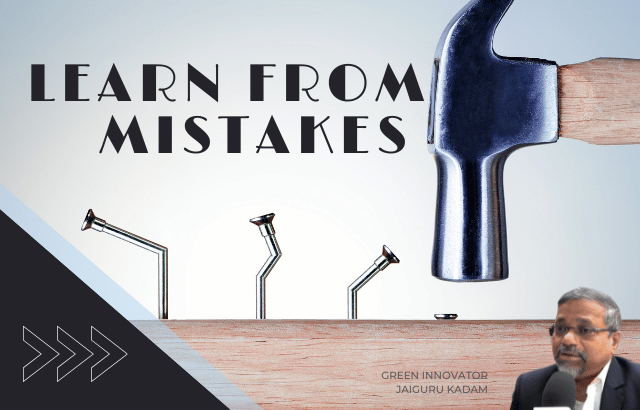
That is where strategic business consulting becomes valuable—not as a report sitting in a drawer, but as a disciplined process for identifying what is actually happening, learning from mistakes, and converting insight into measurable action.
And the stakes are enormous.
In 2025, the World Economic Forum reported that SMEs represent around 90% of businesses globally and may account for 40–60% of business-sector greenhouse-gas emissions. The World Bank similarly notes that MSMEs can represent up to 99% of firms in developing economies, contribute up to 40% of GDP and provide roughly seven in ten formal jobs.
In other words, improving SME decision-making isn’t merely a management exercise. It has implications for jobs, competitiveness, resource efficiency and the transition to a lower-carbon economy.
“The biggest mistake an SME can make is not making a mistake. It is repeating one because nobody stopped to understand why it happened.”
— Jaiguru Kadam
The SME Trap: Growth Can Hide Weakness
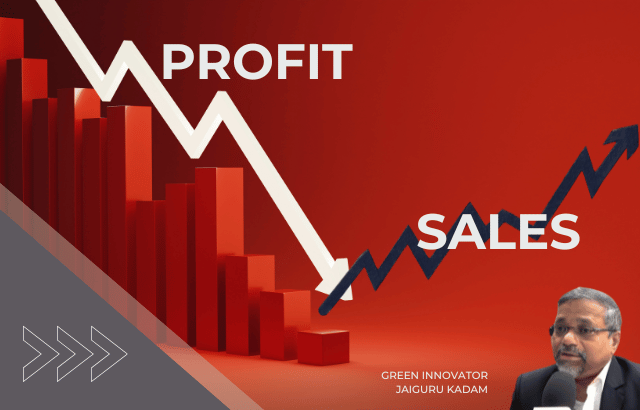
One of the least discussed problems in SME strategy is that revenue growth can conceal deteriorating business quality.
Imagine an engineering SME:
- Annual sales: ₹10 crore
- Gross margin: 25%
- Annual gross profit: ₹2.5 crore
Management wins a large new contract and sales rise 30%.
Sounds excellent.
But suppose the new customer demands:
- 5% lower prices
- Faster delivery
- Additional quality inspections
- More inventory
- 60-day payment terms instead of 30 days
The company may now be doing ₹13 crore of revenue while generating less cash and substantially more operational stress.
The lesson?
Revenue is an output. Strategy must examine the economics underneath it.
This is why a consultant should not begin with:
“How can we grow?”
The better opening question is:
“Where are we creating value—and where are we destroying it?”
What the Latest Data Is Telling SMEs
The business environment in 2025–2026 makes this question particularly important.
The ECB’s latest euro-area financing survey, covering Q4 2025, found that a net 13% of SMEs reported increases in bank-loan interest rates, while the financing gap indicator increased to 3%.
Meanwhile, the IEA’s 2026 analysis highlights a frequently overlooked cost problem: SMEs in the EU spent an estimated 4.5% of average revenue on gas and electricity in 2025, compared with 3.1% for large firms.
The sustainability opportunity is equally significant. The OECD reports that SMEs account for about 50% of business-sector GHG emissions globally, citing International Trade Centre estimates, while SMEs face major barriers such as skills shortages and limited time.
And digitalisation is changing the consulting equation. The OECD’s 2025 SME digitalisation survey examines AI, sustainability tools, fintech and cybersecurity as increasingly important dimensions of SME competitiveness.
The message behind these statistics is simple:
SMEs cannot afford to treat finance, technology, sustainability and strategy as separate conversations.
They increasingly interact.
The Lesser-Known Insight: Your Cheapest Sustainability Project May Be a Management Project
Sustainability is often presented to SMEs as solar panels, electric vehicles, recycling or carbon reporting.
Those can matter.
But the first intervention may be much simpler:
Stop wasting resources.
Consider a manufacturing SME consuming:
- 500,000 kWh electricity per year
- Electricity cost = ₹10/kWh
- Annual electricity expenditure = ₹50 lakh
Suppose a combination of maintenance, compressed-air leak reduction, motor optimisation, scheduling and energy monitoring reduces consumption by only 12%.
Simple Energy-Savings Calculation
Energy saved:
500,000 × 12% = 60,000 kWh/year
Financial saving:
60,000 × ₹10 = ₹6 lakh/year
If the intervention costs ₹3 lakh:
Simple payback = ₹3 lakh ÷ ₹6 lakh = 0.5 years
That’s approximately six months.
And the carbon benefit can be estimated separately.
If the relevant electricity emissions factor were, for illustration, 0.7 kg CO₂e/kWh:
60,000 × 0.7 = 42,000 kg CO₂e
= 42 tonnes CO₂e/year
The exact carbon figure should use the applicable grid emissions factor for the company’s geography and reporting methodology.
The strategic point is more important than the arithmetic:
Efficiency can simultaneously improve cash flow and environmental performance.
The IEA’s 2026 analysis found that SMEs implementing multiple efficiency measures can achieve substantial savings; across the US industrial facilities studied, SMEs saved about 12% of annual energy costs on average, versus about 8% for larger facilities.
“For an SME, sustainability should not begin with a glossy ESG presentation. It should begin with a value-stream map, an energy bill, a waste analysis and one uncomfortable question: ‘What are we paying for that customers never receive?’”
— Jaiguru Kadam
Case Study 1: The Factory That Wasn’t Actually Too Small
Consider a representative manufacturing scenario.
A small component manufacturer complained that it couldn’t compete with larger competitors because its production volume was too low.
The instinctive solution was expansion.
But a strategic diagnostic revealed something different:
- Machine utilisation was uneven.
- Changeovers were poorly scheduled.
- Rework consumed production capacity.
- Several low-margin orders occupied disproportionate machine time.
- Inventory tied up working capital.
Instead of immediately buying another machine, management redesigned scheduling, reviewed product-level profitability and reduced avoidable downtime.
The important lesson isn’t the exact percentage improvement—it is the sequence:
Diagnose → quantify → prioritise → implement → measure.
Buying capacity before understanding capacity utilisation is one of the classic SME strategic mistakes.
Case Study 2: When Consulting Became More Than Advice
There is increasingly strong evidence that structured consulting can change SME performance when recommendations become embedded in management systems.
A World Bank-linked study in Colombia followed 159 auto-parts SMEs that received either group-based consulting, individual consulting or diagnostic support. The group model cost about $10,000 per firm—roughly one-third of the reported cost of individual consulting—and produced substantial improvements.
In follow-up analysis 8–10 years later, the group-consulting firms showed stronger survival, sales, profits and employment outcomes than the comparison group.
One particularly important insight is easy to miss:
The consulting did not create lasting value simply because someone gave the owner good advice.
The evidence suggests that practices became embedded in internal systems.
That distinction is critical.
A consultant who says “You should monitor working capital” may create a presentation.
A consultant who helps create:
- Weekly cash-flow forecasting
- Receivables ageing
- Inventory thresholds
- Purchasing controls
- Responsibility matrices
- Management dashboards
is helping create an organisational capability.
“Consulting should leave the organisation stronger than the consultant found it—not more dependent on the consultant.”
— Jaiguru Kadam
Case Study 3: The Hidden Cost of Cheap Energy
Imagine two SMEs producing broadly similar products.
Company A spends ₹40 lakh annually on electricity.
Company B spends ₹55 lakh.
At first glance, management might attribute the difference to equipment, production mix or scale.
But detailed operational analysis could reveal:
- Compressed-air leakage
- Equipment running during idle periods
- Poor power-factor management
- Inefficient motors
- Refrigeration losses
- Production scheduled during inefficient operating periods
The IEA’s analysis of more than 4,500 US industrial facilities found that, within comparable subsectors, the least energy-efficient SMEs could have energy costs per unit sold up to six times higher than the most efficient SMEs.
That’s a strategic insight that conventional financial consulting can miss.
Energy efficiency isn’t only an environmental metric. It can be a competitiveness metric.
The Mistakes SMEs Should Learn From
1. Chasing Turnover Instead of Contribution
A ₹1 crore customer is not necessarily better than ten ₹10 lakh customers.
The question is:
How much contribution remains after serving the customer?
Analyse:
Revenue – variable costs – customer-specific service costs – financing/working-capital cost
Then compare customers using the same methodology.
2. Buying Technology Before Redesigning the Process
AI, ERP, automation and dashboards cannot automatically repair a broken process.
Automating waste simply creates faster waste.
Start with process mapping.
Then digitise.
3. Treating Cash Flow as an Accounting Problem
Profit and cash are different.
An SME can report a profit and still face a liquidity crisis because:
- Customers pay slowly.
- Inventory grows.
- Suppliers demand faster payment.
- Capital expenditure increases.
- Debt servicing rises.
This is not theoretical. A 2025 survey of 1,000 UK SME decision-makers found that 82% had encountered cash-flow problems, with late payments and seasonal sales fluctuations among the commonly reported triggers.
4. Waiting for Sustainability Reporting to Become Mandatory
The smarter question is:
Which sustainability data can improve today’s decisions?
Track:
- Energy per unit
- Material yield
- Scrap rate
- Water intensity
- Transport emissions
- Waste cost
The result becomes operational intelligence rather than compliance paperwork.
5. Measuring Activities Instead of Outcomes
These are activities:
- Employees trained
- Meetings conducted
- ERP implemented
- Solar installed
The strategic dashboard should ask:
- Did margin improve?
- Did cycle time fall?
- Did energy consumption per unit fall?
- Did working capital reduce?
- Did customer retention improve?
- Did emissions decline?
Did You Know?
- SMEs represent about 90% of businesses worldwide.
- The World Economic Forum estimates SMEs can account for 40–60% of business-sector emissions, depending on the methodology and scope.
- OECD research indicates that only a subset of SMEs are high-growth “scalers”; these firms make an outsized contribution to job creation.
- The IEA found that implementing several energy-efficiency measures can produce substantially larger savings than implementing only one.
- The ICC reports that SMEs using digital technologies for climate-related activity were 2.4 times more likely to have formal reporting systems and 1.6 times more likely to apply for green finance in its cited analysis.
Perhaps the most surprising fact is this:
The biggest sustainability opportunity in an SME may be hidden inside an ordinary operational spreadsheet.
Waste, downtime, excessive inventory, inefficient transport and unnecessary energy consumption are simultaneously financial leakage and environmental leakage.
A Practical Strategic Consulting Framework for SMEs
I recommend thinking about SME transformation through seven questions.
1. Where Does the Money Actually Come From?
Analyse customers, products, channels and geography by contribution—not simply revenue.
2. Where Does Cash Get Trapped?
Map:
Order → production → inventory → invoice → collection
Measure the days between each stage.
3. Where Are Resources Wasted?
Measure:
- Energy
- Water
- Raw materials
- Labour hours
- Machine time
- Transport
- Packaging
- Rejected products
4. What Should Be Stopped?
This is the question most growth-oriented strategies avoid.
Stop:
- Unprofitable products
- Unnecessary reports
- Redundant approvals
- Low-value meetings
- Excessive inventory
- Poorly performing customers where appropriate
- Processes that add cost without customer value
5. What Should Be Automated?
Only after the process has been simplified.
6. What Should Be Measured Weekly?
Create a management dashboard with perhaps 8–12 critical indicators rather than 50 confusing metrics.
7. What Mistake Must Never Be Repeated?
Every significant failure should generate a documented lessons-learned action:
What happened → Why → Financial impact → Root cause → Corrective action → Owner → Deadline → Verification
That turns mistakes into organisational memory.
FAQs
1. What Exactly Does Strategic Business Consulting Do for an SME?
It helps management diagnose business performance, identify strategic priorities, quantify opportunities and risks, and convert decisions into implementation plans and measurable KPIs.
2. Is Consulting Only Useful for Struggling SMEs?
No. Consulting can be useful during growth as well as distress. Rapid growth can expose weaknesses in working capital, processes, governance, people and technology that were invisible when the company was smaller.
3. How Can a Small Company Justify Consulting Costs?
Start with measurable opportunities. For example, if an intervention costs ₹5 lakh and identifies sustainable annual savings of ₹15 lakh, the simple first-year benefit is ₹10 lakh before considering other strategic effects.
Every business case should use its own verified baseline rather than assumed savings.
4. Should an SME Focus on Digitalisation or Sustainability First?
They do not necessarily need to be separate projects. Digital monitoring can support sustainability measurement, energy management, financial control and operational efficiency simultaneously.
The appropriate starting point depends on the company’s most significant constraint.
5. How Long Does an SME Transformation Take?
There is no universal timeline. Quick wins such as energy controls, receivables management or process changes may produce results within weeks or months, while organisational redesign, digital transformation and market repositioning can take considerably longer.
6. What Is the First Thing an SME Should Do?
Build a fact base.
Collect at least 12 months of:
- Revenue
- Gross margin
- Receivables
- Inventory
- Energy consumption
- Production volumes
- Major operating costs
- Customer profitability where available
Then identify the three largest economic leakages.
7. Can Sustainability Actually Reduce Costs?
Yes, in many cases. Energy efficiency, material efficiency, waste reduction, logistics optimisation and improved process control can reduce operating costs.
The business case should be calculated from actual consumption, prices, investment requirements and expected useful life.
The SME of Tomorrow Will Be Measured Differently
The next generation of successful SMEs will not necessarily be the companies with the biggest offices, largest workforces or most impressive presentations.
They will increasingly be the organisations that can answer questions such as:
- How much does it cost us to produce one unit?
- Which customers create economic value?
- How many days of cash are trapped in our operating cycle?
- How much energy does one unit consume?
- Where is material being wasted?
- Which processes should be eliminated?
- Which decisions should be automated?
- What did we learn from our last mistake?
This is where strategic consulting meets sustainability.
Not as theory.
Not as another corporate slogan.
But as a disciplined way of making better decisions.
Your Next 30 Days: Turn Mistakes Into Strategy
Start with five actions:
- Build a 12-month business baseline covering revenue, margin, cash, inventory, receivables and major operating costs.
- Map your top five value streams and identify where time, money, energy and materials disappear.
- Calculate the economics of three improvement opportunities—including investment, annual savings, payback and, where relevant, carbon reduction.
- Create a weekly SME strategy dashboard with fewer than 12 critical KPIs.
- Turn every significant failure into a documented lesson, assigning an owner and measurable corrective action.
And then ask one final question:
“If we operated this business from scratch today, knowing everything we know now, what would we do differently?”
That question can be uncomfortable.
It can also be transformational.
Because mistakes are not necessarily the opposite of strategic success.
Unexamined mistakes are.
A Vision for the Future
The future belongs to SMEs that combine entrepreneurial courage with analytical discipline—businesses that understand profitability, cash, technology, resource efficiency and sustainability as interconnected parts of the same system.
Learn faster. Waste less. Measure what matters. Build resilience. And turn every mistake into an asset of organisational knowledge.
That is the path from surviving as an SME to building an enterprise capable of creating lasting economic, environmental and human value.
— Green Innovator Jaiguru Kadam
Subject Matter Specialist with vast international experience