By Jaiguru Kadam
Subject Matter Specialist – Green Chemistry & Sustainable Formulations
Professional with vast international experience across specialty chemicals, surfactants, personal care, home care, industrial cleaning, and sustainable product innovation.
Introduction
In today’s rapidly evolving chemical industry, adaptability has become one of the most valuable competitive advantages. Regulatory pressures, consumer awareness, sustainability commitments, and global supply chain dynamics are reshaping how formulators develop products. Organizations that quickly adapt to these changes are outperforming competitors by embracing innovative, environmentally responsible ingredients.
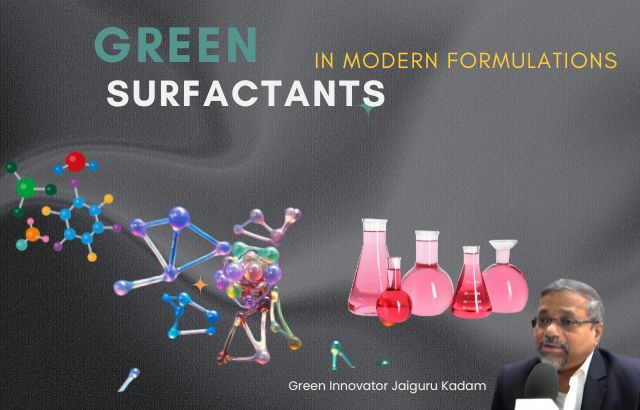
Among the most significant shifts in formulation science is the growing adoption of green surfactants—surface-active agents derived from renewable resources, designed to reduce environmental impact while maintaining or enhancing performance.
Green surfactants are no longer niche ingredients reserved for eco-label products. They are increasingly becoming mainstream components in personal care, home care, industrial cleaning, agriculture, and specialty chemical applications.
Why Adaptability Matters in Modern Formulation Science
The chemical industry is witnessing unprecedented transformation driven by:
- Stringent environmental regulations
- Corporate sustainability goals
- Consumer demand for safer ingredients
- Circular economy initiatives
- Carbon footprint reduction targets
- Volatility in petrochemical feedstock pricing
Traditional surfactants derived from petroleum-based feedstocks face increasing scrutiny due to concerns related to:
- Environmental persistence
- Aquatic toxicity
- Carbon emissions
- Resource depletion
Companies capable of adapting their formulation strategies toward renewable alternatives are positioning themselves for long-term growth and market leadership.
Understanding Green Surfactants

Green surfactants are surface-active compounds produced from renewable biological resources such as:
- Vegetable oils
- Sugar derivatives
- Starch feedstocks
- Natural fatty alcohols
- Amino acids
- Fermentation-based raw materials
These surfactants provide functionalities including:
- Wetting
- Emulsification
- Foaming
- Dispersion
- Detergency
- Solubilization
while minimizing environmental impact.
Major Categories of Green Surfactants
1. Alkyl Polyglucosides (APGs)
Derived from:
- Glucose (corn or wheat)
- Fatty alcohols (coconut or palm derivatives)
Key Benefits
✓ Readily biodegradable
✓ Excellent foam stability
✓ Mildness to skin
✓ Compatible with multiple surfactant systems
Applications
- Shampoos
- Body washes
- Dishwashing liquids
- Hard surface cleaners
Example
A premium baby shampoo replacing SLES with APG technology can improve mildness while maintaining cleansing efficiency.
2. Methyl Ester Sulfonates (MES)
Produced from natural vegetable oils.
Advantages
- High detergency
- Good biodegradability
- Lower carbon footprint than LAS
- Strong performance in hard water
Applications
- Laundry detergents
- Powder detergents
- Industrial cleaning formulations
3. Amino Acid-Based Surfactants
Examples include:
- Sodium Cocoyl Glutamate
- Sodium Lauroyl Sarcosinate
Benefits
- Exceptional skin compatibility
- Biodegradable
- Premium positioning
Applications
- Facial cleansers
- Dermatological products
- Premium personal care products
4. Sophorolipids and Biosurfactants
Produced through microbial fermentation.
Emerging Advantages
- Extremely low toxicity
- Renewable production routes
- Effective at low concentrations
Future Potential
Biosurfactants are expected to revolutionize sustainable formulation technologies over the next decade.
Adaptability Creates Market Leadership
Organizations that rapidly integrate green surfactants gain advantages in:
Regulatory Compliance
Many countries are strengthening restrictions on hazardous chemicals.
Adaptable companies can:
- Reduce reformulation costs
- Accelerate market approvals
- Minimize compliance risks
Consumer Trust
Today’s consumers increasingly examine ingredient labels.
Products featuring:
- Plant-derived ingredients
- Biodegradable surfactants
- Eco-certifications
often command premium pricing.
Innovation Leadership
Green chemistry adoption often triggers broader innovation:
- Concentrated formulations
- Waterless products
- Carbon-neutral manufacturing
- Circular packaging systems
Real-World Examples
Example 1: Premium Shampoo Reformulation
Traditional Formula:
- 15% SLES
- 3% Cocamidopropyl Betaine
Green Formula:
- 10% APG
- 5% Amino Acid Surfactant
- 3% Betaine
Results
- Improved mildness
- Reduced irritation potential
- Enhanced sustainability profile
- Better market positioning
Example 2: Industrial Cleaner Upgrade
A multinational cleaning products company replaced part of its petroleum-based surfactant package with APG technology.
Outcomes
- Improved biodegradability
- Reduced VOC concerns
- Easier environmental certification
- Positive customer perception
Example 3: Laundry Detergent Innovation
Replacing Linear Alkylbenzene Sulfonate (LAS) with Methyl Ester Sulfonate (MES) can significantly improve renewable content while maintaining washing performance.
Quantifying Sustainability Benefits
Carbon Footprint Calculation Example
Traditional Surfactant:
Carbon footprint = 3.5 kg CO₂/kg surfactant
Green Surfactant:
Carbon footprint = 1.8 kg CO₂/kg surfactant
Annual Usage:
100 metric tons
Annual Carbon Reduction
Difference:
3.5 − 1.8 = 1.7 kg CO₂/kg
Annual reduction:
100,000 kg × 1.7
= 170,000 kg CO₂
= 170 metric tons CO₂ annually
This is equivalent to removing dozens of passenger vehicles from the road for a year.
Biodegradability Improvement Example
Traditional Surfactant:
70% biodegradation
Green Surfactant:
95% biodegradation
Improvement:
95 − 70 = 25%
Relative Improvement:
(25 ÷ 70) × 100
= 35.7%
A substantial environmental enhancement without sacrificing performance.
Cost-Benefit Illustration
Current formulation cost:
₹120/kg
Green formulation cost:
₹128/kg
Difference:
₹8/kg
For 50,000 kg annual production:
Additional cost:
50,000 × ₹8
= ₹400,000
If premium pricing increases sales revenue by only ₹15/kg:
Revenue increase:
50,000 × ₹15
= ₹750,000
Net gain:
₹750,000 − ₹400,000
= ₹350,000
This demonstrates how sustainability can create direct financial value.
Challenges in Green Surfactant Adoption
Despite their advantages, several challenges remain:
Cost Competitiveness
Renewable feedstocks can be more expensive than conventional alternatives.
Supply Chain Stability
Global demand is increasing rapidly.
Formulation Complexity
Direct substitution is not always possible.
Performance Benchmarking
Extensive testing is required to ensure equivalent or superior functionality.
However, ongoing technological advances continue to reduce these barriers.
Future Trends
Several developments are expected to accelerate adoption:
Fermentation-Derived Biosurfactants
Rapid growth in microbial surfactant production.
Carbon-Neutral Manufacturing
Integration with renewable energy systems.
AI-Assisted Formulation Design
Faster optimization of sustainable formulations.
Circular Economy Integration
Increased use of renewable and recyclable feedstocks.
Green Chemistry Regulations
More governments promoting environmentally preferable ingredients.
Frequently Asked Questions (FAQs)

What are green surfactants?
Green surfactants are surface-active agents derived from renewable resources that are designed to reduce environmental impact while maintaining effective cleaning and formulation performance.
Are green surfactants as effective as conventional surfactants?
Yes. Modern green surfactants such as APGs, MES, and amino acid surfactants often deliver comparable or superior performance depending on the application.
Which industries use green surfactants?
They are widely used in:
- Personal care
- Home care
- Industrial cleaning
- Agriculture
- Textiles
- Institutional hygiene
- Specialty chemicals
Are green surfactants biodegradable?
Most green surfactants exhibit excellent biodegradability and lower aquatic toxicity compared with many traditional alternatives.
Why are companies switching to green surfactants?
Key drivers include:
- Regulatory compliance
- Sustainability targets
- Consumer demand
- Brand differentiation
- Carbon footprint reduction
Are green surfactants more expensive?
Some may carry a higher initial cost. However, improved market acceptance, premium positioning, regulatory benefits, and sustainability credentials often offset the additional expense.
What is the future of biosurfactants?
Biosurfactants represent one of the fastest-growing segments of green chemistry and are expected to play a major role in next-generation sustainable formulations.
Conclusion
Adaptability has emerged as a defining characteristic of successful organizations in the chemical and formulation industries. The transition toward green surfactants is not merely an environmental initiative—it is a strategic business decision that enhances innovation, regulatory resilience, consumer trust, and long-term competitiveness.
Companies that embrace renewable surfactant technologies today are positioning themselves to lead tomorrow’s markets. As sustainability increasingly influences purchasing decisions and regulatory frameworks, green surfactants will continue evolving from alternative ingredients into industry standards.
The future belongs to organizations that adapt quickly, innovate responsibly, and leverage green chemistry as a driver of both environmental stewardship and commercial success.
About the Author
Jaiguru Kadam is a Subject Matter Specialist in Green Chemistry, Sustainable Surfactants, Home Care, Personal Care, Industrial Cleaning, and Specialty Chemical Technologies. With vast international experience across formulation development, product innovation, business strategy, and sustainability-driven growth initiatives, he has supported organizations in implementing next-generation green technologies that deliver both environmental and commercial value.