A healthy soil profile, a well-calibrated spray application, a stable formulation, a seed with improved resilience, a fermentation process with fewer losses, a manufacturing batch that produces less waste, or an engineer who identifies a small energy-saving opportunity may appear insignificant when viewed independently. From a systems perspective, however, these small improvements can become highly consequential when repeated across products, factories, farms, geographies and growing seasons.
The central argument of this article is therefore not that industry should become less ambitious. It is the opposite. Sustainable industry should become more precise about where ambition creates value. The future of agricultural and chemical innovation will depend not only on breakthrough technologies, but also on the ability to identify, validate, scale and continuously improve thousands of apparently modest interventions.
The Strategic Meaning of Simple Things
In a complex industrial system, simplicity should not be confused with superficiality. A simple outcome may be the result of sophisticated science, engineering and management.
Consider the apparently simple objective of reducing the amount of formulation required per hectare. Achieving this responsibly may require improvements in active-ingredient characteristics, particle engineering, formulation chemistry, adjuvancy, deposition, application equipment, environmental compatibility and field efficacy. The farmer ultimately experiences a simple benefit: the product performs effectively with less material.
This illustrates an important principle of green innovation:
The complexity should be absorbed by the innovation system, not unnecessarily transferred to the farmer or the environment.
For sustainability leaders, this changes the question from “How sophisticated is the technology?” to “How effectively does the technology convert scientific sophistication into measurable environmental, agronomic and economic value?”
From Innovation as an Event to Innovation as a System
Traditional innovation metrics frequently emphasize launches, patents, registrations, revenue growth and research pipelines. These are useful indicators, but they do not fully capture sustainability performance.
A more mature innovation framework also examines resource intensity, waste generation, energy consumption, product-use efficiency, environmental exposure, farmer practicality, lifecycle impacts and scalability.
| Traditional innovation question | Sustainability-oriented question |
|---|---|
| Can we develop a new product? | Can we create the required performance with lower resource intensity? |
| Can we increase production? | Can we increase useful output without proportionally increasing waste and energy demand? |
| Can we improve efficacy? | Can we improve efficacy while maintaining an appropriate environmental and resistance-management profile? |
| Can we launch globally? | Can the technology create measurable value across diverse regulatory, climatic and farming conditions? |
| Can we reduce cost? | Can we reduce total system cost without shifting hidden costs to workers, farmers or ecosystems? |
Agrochemical Companies: Where Efficiency Becomes an Environmental Strategy
Agrochemical companies occupy a particularly interesting position within the sustainability transition. Their products can contribute to crop protection and agricultural productivity, while their manufacturing, formulation, logistics and use phases create opportunities for environmental improvement.
The most productive sustainability discussion is therefore neither an unconditional celebration nor a blanket criticism of agrochemicals. It is an examination of the complete system: chemistry, formulation, manufacturing, application, agronomic necessity, exposure, resistance management, waste and lifecycle performance.
Formulation Efficiency as a Source of Joy
Imagine a crop-protection formulation that delivers equivalent agronomic performance at an application rate of 0.75 kg active ingredient per hectare rather than 1.00 kg per hectare, subject to appropriate efficacy, regulatory and stewardship validation.
The theoretical reduction is:
1.00 − 0.75 = 0.25 kg active ingredient/ha
The percentage reduction is:
(0.25 ÷ 1.00) × 100 = 25%
If the same improvement were responsibly implemented across 10,000 hectares, the arithmetic would be:
0.25 kg/ha × 10,000 ha = 2,500 kg
That equals 2.5 tonnes of active ingredient in this simplified scenario.
This calculation does not by itself establish environmental benefit. A rigorous assessment would need to consider the active substance, formulation composition, toxicity and ecotoxicity characteristics, manufacturing inputs, application method, fate and transport, resistance implications and the complete lifecycle. Nevertheless, it demonstrates why apparently small efficiency improvements deserve strategic attention.
Manufacturing Waste: The Joy of Preventing a Kilogram
Waste reduction is sometimes discussed as a downstream management issue: collect it, treat it, dispose of it or recycle it. Green chemistry takes a more powerful perspective by asking whether the waste can be prevented at source.
Suppose a manufacturing process historically generates 50 kg of process waste for every 100 kg of finished product. If process redesign reduces that waste by 30%, the avoided quantity is:
50 kg × 30% = 15 kg waste avoided per 100 kg product
At a production scale of 1,000 tonnes, assuming the relationship remains valid after process validation and scale-up:
1,000 tonnes × 15% = 150 tonnes
The simple calculation reveals the strategic significance of process engineering. Sustainability can be hidden in reaction conditions, solvent selection, purification, heat integration, equipment design, yield improvement and process control.
Crop-Protection Companies: Moving From Product Performance to System Performance

Crop protection is fundamentally a systems problem. The performance of a product is influenced not only by its intrinsic biological activity but also by crop stage, pest pressure, weather, application quality, resistance status, formulation, water quality, equipment, timing and integrated management practices.
A crop-protection company pursuing sustainability therefore has an opportunity to move beyond the narrow concept of “product efficacy” toward “system-level performance.”
Application Efficiency Matters
Consider a simplified farm scenario involving 500 hectares and an application volume of 200 litres per hectare.
Total spray volume:
500 ha × 200 L/ha = 100,000 L
If improved application technology or agronomic optimization reduces the required carrier volume by 15%, while maintaining appropriate biological performance:
100,000 L × 15% = 15,000 L
The theoretical reduction would therefore be 15,000 litres of spray solution.
However, application-volume reduction should never be treated as an environmental benefit in isolation. Coverage, droplet characteristics, drift potential, target biology, formulation requirements and equipment compatibility must be evaluated. The sustainability objective is not “use less water at any cost”; it is “achieve the required crop-protection outcome with an optimized use of resources and acceptable environmental risk.”
Resistance Management as an Expression of Long-Term Thinking
There is also a less visible dimension of sustainability: preserving the useful life of crop-protection technologies.
When a mode of action loses effectiveness because resistance develops, the industry, farmer and environment can all face additional pressure. More frequent applications, alternative products, higher complexity in integrated pest management and increased production requirements can follow.
Responsible resistance-management strategies therefore represent a form of resource conservation. Protecting the effectiveness of existing technologies can reduce the pressure to continually replace them.
Biopesticide and Bioherbicide Companies: Learning From Biological Complexity
Biological crop protection offers a powerful lesson in humility. A microorganism, metabolite, peptide, natural compound or biological interaction can possess useful agricultural characteristics that are not immediately obvious from conventional chemical screening.
The challenge is that biological systems can also be highly variable. Performance may depend on temperature, humidity, ultraviolet exposure, formulation, storage, application timing, target population and interactions with the crop environment.
For companies developing biopesticides and bioherbicides, the opportunity is not simply to replace a synthetic chemical with a biological product. The deeper opportunity is to understand where biological tools create the greatest system-level value.
The Development Pipeline Is Part of the Sustainability Story
A biological product that performs reliably under realistic farming conditions may create substantial value. Conversely, a laboratory result that cannot be translated into field performance has limited practical sustainability value.
This makes translational science essential:
Discovery → Screening → Mechanistic understanding → Formulation → Stability → Field validation → Manufacturing → Registration → Farmer adoption → Monitoring
Every transition represents an opportunity to eliminate inefficiency.
A fermentation process that improves yield, a formulation that extends stability, or packaging that protects viability without excessive material use can each become a sustainability intervention.
Specialty Chemical Manufacturers: Sustainability Hidden Inside Molecules and Processes
Specialty chemical manufacturers often operate behind the scenes of agricultural innovation. Their materials may not carry the consumer visibility of a seed or crop-protection brand, but they can determine formulation stability, delivery, compatibility, dispersion, adhesion, controlled release and manufacturing efficiency.
This is why specialty chemicals deserve to be evaluated not merely as individual substances but as enabling technologies.
Small Changes in Chemistry Can Produce Large System Effects
Suppose an additive enables a formulation to maintain required performance while reducing the amount of another component by 10%. At first glance, this may look like a small formulation optimization.
At 100 tonnes of formulation scale:
100 tonnes × 10% = 10 tonnes
The arithmetic is simple. The science behind validating the result is not.
A responsible assessment must ask whether the substitution changes toxicity, biodegradation, persistence, worker exposure, aquatic impact, energy demand, raw-material sourcing, recyclability or product performance.
This distinction is fundamental to credible green innovation:
A reduction in one material is not automatically a sustainability improvement if the burden simply moves elsewhere in the lifecycle.
Agricultural Biotechnology: Finding Joy in the Question Before the Answer
Agricultural biotechnology demonstrates how powerful a simple question can become.
Why does one genotype tolerate drought better? Why does a plant respond differently to a pathogen? Which biological mechanism controls a desirable trait? Can a microbial process be improved? Can a biological pathway be understood well enough to support a useful agricultural application?
The scientific breakthrough may eventually be visible, but the initial act is often simply curiosity.
Failed Experiments Can Become Sustainable Knowledge
Research organizations sometimes focus heavily on successful programs. Yet failed experiments can prevent future waste by eliminating poor hypotheses, unsuitable pathways and technically impractical approaches.
If a research program invests resources to test ten hypotheses and successfully eliminates six that are unlikely to work, the resulting knowledge can improve portfolio allocation.
This is an underappreciated sustainability principle:
Knowledge that prevents future resource expenditure is itself a form of efficiency.
The value of research should therefore be assessed not only by the number of successful products but also by the quality of decisions it enables.
Seed Companies: The Extraordinary Potential of Something Small
A seed may weigh only a fraction of a gram, yet it carries genetic information capable of influencing an entire production cycle.
For seed companies, sustainability can intersect with yield stability, disease resistance, abiotic-stress tolerance, input-use efficiency, quality traits and adaptation to specific environments.
A Simple Yield Calculation
Consider a hypothetical improvement in average yield from 3.0 tonnes per hectare to 3.3 tonnes per hectare.
Yield gain:
3.3 − 3.0 = 0.3 tonnes/ha
Across 10,000 hectares:
0.3 × 10,000 = 3,000 tonnes
This does not mean that increased yield automatically equals sustainability. A credible assessment would consider fertilizer requirements, irrigation, pesticide use, soil impacts, genetic diversity, post-harvest losses, land-use effects and the conditions under which the yield advantage occurs.
Nevertheless, the example illustrates why genetic improvement can be a powerful sustainability lever: increasing useful output from existing land can potentially change the resource intensity of agricultural production.
Green Chemistry: From Waste Treatment to Waste Prevention
Green chemistry provides one of the clearest intellectual foundations for finding value in simple things. Instead of asking how to manage waste after it has been generated, the better question is often how to redesign the chemistry so that less waste is generated in the first place.
Process Efficiency as a Sustainability Metric
Important variables include reaction yield, selectivity, atom economy, solvent intensity, energy demand, water consumption, purification requirements and the hazard profile of materials used.
For example, increasing reaction yield from 80% to 90% represents:
90 − 80 = 10 percentage points
Relative improvement:
(90 − 80) ÷ 80 × 100 = 12.5%
A higher yield can potentially reduce raw-material requirements per unit of output, although the actual lifecycle benefit depends on what changed to achieve the higher yield and whether the change introduced additional energy, solvent or waste burdens.
The Difference Between a Green Metric and a Green Outcome
This distinction deserves emphasis. A single metric can indicate improvement without proving that the entire system is better.
| Metric | Potential improvement | Question that must follow |
|---|---|---|
| Reaction yield | Higher product output from inputs | Did energy or solvent demand increase? |
| Water consumption | Lower water use | Did wastewater concentration or treatment burden increase? |
| Active-ingredient rate | Less material per hectare | Was efficacy and environmental performance maintained? |
| Waste generation | Lower waste volume | Did waste become more hazardous or difficult to treat? |
| Energy consumption | Lower energy per tonne | What energy source is being displaced? |
The Mathematics of Small Improvements at Scale
One of the most important lessons for sustainability leaders is that scale changes the meaning of a percentage.
Example: A 2% Improvement
Suppose a company produces 50,000 tonnes of material annually and identifies a validated process improvement that reduces material losses by 2%.
Theoretical avoided loss:
50,000 × 0.02 = 1,000 tonnes
A two-percent improvement therefore corresponds to 1,000 tonnes at this hypothetical scale.
This is why organizations should not dismiss small percentages without first considering their operational scale.
Example: Compounding Operational Improvements
Suppose three independent process improvements each deliver a 5% reduction in a relevant resource intensity, and assume the effects compound rather than simply add.
Remaining intensity after the first improvement:
100% × 0.95 = 95%
After the second:
95% × 0.95 = 90.25%
After the third:
90.25% × 0.95 = 85.7375%
The cumulative reduction is therefore approximately:
100 − 85.7375 = 14.2625%
This is different from simply adding 5% + 5% + 5% = 15%, because the second and third improvements operate on an already-improved baseline.
The broader lesson is that sustainability programs require disciplined measurement rather than headline percentages.
Why Joy Matters in Technical Organizations
Joy may appear to be an unusual word in a sustainability research discussion, but it has an organizational dimension.
Innovation requires persistence. Scientists face failed experiments. Manufacturing teams face deviations. Regulatory professionals face delays. Agronomists face unpredictable field conditions. Product-development teams encounter commercial uncertainty.
An organization that celebrates only major breakthroughs can unintentionally teach employees that small contributions have little value.
That is dangerous because many sustainability gains are incremental.
Recognizing the Small Technical Victory
Consider the following examples:
- A formulation scientist improves stability sufficiently to reduce product losses during storage.
- A process engineer reduces a purification step without compromising product quality.
- A biologicals team improves fermentation consistency.
- A seed researcher identifies a line with a promising resilience characteristic.
- A manufacturing team reduces off-specification batches.
- An agronomist identifies an application practice that improves field efficiency.
- A supply-chain team reduces unnecessary packaging material.
- A laboratory team develops a faster analytical method that reduces solvent or sample consumption.
None of these examples necessarily sounds revolutionary. Collectively, however, they can alter the environmental and economic profile of an organization.
A Practical Framework for Green Innovators
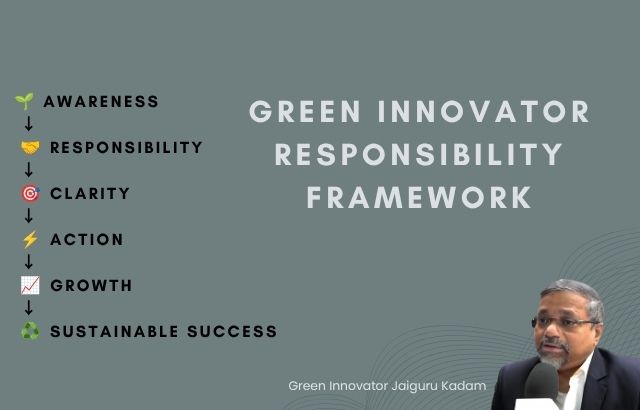
I recommend evaluating apparently simple improvements through five questions.
Question One: What Resource Is Being Consumed?
Identify the material, water, energy, land, time, labor or chemical input involved. Sustainability begins with understanding the resource baseline.
Question Two: What Is the Useful Output?
Do not measure efficiency merely as reduced input. Determine what useful agricultural, chemical or biological function is being delivered.
Question Three: Where Could the Burden Move?
A reduction in one impact may increase another. A lower solvent volume, for example, may be accompanied by greater energy demand if the alternative process requires additional heating or purification.
Question Four: Can the Improvement Scale?
A laboratory improvement is valuable, but sustainability impact depends on translation into manufacturing, supply chains and real-world use.
Question Five: Can the Improvement Be Repeated?
The strongest innovations become routines. A one-time reduction is useful; a permanently redesigned process can deliver value year after year.
From Individual Products to Portfolio-Level Sustainability
One of the next frontiers for agricultural and chemical companies is moving from product-level sustainability to portfolio-level optimization.
A company may have multiple products serving similar agronomic needs. Rather than evaluating each product independently, decision-makers can examine resource intensity, manufacturing complexity, lifecycle impacts, efficacy, farmer value, regulatory trajectory and strategic relevance across the portfolio.
| Portfolio dimension | Strategic question |
|---|---|
| Resource intensity | Which products require disproportionately high material, energy or water inputs? |
| Manufacturing complexity | Which processes create avoidable waste or excessive processing steps? |
| Field efficiency | Which technologies deliver strong performance with optimized application requirements? |
| Biological alternatives | Where can biological or integrated approaches complement existing solutions? |
| Longevity | Which technologies can remain effective through responsible stewardship and resistance management? |
| Scalability | Which innovations can create measurable impact across markets rather than only in controlled environments? |
The Farmer Should Remain the Ultimate Reality Check
Sustainability strategies designed exclusively inside corporate offices can miss the operational realities of agriculture.
A farmer evaluates solutions through practical questions: Does it work? Can I afford it? Can I obtain it when needed? Can my equipment apply it correctly? Is it compatible with my farming system? Does it deliver a reliable return? Does it create additional operational complexity?
This is why farmer-centered innovation is essential.
A sustainable technology that cannot be practically adopted has limited real-world impact. Conversely, a solution that simultaneously improves productivity, resource efficiency, economics and operational simplicity can accelerate adoption.
What International Experience Teaches About Sustainable Innovation
Working across international agricultural and chemical environments makes one fact particularly clear: there is no single sustainability formula that works identically everywhere.
Climate, cropping systems, regulatory frameworks, infrastructure, farmer economics, water availability, supply chains and local agronomic practices differ substantially.
Therefore, the global sustainability challenge is not simply about developing universal technologies. It is about creating adaptable innovation platforms that can be responsibly localized.
As a Green Innovator and Subject Matter Specialist with vast international experience, I see this adaptability as one of the defining capabilities of the next generation of agricultural and chemical businesses.
Frequently Asked Questions
What does finding joy in simple things mean for a sustainability professional?
It means recognizing that sustainability progress often emerges from small, measurable improvements in processes, products, formulation, application, manufacturing, biological performance and resource management. The emphasis is not on accepting small ambitions but on recognizing the cumulative power of disciplined improvements.
Why should agrochemical companies focus on small improvements?
Because agricultural value chains operate at enormous scale. A modest reduction in material intensity, manufacturing loss or application inefficiency can become significant when multiplied across production volumes and cultivated hectares.
Does using less active ingredient automatically make a product greener?
No. A lower active-ingredient rate can be beneficial under appropriate circumstances, but sustainability requires consideration of efficacy, formulation composition, toxicity, ecotoxicity, persistence, manufacturing impacts, application behavior, resistance management and the complete lifecycle.
How can crop-protection companies connect sustainability with resistance management?
By treating preservation of product efficacy as a long-term resource-management objective. Responsible resistance-management strategies can help protect the useful life of crop-protection technologies and reduce the pressure created by loss of effectiveness.
Are biopesticides automatically more sustainable than synthetic pesticides?
No. Biological origin alone does not establish overall sustainability. Biological products should be assessed according to their efficacy, production requirements, formulation, stability, application, environmental fate, manufacturing footprint, packaging, logistics and actual role within an agricultural system.
How can specialty chemical manufacturers contribute to sustainable agriculture?
They can develop enabling materials and processes that improve formulation performance, resource efficiency, stability, delivery, manufacturing yields and product functionality. Their contribution may be indirect but can influence the sustainability profile of downstream agricultural products.
What is the role of green chemistry in agrochemical manufacturing?
Green chemistry can help redesign chemical processes to prevent waste, reduce hazardous materials where feasible, improve resource efficiency, optimize solvents, increase selectivity and yield, and reduce energy or material intensity. The objective should be evaluated using lifecycle thinking rather than a single metric.
Can seed innovation contribute to sustainability?
Yes. Traits that improve productivity, resilience, disease resistance or adaptation can potentially improve agricultural resource efficiency. However, the sustainability impact must be evaluated within the complete farming system, including inputs, irrigation, soil management, biodiversity and local production conditions.
Why are small percentage improvements important?
Because scale multiplies them. A 2% improvement in a process producing 50,000 tonnes annually represents a theoretical 1,000 tonnes of improvement if the percentage applies directly to the relevant baseline.
What should companies measure beyond carbon emissions?
Depending on the business, relevant indicators can include water intensity, energy intensity, material efficiency, waste generation, hazardous-material substitution, process yield, formulation efficiency, packaging intensity, product-use efficiency, land-use implications, biodiversity considerations and lifecycle environmental impacts.
A Leadership Philosophy: Make the Complex Valuable and the Valuable Simple
The most effective green innovators are not necessarily those who make the most complicated technology. They are those who understand complexity deeply enough to create solutions that are useful, measurable and scalable.
That is the paradox of sustainable innovation.
Behind a simple outcome may be years of chemistry, biology, engineering, agronomy, data analysis, regulatory work and field validation.
The farmer, however, should ideally experience a solution that is understandable and practical.
The manufacturing team should experience a process that is robust.
The scientist should experience an organization willing to learn.
The sustainability team should have measurable evidence.
And the environment should experience reduced unnecessary pressure.
Conclusion: Great Change Can Grow From Small Things

Finding joy in simple things is not a retreat from technological ambition. It is a more mature definition of innovation.
In agrochemical companies, it may be a formulation improvement.
In crop protection, it may be better application efficiency.
In biopesticides and bioherbicides, it may be a more robust biological formulation.
In specialty chemicals, it may be a more efficient synthesis route.
In agricultural biotechnology, it may be a scientific question that opens an entirely new pathway.
In seed companies, it may be a small seed carrying a valuable genetic characteristic.
In green chemistry, it may be the elimination of a waste stream before it ever exists.
The strategic lesson is powerful: sustainability is not created only by spectacular breakthroughs. It is created by identifying valuable improvements, validating them rigorously, scaling them responsibly and repeating them consistently.
As a Green Innovator and Subject Matter Specialist, Jaiguru Kadam, with vast international experience, I believe the next generation of agricultural and chemical innovation should combine scientific ambition with operational humility.
We should continue searching for breakthroughs. But we should also learn to celebrate the kilogram of waste that was never generated, the litre of water that was conserved, the batch that was produced without avoidable loss, the hectare protected more efficiently, the seed that performs more reliably, the biological process that became more robust and the young scientist whose seemingly small idea improved an entire system.
Because sustainable transformation rarely arrives as one enormous decision. More often, it grows through thousands of small decisions made well.
And sometimes, the simplest improvement is where the greatest joy—and the greatest sustainability impact—begins.