Silkworm Pupae Protein for Pets & Animal Nutrition
Author: Green Innovator Jaiguru Kadam
A Story from a Silk Village
In a quiet sericulture village in Karnataka, a silk farmer once told me something that changed my perspective forever:
“ We sell silk to the world… but we throw away the future.”
He pointed toward heaps of discarded silkworm pupae—byproducts of silk extraction. Traditionally seen as waste, these nutrient-rich pupae were either underutilized or sold cheaply.
Fast forward to 2026: that “waste” is now at the center of a global sustainability revolution in pet food and animal nutrition.
What changed?
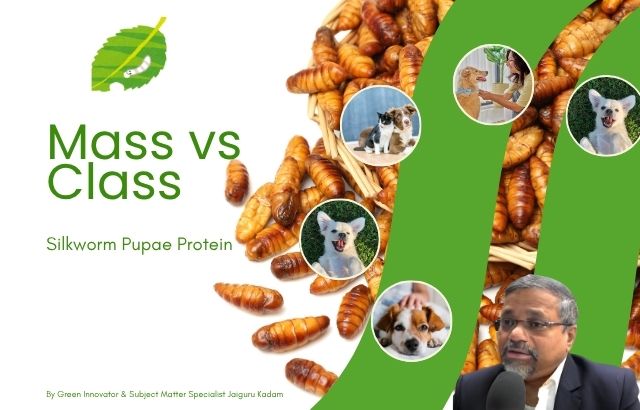
Understanding the audience—Mass vs Class.
Surprising Data: Numbers That Tell the Story (2025–2026)

- The silkworm pupae protein market is projected to reach $445 million by 2025, growing steadily due to sustainable feed demand
- The broader silkworm pupae powder market hit $1.8 billion in 2025
- The insect-based pet food market is already $1.5 billion in 2026, heading toward $4 billion
- The global insect feed market is expected to grow to $6.38 billion by 2035
Behind these numbers lies a deeper shift:
From curiosity-driven adoption (class) to cost-driven scalability (mass)
Mass vs Class: The Core Insight Most Blogs Miss
Class Market (Premium, Early Adopters)
- Eco-conscious pet owners
- Demand hypoallergenic, novel proteins
- Willing to pay 30–50% premium
- Focus on sustainability storytelling
Example: Urban pet parents choosing insect protein dog food for allergies.
Mass Market (Scale, Economics Driven)
- Feed manufacturers, poultry farms, aquaculture
- Focus on cost per kg protein and supply reliability
- Adoption happens only when price matches or beats conventional protein and performance is proven
Example: Replacing 30–50% fishmeal in aquaculture diets with silkworm pupae
Jaiguru Kadam Insight:
“Class builds aspiration. Mass builds transformation. Sustainability succeeds only when both align.”
Lesser-Known Insights (That Most Blogs Ignore)
- Silkworm Pupae as a Circular Economy Goldmine
For every kg of silk produced, around 8 kg of wet pupae is generated. This is not a niche resource—it is industrial-scale biomass. - Protein Efficiency Beats Conventional Feed
Silkworm pupae contains up to 55–60% protein with high digestibility. Better feed conversion leads to lower feed cost. - Not Just Sustainability—It’s Supply Chain Strategy
Insect protein is locally producible and less dependent on global soy and fishmeal volatility, offering resilience in uncertain markets.
Simple Calculation: Carbon and Cost Impact
Traditional Protein vs Silkworm Pupae
Silkworm pupae emits up to 80% fewer greenhouse gases than beef protein.
If a pet food company replaces 1,000 tons of beef protein, carbon savings can reach approximately 800 tons of CO₂ equivalent.
Cost Comparison in Aquaculture
Fishmeal costs around $1,700 per ton. Silkworm pupae offers a cheaper, locally sourced alternative.
Replacing 30% fishmeal in 10,000 tons of feed can result in savings of approximately $300,000 to $500,000 annually.
Real-World Case Studies
Case 1: Aquaculture in Asia
Farmers replaced 30–40% fishmeal with silkworm pupae and achieved similar growth rates at lower costs.
Case 2: Premium Pet Food Brands in Europe
Brands positioned insect protein as hypoallergenic and sustainable, targeting premium consumers first before scaling.
Case 3: Poultry Feed Integration in India
Trials showed improved feed conversion and reduced dependence on imported soy.
Expert Voice – Jaiguru Kadam
“The future of protein is not about replacing one ingredient—it’s about redesigning the system.”
“Silkworm pupae is not just feed. It’s a bridge between agriculture, industry, and sustainability.”
Did You Know?
- Insect protein markets could exceed $2 billion globally by 2030
- Livestock feed uses about 33% of global cropland, and insects can reduce this pressure
- Silkworm pupae contains bioactive compounds with anti-inflammatory benefits
- Insect protein is gaining popularity as a novel protein for allergy-prone pets
FAQs
- Is silkworm pupae protein safe for pets?
Yes, when properly processed, it is highly digestible and nutritionally rich. - Why isn’t it widely used yet?
Cultural perceptions and regulatory barriers still limit adoption. - Is it cheaper than traditional protein?
At scale, it becomes cost-effective, especially in feed applications. - Can it fully replace fishmeal or soy?
Not entirely yet, but 30–50% replacement is already viable. - What is the biggest opportunity?
Converting silk industry byproducts into high-value feed. - Who should adopt first—mass or class?
Start with the premium market, then scale to mass adoption.
Actionable Steps for Stakeholders
For Entrepreneurs
Start with the premium pet food segment and build a sustainability-focused brand.
For Feed Manufacturers
Pilot partial replacement models and focus on performance and cost data.
For Policymakers
Support regulatory frameworks and incentivize circular economy initiatives.
For Farmers
Integrate sericulture with feed production to create additional income streams.
Final Vision: The Green Protein Revolution
The future of animal nutrition is not hidden in laboratories—it already exists in our fields, silk farms, and overlooked byproducts.
The real question is not whether silkworm pupae protein will scale.
The real question is whether we will design it for the mass or restrict it to the class.
Closing Thought – Jaiguru Kadam
“Sustainability becomes real only when it is affordable. The day green protein reaches the mass market—that is the day we change the planet.”