By Subject Matter Specialist Jaiguru Kadam (Green Innovator with vast international experience)
Introduction
Control often disguises itself as discipline, responsibility, or care. But when overused, it creates rigidity, anxiety, and strained relationships.
Across international work environments and behavioral observations, one pattern stands out:
People who thrive long-term don’t control everything—they adapt, learn, and grow.
This is the difference between a Control Mindset and a Growth Mindset.
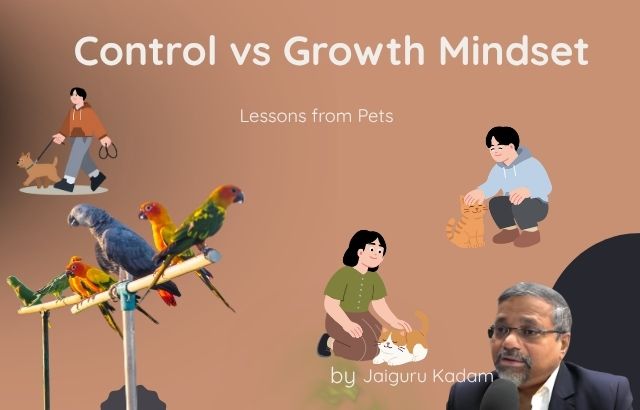
Surprisingly, our everyday pets demonstrate this distinction better than most theories.
Control Mindset vs Growth Mindset
🔒 Control Mindset
- Needs certainty before acting
- Avoids mistakes
- Tries to manage outcomes and people
- Feels anxious when things are unpredictable
- Believes: “If I control it, I’ll be safe”
🌱 Growth Mindset
(Concept popularized by Carol Dweck)
- Accepts uncertainty as part of life
- Learns from mistakes
- Focuses on effort, not outcomes
- Adapts to change
- Believes: “I can handle whatever happens”
A Simple Control vs Growth Calculation
Let’s model a real-life scenario:
Situation: Planning a day
Control Mindset Approach
- Attempts to control 90% of outcomes
- Reality success rate: ~60%
Stress generated:
90% expectation – 60% reality = 30% frustration gap
Growth Mindset Approach
- Focuses on 50% controllable factors
- Accepts 50% uncertainty
Stress generated:
50% expectation – 50% reality = 0% frustration gap
Lessons from Pets: Growth Without Control
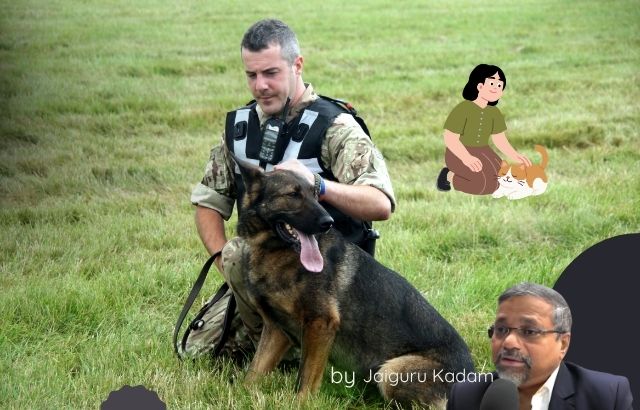
Pets don’t over-engineer life. They operate with instinct, adaptation, and presence.
🐶 Dog: Trust Over Control
Example:
A dog doesn’t control when you leave or return. It may feel discomfort—but it adapts quickly and reconnects joyfully.
Control Mindset Reaction (Human):
“Why didn’t you call? Why were you late?”
Growth Mindset Lesson:
Trust relationships without micromanaging them.
🐱 Cat: Boundaries, Not Domination
Example:
A cat doesn’t try to control your behavior. If something doesn’t suit it, it simply disengages.
Control Mindset Reaction:
Trying to change people’s behavior constantly
Growth Mindset Lesson:
Set boundaries instead of controlling others.
🐦 Pet Bird: Adaptation to Change
Example:
A pet bird may get startled by a new environment but gradually adapts without trying to “fix” everything.
Control Mindset Reaction:
Avoid change or force predictability
Growth Mindset Lesson:
Uncertainty is not danger—it’s a learning space.
🐠 Fish: Flow Over Resistance
Example:
Fish don’t fight water currents endlessly—they adjust their movement.
Control Mindset Reaction:
Resisting every unexpected situation
Growth Mindset Lesson:
Flow reduces effort; resistance increases stress.
The Hidden Cost of a Control Mindset
Daily Mental Energy Breakdown
- Monitoring others: 1.5 hours
- Overthinking outcomes: 2 hours
- Stress from unmet expectations: 2 hours
Total: 5.5 hours/day
Yearly Impact:
5.5 × 365 = ~2000 hours lost
That’s:
- ~83 days
- Nearly 3 months of mental energy drained
Why Control Feels Necessary
Control is rooted in the fear of uncertainty—linked to the concept of Intolerance of Uncertainty.
Your brain prefers:
- Predictability over possibility
- Certainty over growth
But growth only happens in uncertain conditions.
How to Shift from Control Mindset to Growth Mindset
1. Reframe Control as Limitation
Instead of thinking:
“Control protects me”
Understand:
“Excess control restricts growth”
2. Use the 3-Zone Awareness Model
| Zone | Description | Action |
|---|---|---|
| Control | Your actions, effort | Focus here |
| Influence | Others, outcomes | Guide lightly |
| No Control | External events | Accept |
3. Practice “Pet-Based Thinking”
Ask:
- “What would a calm dog do here?” → Trust
- “What would a cat do?” → Set a boundary
- “What would a fish do?” → Adjust and move
This simplifies complex emotional reactions.
4. Run Micro Experiments
Start small:
- Let someone else make decisions
- Allow minor uncertainty
- Avoid correcting trivial things
Goal: Increase tolerance, not perfection.
5. Replace Outcome Control with Response Control
Shift from:
“I must control what happens”
To:
“I will control how I respond”
Practical Example: Relationship Scenario
Situation:
Your partner doesn’t reply for hours.
Control Mindset:
- Overthinking
- Repeated messaging
- Assuming worst-case scenarios
Growth Mindset:
- Acknowledge uncertainty
- Continue your own activities
- Respond calmly when they reply
Energy Saved: Immediate reduction in stress cycles
FAQs
1. Is control ever useful?
Yes—in personal discipline and planning. The issue is overextension into uncontrollable areas.
2. Can I completely eliminate controlling tendencies?
No. The goal is balance, not elimination.
3. Why is a growth mindset harder?
Because it requires tolerating uncertainty, which the brain naturally resists.
4. How long does it take to shift mindsets?
With consistent practice: 4–8 weeks for noticeable change, longer for deep habits.
5. What’s the fastest way to start?
Pause before reacting and ask:
“Am I trying to control this or grow through this?”
Final Thought
Pets don’t try to control life—they engage with it.
Humans often try to control life—and disengage from living.
The shift from control to growth is not about losing power.
It’s about using your energy where it actually works.