By Green Innovator & Subject Matter Specialist Jaiguru Kadam (with vast international experience)
Introduction: When Words Shape Sustainability
Green innovation is often associated with technology, renewable energy, and scientific breakthroughs. But one of the most overlooked drivers of sustainable change is language itself. The words we choose—efficient, regenerative, responsible, circular—don’t just describe innovation; they define how it is designed, adopted, and scaled.
As emphasized by Jaiguru Kadam, transformational vocabulary plays a crucial role in shifting mindsets from short-term gains to long-term sustainability.
The Hidden Power of Words in Green Innovation
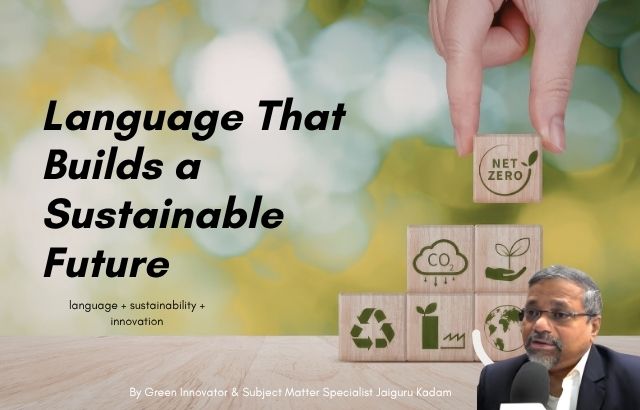
In sustainability, language determines intention and action:
- “Reduce damage” → reactive thinking
- “Regenerate ecosystems” → proactive innovation
- “Waste management” → handling a problem
- “Resource recovery” → creating value
This shift in vocabulary changes how industries approach environmental challenges.
Connecting Vocabulary to Action
Example 1: Waste to Resource Thinking
Old approach:
“We need to manage waste.”
Transformational shift:
“We will convert waste into usable resources.”
Impact Calculation
If a factory produces 1,000 kg waste/month:
- Traditional management recycles 20% = 200 kg
- Resource-focused approach recovers 60% = 600 kg
Net improvement: 400 kg/month → 4,800 kg/year
Example 2: Animal Feed Supplements in Green Innovation 🐄
Language shift:
- “Feed additives for growth” → short-term productivity
- “Nutritional optimization for sustainable livestock” → long-term ecological balance
When we develop animal feed supplement products with this mindset:
- Animals digest feed more efficiently
- Methane emissions reduce
- Resource use becomes optimized
Calculation Example
If improved digestion reduces feed waste by 15%:
- Daily feed = 10 kg
- Savings = 1.5 kg/day
- Annual savings = 1.5 × 365 = 547.5 kg per animal
Multiply this across farms, and the environmental impact becomes massive.
Example 3: Energy Systems
Old phrase:
“Alternative energy”
New phrase:
“Primary renewable energy systems”
This subtle shift moves renewables from optional to essential.
Why Vocabulary Matters in Green Innovation
1. Drives Mindset Shift
Words like “sustainable” vs “less harmful” create entirely different ambitions.
2. Influences Policy & Strategy
Governments and organizations act based on how problems are framed.
3. Shapes Consumer Behavior
People respond better to positive, purpose-driven messaging.
4. Encourages Measurable Action
Clear language leads to clear targets.
A Practical Framework by Jaiguru Kadam

1. Replace Reactive Words
- Problem → Opportunity
- Waste → Resource
2. Use Measurable Language
- “Improve efficiency” → “Increase efficiency by 25%”
3. Align Words with Outcomes
- Ensure vocabulary reflects long-term sustainability goals
Real-World Integration: Farm to Ecosystem
Consider a livestock farm:
Old mindset:
- “Maximize production”
Transformational mindset:
- “Optimize ecosystem productivity”
Combined Impact Calculation
- Milk increase per cow/year = 730 liters
- Feed savings per cow/year = 547.5 kg
For 10 cows:
- Milk gain = 7,300 liters
- Feed saved = 5,475 kg
This is not just productivity—it is sustainable efficiency.
The Bigger Picture
Green innovation is not only about what we build—it is about how we think. And thinking begins with words.
Across industries, from agriculture to energy to urban systems, transformational vocabulary:
- Aligns teams with purpose
- Accelerates innovation
- Ensures sustainability is embedded, not added later
Green Innovation Language Upgrades

Sericulture / Silkworm Context
- “Insect farming” → “Bio-based fiber production system”
- “Waste leaves” → “Nutrient input for silk ecosystems”
- “Production” → “Regenerative biological manufacturing”
- “Silkworm rearing” → “Controlled bio-fiber cultivation process”
- “Cocoon harvesting” → “Sustainable fiber extraction phase”
- “Silk waste” → “Secondary bio-material stream”
- “Feed shortage” → “Nutrient supply imbalance in bio-cycle”
Agriculture & Livestock
- “Animal feeding” → “Nutritional ecosystem optimization”
- “Manure” → “Organic soil regeneration input”
- “Livestock waste” → “Circular nutrient recovery resource”
- “Milk production” → “Bio-nutrient output system”
- “Fodder” → “Plant-based energy supply matrix”
Waste & Environment
- “Garbage” → “Recoverable material stream”
- “Disposal” → “Material reintegration process”
- “Pollution control” → “Environmental restoration strategy”
- “Recycling” → “Circular resource regeneration loop”
- “Landfill” → “End-stage material containment system”
Energy & Industry
- “Fuel consumption” → “Energy utilization cycle”
- “Factory emissions” → “Industrial output by-product stream”
- “Electricity usage” → “Energy demand optimization flow”
- “Alternative energy” → “Primary renewable energy system”
- “Industrial waste heat” → “Recoverable thermal energy stream”
Innovation & Mindset
- “Problem solving” → “Opportunity engineering process”
- “Cost cutting” → “Resource efficiency optimization”
- “Experiment failure” → “Data-driven learning feedback loop”
- “Trial and error” → “Iterative innovation cycle”
- “Low efficiency” → “Optimization potential zone”
Core Idea Behind This Language Shift
These transformations are not just semantic—they:
- Change how people perceive value
- Improve innovation thinking
- Encourage sustainability-first design
- Shift mindset from waste → resource
Final Thought
Small words carry big responsibility. In green innovation, they can mean the difference between incremental change and systemic transformation.
As Jaiguru Kadam highlights:
“When we change the language of sustainability, we change the direction of innovation itself.”
Written by Green Innovator & Subject Matter Specialist Jaiguru Kadam
(With vast international experience in sustainability, animal nutrition, and innovation strategy)